10 Best Towns In Portugal To Retire Comfortably
The best towns in Portugal to retire comfortably keep median listing prices well below the national average while delivering the infrastructure retirees actually need. Portugal's median listing price reached €3,107 per square meter (roughly US$336 per square foot) in March 2026, according to Idealista, but these communities across the interior and the islands offer prices at roughly one-third of that figure, making them some of the most affordable retirement destinations in Europe. Better yet, each town combines walkable historic centers with practical amenities, such as district hospitals, train stations, and local markets, making daily errands manageable without a car. Guarda combines mountain access and Portugal’s highest city elevation with direct rail links and a major public hospital. Ponta Delgada offers subtropical island living in the Azores alongside an international airport and the region’s largest hospital. Read on to discover where and why Portugal shines as an affordable option for retirement.
Portalegre

Portalegre consistently records the lowest median residential listing prices of any district capital in mainland Portugal. Here, the Serra de São Mamede mountains lift the town above the Alentejo plains and cool the summer air. A median listing price of €1,011 per square meter (US$110 per square foot) buys stone houses in the historic center and access to Hospital Dr. José Maria Grande, the district's public hospital with 24-hour emergency services, plus the municipal market and bus connections to Lisbon, just three hours south. The elevation keeps temperatures moderate compared with the scorching lower Alentejo, and the surrounding cork oak (montado) forests shape the local economy.
The Museu de Tapeçarias de Portalegre displays the Guy Fino tapestries that once made the town famous for needlework, and Serra de São Mamede Natural Park covers the nearby mountains with hiking trails through oak and chestnut woodland. The historic center preserves 13th-century walls and the cathedral around quiet squares. For day trips, the UNESCO garrison town of Elvas sits about an hour away, with its star forts and aqueduct visible from the road as you approach.
Guarda

At 1,056 meters (3,465 feet) above sea level, Guarda ranks as the highest city in Portugal, a position that delivers cool summers and often snowy winters in the eastern Centro region. A median listing price of €1,050 per square meter (US$115 per square foot) places the Gothic cathedral, the Jewish quarter, and the train station within financial reach of retirees who want mountain access without the prices of the Alps. The city functions as a regional hub, with Hospital Sousa Martins providing public hospital care, shopping districts, and direct rail links to Lisbon and Porto.
The Sé da Guarda stands as one of Portugal's finest Gothic cathedrals, with its granite bulk visible across the plateau, while the historic Jewish quarter preserves narrow medieval streets behind the main commercial axis. Serra da Estrela, home of Portugal's highest peak at 1,993 meters (6,539 feet), sits just over an hour away by car and offers skiing in winter and hiking trails through granite tors in summer. Seasonal praias fluviais, river beaches on the mountain streams, provide freshwater swimming when the highland heat arrives.
Castelo Branco

Granite statues and boxwood hedges fill the Baroque gardens that define Castelo Branco, a district capital near the border of Spain, where the median listing price sits at €1,053 per square meter (US$106 per square foot). The town anchors Raiana, a flat agricultural zone of olive groves and wheat fields that stretches toward the frontier. A university campus, Hospital Amato Lusitano, and a train station give the town practical depth beyond its modest size, and the Naturtejo UNESCO Global Geopark draws hikers and geotourists to the surrounding schist villages.
The Jardim do Paço Episcopal displays one of Portugal's most unusual Baroque gardens, with stone figures representing apostles, the seasons, and the continents arranged among clipped boxwood. Castelo Branco castle crowns the hill above the gardens with views across the plateau. The Geopark Naturtejo protects the region's schist landscapes, dinosaur footprints, and river gorges within a short drive, and nearby Idanha-a-Velha preserves Roman and Visigothic ruins in a valley village that predates the modern border.
Bragança

A medieval citadel still dominates the skyline of Bragança, the northeastern district capital, where the median listing price reaches €1,115 per square meter (US$112 per square foot). The town sits on the edge of the Montesinho Natural Park, one of Portugal's largest protected areas, and the isolation keeps prices low despite access to valuable local services provided by the polytechnic institute and public hospital in town. Winter temperatures drop below freezing, but the dry continental climate delivers crisp air and reliable sunshine through the colder months.
The Bragança Citadel encloses a 12th-century walled village with the unique Domus Municipalis, a Romanesque civic building that served as a cistern and council chamber. Montesinho Natural Park protects wolf, wild boar, and golden eagle habitat across oak and chestnut forests north of the town, with an extensive network of walking trails, mountain viewpoints, and scenic overlooks, while the Iberian Plateau Transboundary Biosphere Reserve, recognized by UNESCO, extends the protected landscape across the Spanish border. For history buffs or a more leisurely afternoon, the Museu do Abade de Baçal collects and displays regional ethnography and archaeology in a former monastery.
Beja

The Alentejo heat shapes life in Beja, where whitewashed houses and orange trees line streets that radiate from a 13th-century castle keep. The median listing price of €1,389 per square meter (US$150 per square foot) makes this district capital one of the cheapest in southern Portugal, well below the coastal premiums of the Algarve. Hospital José Joaquim Fernandes is the main hospital for the entire Baixo Alentejo region, having 24-hour emergency care, and the town also has an agriculture college and a train station. The flat surrounding plains of wheat and cork oak keep the pace deliberately slow.
Castelo de Beja rises 40 meters (131 feet) in one of Portugal's tallest keeps, with views across the Alentejo plains to the horizon, while the Museu Regional de Beja occupies the former Convento da Conceição and displays Roman mosaics from Pax Julia, one of the principal Roman centers of southern Lusitania. The Alentejo plains themselves function as the main attraction, with country roads threading through cork oak forests and sunflower fields. As for daily errands, local markets sell regional cheeses, black pork, and wines from the nearby Vidigueira DOC.
Vila Real

The Douro Valley wine region spills eastward from Vila Real, a district capital where the median listing price sits at €1,424 per square meter (US$154 per square foot). The town occupies a plateau above the Corgo River, with the Marão mountains rising to the west and the terraced vineyards of the Douro dropping to the east. The Hospital da Luz offers comprehensive care, and a major road junction connects the town to Porto, 100 kilometers (62 miles) west, for more urban amenities.
The Palácio de Mateus, the Baroque manor house featured on Portuguese Mateus Rosé wine labels, sits just outside town with formal gardens and a reflecting pool. The Douro Valley terraces, a UNESCO World Heritage landscape, begin within a short drive and offer river cruises, wine tastings, and harvest-season grape picking for immersive day trips and outings. Meanwhile, Parque Natural do Alvão is home to trails that lead to waterfalls and granite outcrops in the mountains west of the city, and the historic center preserves 19th-century bourgeois architecture around the central Praça do Município, where numerous cafés, pastry shops, and espresso bars are within a short walk.
Santarém

The Tagus River bends around Santarém, where the median listing price reaches €1,777 per square meter (US$192 per square foot). The town sits on a limestone ridge above Portugal's longest river, with fertile agricultural plains stretching in every direction and the nation's capital around 80 kilometers (50 miles) south by train or highway. Hospital de Santarém and busy market halls serve the surrounding farm country, while the old town's Gothic churches and miradouros retain the character of a former royal garrison.
Portas do Sol delivers the most photographed view in town, a terrace overlooking the Tagus floodplain where the river bends below the limestone cliffs. The Convento de São Francisco preserves a Gothic church, cloister spaces, royal tombs, and historic tilework that visitors can explore in Santarém’s old town. The surrounding Ribatejo horse country maintains the Lusitano breeding tradition, with riding schools and working cattle estates open to visitors. Also of note, the pilgrimage site of Fátima is just 40 kilometers (25 miles) north, making it easily accessible for day trips or religious observance.
Covilhã

Textile mills once powered Covilhã, a university town at the foot of Serra da Estrela, just 50 kilometers (30 miles) from Guarda, with a median listing price of €1,368 per square meter (US$148 per square foot). The old factory buildings now house the Museu dos Lanifícios and student housing for the University of Beira Interior, giving the town an academic energy that belies its mountain setting. Centro Hospitalar Universitário Cova da Beira, a major public teaching hospital, anchors the regional health system alongside a train station and direct bus links to Lisbon.
The Museu dos Lanifícios traces the region's wool industry from medieval shearing to 20th-century factory production in a restored mill building, and the historic textile quarter preserves 19th-century worker housing and factories that now house cafes and bookshops. Praça do Município serves as a modern town center, with shops, restaurants, and the municipal theater gathered around a pedestrian square. As in Guarda, Serra da Estrela offers skiing at Torre in winter and hiking through glacial valleys in the summer.
Ponta Delgada

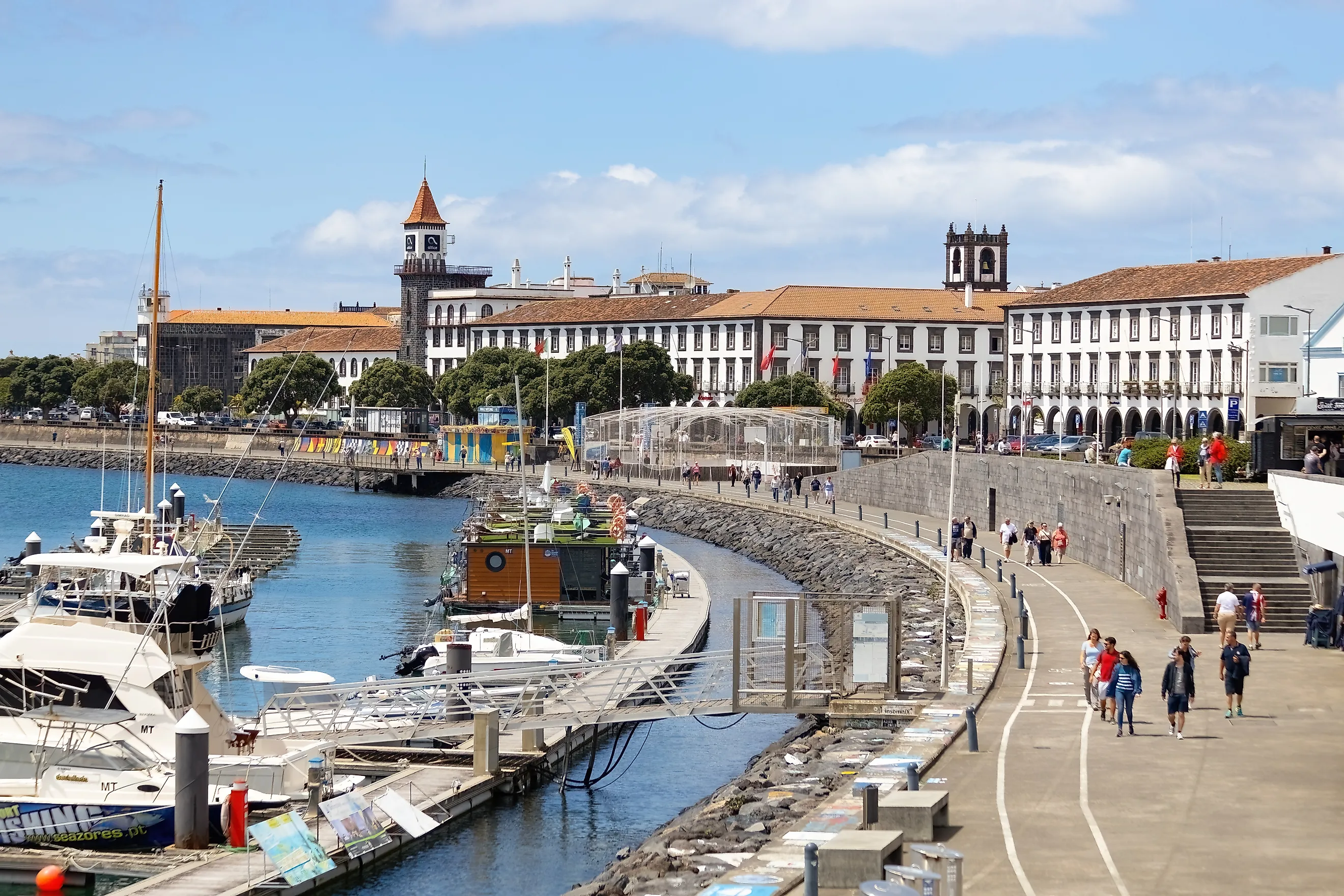
Subtropical vegetation and volcanic crater lakes define Ponta Delgada, the Azorean capital. The town sits on São Miguel Island in the North Atlantic, and is home to João Paulo II International Airport, the University of the Azores (Universidade dos Açores), and Hospital do Divino Espírito Santo, the largest in the Azores. Its location and amenities are reflected in a higher median listing price of €2,401 per square meter (US$260 per square foot), which remains more affordable than many of Portugal’s best-known retirement destinations along the Lisbon coast and the Algarve. The mild maritime climate keeps temperatures between about 14°C and 25°C (57°F-77°F), and the volcanic soil yields pineapples, tea, and hydrangeas that shape the island's appearance and economy.
The famous Sete Cidades is a twin-lake crater where green and blue waters fill the caldera of an extinct volcano. Here, you can hike rim trails, cycle quiet backroads, kayak the lakes, or stop at roadside miradouros overlooking the volcanic basin. The Furnas Valley offers geothermal hot springs, mud pots, and the tradition of cozido das Furnas, a stew cooked underground by volcanic heat. Whale watching tours depart from the marina from April to October, searching for sperm whales, blue whales, and dolphins in the deep Atlantic waters, while the Jardim Botânico José do Canto preserves 19th-century collections of camellias, azaleas, and tree ferns in a valley north of the city.
Mangualde

The Dão wine region surrounds Mangualde, a small municipality where the median listing price sits at just €676 per square meter (US$73 per square foot). The town lies on the Linha da Beira Alta railway, with connections to Lisbon and Hospital de São Teotónio in Viseu, just 20 kilometers (12 miles) north, giving retirees access to a full-service regional hospital and larger-city shopping without the higher cost of living. The Serra da Estrela foothills rise to the east, and the Dão River valley produces the tannic red wines that give the region its identity.
The Dão wine region offers cellar tours and tastings at family-owned quintas that produce the DOC wines from native grape varieties. Serra da Estrela mountain trails begin within a 30-minute drive, with hiking through granite landscapes and swimming in mountain lagoons. The historic center of Mangualde preserves granite houses and historic churches around a compact praça, and the local market sells regional sausages, cheeses, and breads on set days, maintaining the agricultural rhythm of the interior.
An Affordable Portugal
These communities span Portugal's most affordable interior districts and its subtropical Atlantic islands, each offering a different combination of climate, landscape, and retiree infrastructure. Portalegre, Guarda, and Castelo Branco cover the eastern plateau at prices below €1,100 per square meter (roughly US$119 per square foot), with mountain coolness and district hospitals. Bragança and Beja push south and east into the remote borderlands and the Alentejo heat. Santarém and Covilhã sit closer to Lisbon and the university corridor, while Ponta Delgada delivers island living with year-round mild temperatures. Mangualde distills the value proposition to its essence: wine country, mountain access, and a railway line, at the lowest price on the list. Each town proves that retiring in Portugal does not require paying the Lisbon premium.