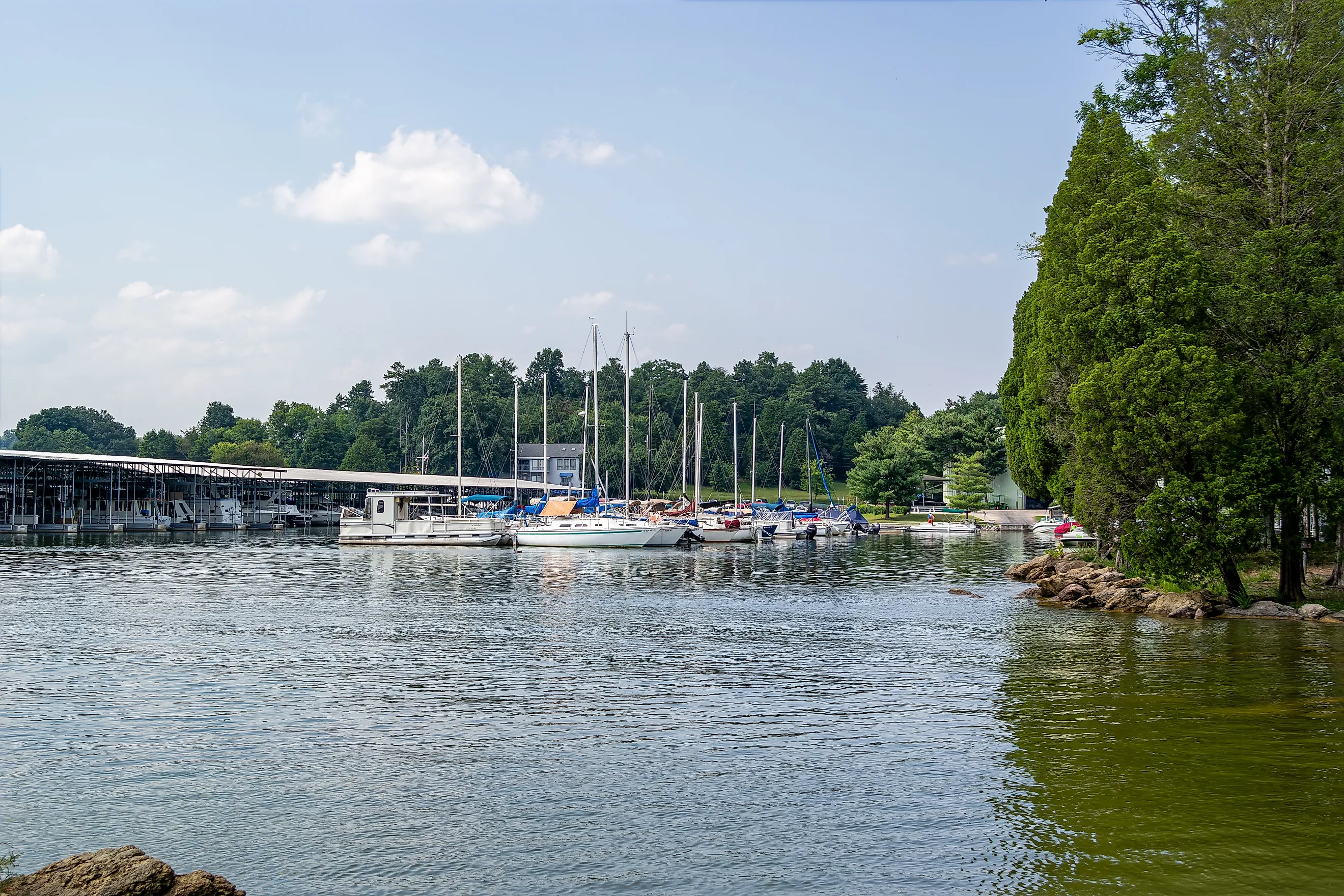
10 Best Lakeside Towns in Tennessee
Many of Tennessee's best-known lakes are TVA reservoirs, and some of the towns around them are younger than their downtowns suggest. Dandridge has had a head start on most of them: it is the second-oldest town in the state (after Jonesborough), with a Revolutionary War graveyard and preserved 19th-century tavern buildings downtown. Morristown took a different direction, laying out enough disc golf courses between Cherokee and Douglas Lakes that players now book trips around the sport. The Strand Theatre in Tiptonville has been running since 1915, making it the oldest active movie theatre in Tennessee. These ten towns show how Tennessee's lake country blends TVA-era infrastructure with much older downtown histories.
Winchester

About 90 miles southeast of Nashville, Winchester was founded in 1809 and sits near Tims Ford Lake, a TVA reservoir completed in 1970. The town has connections to frontier figure Davy Crockett (who owned land nearby) and to singer Dinah Shore, who grew up here. The Old Jail Museum in the historic downtown covers local history, and Hundred Oaks Castle, a stone mansion originally built in the 1830s and later expanded, sits on the edge of town with its grounds open for tours. Harvey's Garden offers walking trails for those staying closer to downtown, and Filo's Tavern and Walnut Hill Coffee Company are the long-standing local favourites for food.
Dandridge

Named after Martha Dandridge Washington, Tennessee's second-oldest town sits on the French Broad River near Douglas Lake. Founded in 1783, Dandridge has preserved an unusual stretch of early American history in a small-town setting. The Revolutionary War Graveyard holds the graves of early citizens and Revolutionary War veterans, and four historic 19th-century tavern buildings still stand in the downtown core. Visitors can follow the Dandridge walking tour guide past significant churches, homes, and buildings. When Douglas Dam was built in 1942, the town was almost flooded; a saddle dam and levee were constructed specifically to preserve downtown Dandridge from the rising reservoir water.
Morristown

Morristown, between Cherokee and Douglas Lakes, calls itself the Disc Golf Capital of Tennessee with six courses including four of 18 or more holes. The town's unique architectural feature is its SkyMart elevated sidewalks, a second-story pedestrian system added to the historic downtown in the 1960s that remains one of the few such systems in the South. The Crockett Tavern Museum, a reconstruction built on the site where Davy Crockett lived as a boy, depicts 18th-century frontier life on a working farmstead setting. Morristown was historically a stagecoach crossroads, and the preserved downtown reflects that era's importance.
LaFollette

In Campbell County, LaFollette offers access to Norris Lake (one of the largest and cleanest TVA reservoirs) and proximity to the Cumberland Mountains. The town is a common basecamp for lake-country weekending in east Tennessee. Lonas Young Memorial Park, locally known as White Bridge, has swimming, boating, fishing, sports facilities, and RV camping with full hookups. The Royal Lunch has been a downtown institution for decades, serving burgers, hot dogs, and other diner staples alongside its pool tables. For lakefront dining, the Tiki Hut handles the summer crowd.
Lenoir City

Lenoir City in Loudon County markets itself as the Lake Capital of the South, with access to Tellico Lake, Fort Loudoun Lake, and Watts Bar Lake all within short drives. The downtown preserves artifacts from the Lenoir Car Works, a 19th-century railroad car manufacturer that gave the town its industrial foundation. The Lenoir City Museum covers Civil War history, industrial growth, and local heritage. Central Park, Rock Springs Park, and Town Creek Greenway give the town a solid mix of recreation space at walking distance from the historic core.
Dayton

Dayton is best known for the 1925 Scopes Monkey Trial, the landmark case in which high school teacher John Scopes was prosecuted for teaching evolution. The 1891 Rhea County Courthouse, where the trial took place, still stands and houses the Rhea County Heritage and Scopes Trial Museum in its basement. Bryan College, founded in 1930 in honour of prosecutor William Jennings Bryan, gives the town a college-town element. Dayton also markets itself as Bass Town USA and has hosted the Bassmaster Classic on nearby Chickamauga Lake. Watts Bar Lake offers additional water access, with Screen Door Kitchen (soul food in an early 1900s home) and Monkey Town Brewing and Restaurant anchoring the local restaurant scene.
Smithville

Smithville, in DeKalb County, sits above Center Hill Lake and is best known for the Smithville Fiddlers' Jamboree and Crafts Festival, held annually on the Fourth of July weekend since 1972. The jamboree draws thousands of visitors and features traditional Appalachian music competitions including old-time fiddle, flatfoot dancing, and buck dancing. Edgar Evins State Park on Center Hill Lake provides boating, fishing, and hiking access nearby. Cheryl's Beau Bees offers local crafts alongside soups and sandwiches, and Button Willow General Store and Coffee Shop occasionally hosts live music.
Tiptonville

Tiptonville sits in the far northwestern corner of Tennessee near the Mississippi River and Reelfoot Lake, an unusual body of water formed by the 1811-1812 New Madrid earthquakes, which caused the Mississippi River to temporarily flow backward and create the lake basin. Reelfoot draws one of the largest wintering bald eagle populations east of the Mississippi, with guided eagle-viewing tours running through the winter months. The Strand Theatre downtown, opened in 1915, holds the record as Tennessee's oldest continuously operating movie theatre. Boyette's Dining Room has been serving Southern staples since 1921, one of the oldest family-owned restaurants in the state. The annual Reelfoot Arts and Crafts Festival each October is one of the longest-running craft shows in the South.
Celina

Celina, in Clay County near Dale Hollow Lake, is a quiet riverine town known locally for its strong community feel and slower pace. The 1873 Clay County Courthouse doubles as a cultural arts centre and remains the most visible historic building in the downtown core. Dale Hollow Lake, a TVA reservoir on the Obey River, is one of the clearest lakes in the Southeast and a major destination for fishing (particularly smallmouth bass, for which the current world record was caught here in 1955). Gone Country Cafe in downtown Celina is housed in a 1938 building that was originally a bus stop, with the original seating and fixtures preserved.
Vonore

Vonore straddles Monroe and Blount counties near Tellico Lake and the foothills of the Great Smoky Mountains. Fort Loudoun State Historic Park preserves a reconstruction of the 1756 British fort built during the French and Indian War as an alliance outpost with the Cherokee Nation. The fort was later besieged and captured by Cherokee forces in 1760, with its fall a major blow to British positions in the Southeast. The Sequoyah Birthplace Museum, owned and operated by the Eastern Band of Cherokee Indians, covers Cherokee history and the life of Sequoyah, who invented the Cherokee syllabary in the 1820s, making Cherokee one of the few Indigenous languages in North America with a purpose-built writing system developed by a native speaker.
Ten Tennessee Lake Towns, Older Than You Think
These ten towns each sit beside a lake but draw their real character from much older histories: colonial-era settlements, frontier taverns, 1800s courthouses, and pre-TVA main streets. The TVA reservoirs arrived in the 1930s and 40s and completely reshaped east and central Tennessee's geography, but the towns themselves go much further back. That combination (old downtowns, newer lake frontages) is what makes this corner of Tennessee distinct from other reservoir-country destinations.