Which State Has More Venomous Snakes: Texas or Arkansas?
The southern United States is somewhat synonymous with snakes. From its dry desert landscapes to its Gulf Coast wetlands to its shrouded forest floors, there are ample serpent-approved ecosystems in these parts. Snakes serve a pivotal role in the middle of the food chain, and spotting one in its natural habitat (from a respectful distance, of course) can be a rather exciting surprise. With that said, venomous snakes are also common down there and deserve an even wider berth. Both Texas and Arkansas have their share of potent reptiles, but which state has more varieties of venomous snakes? This article will uncover the raw numbers and highlight the main cast of characters.
Venomous Snakes of Texas

Texas is home to 105 native species/subspecies of snakes (i.e., the most of any state), 15 of which are venomous (second most in the nation). There are three types of pit vipers: cottonmouths (1), copperheads (3), and rattlesnakes (10) – all of whom use heat-sensing pits located behind the eyes to differentiate prey – and there is one titular coral snake, which is a member of the Elapidae family (as are cobras, mambas, and sea snakes). Collectively, these venomous serpents span the entire Lone Star State, so let's dig a little deeper into each category to figure out who's who.
The Coral Snake

Though a cousin to the cobra, this Texan Elapidae neither looks or behaves anything like its African or Asian counterparts. The brightly-banded Texas coral snake (Micrurus tener) is quite slim and only grows to about 2.5 feet in length, but it still packs a devastating neurotoxin – specifically for the lizards, frogs, and smaller snakes it generally feeds upon. While potentially dangerous to humans, the combination of a weak venom delivery system and the widespread availability of an effective antivenin has stabilized the situation to the point that no related deaths have been reported in the U.S. since the 1960s. But just to be safe, remember the warning rhyme: "Red on yellow, you're a dead fellow. Red on black, you're OK, Jack."
The Cottonmouth

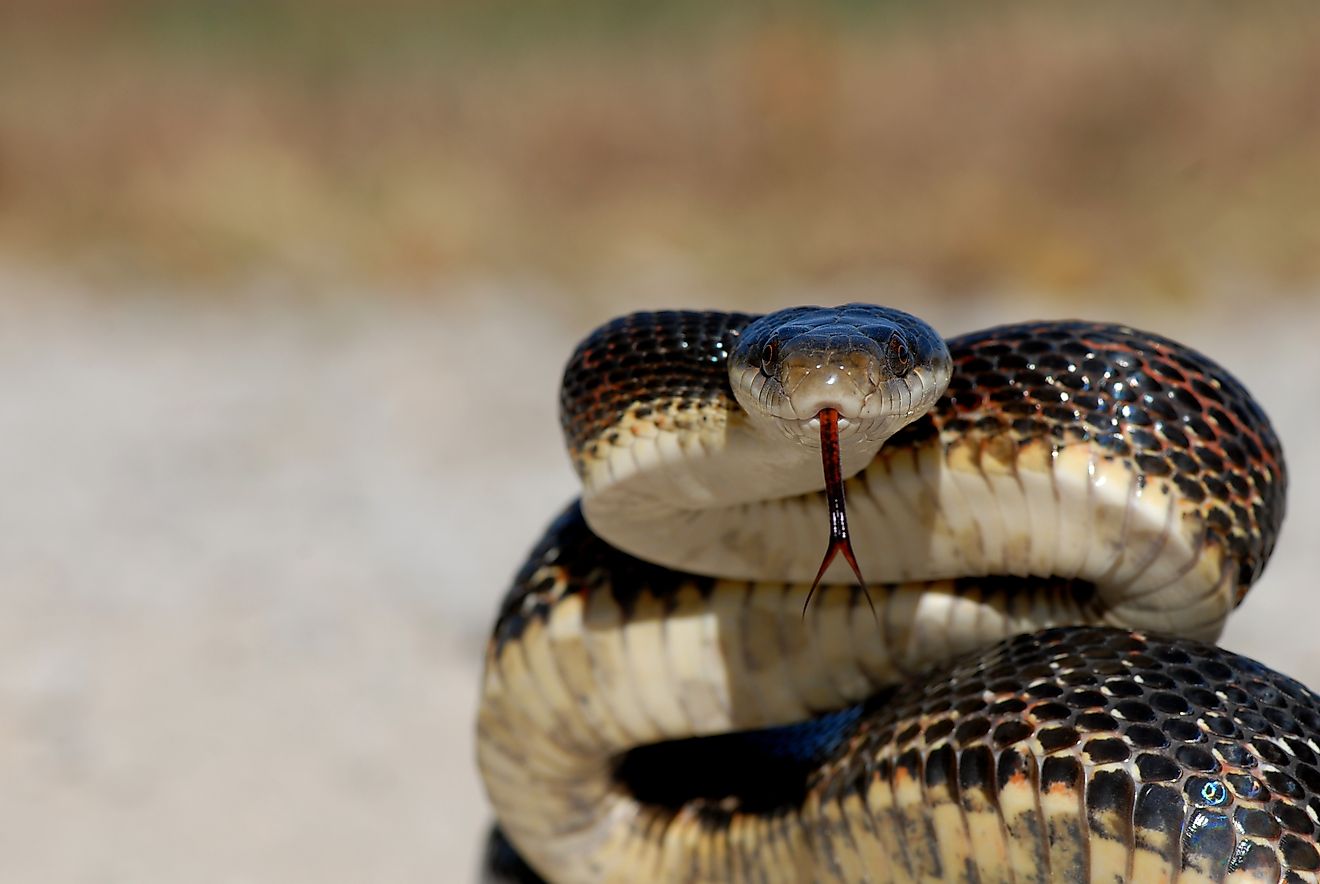
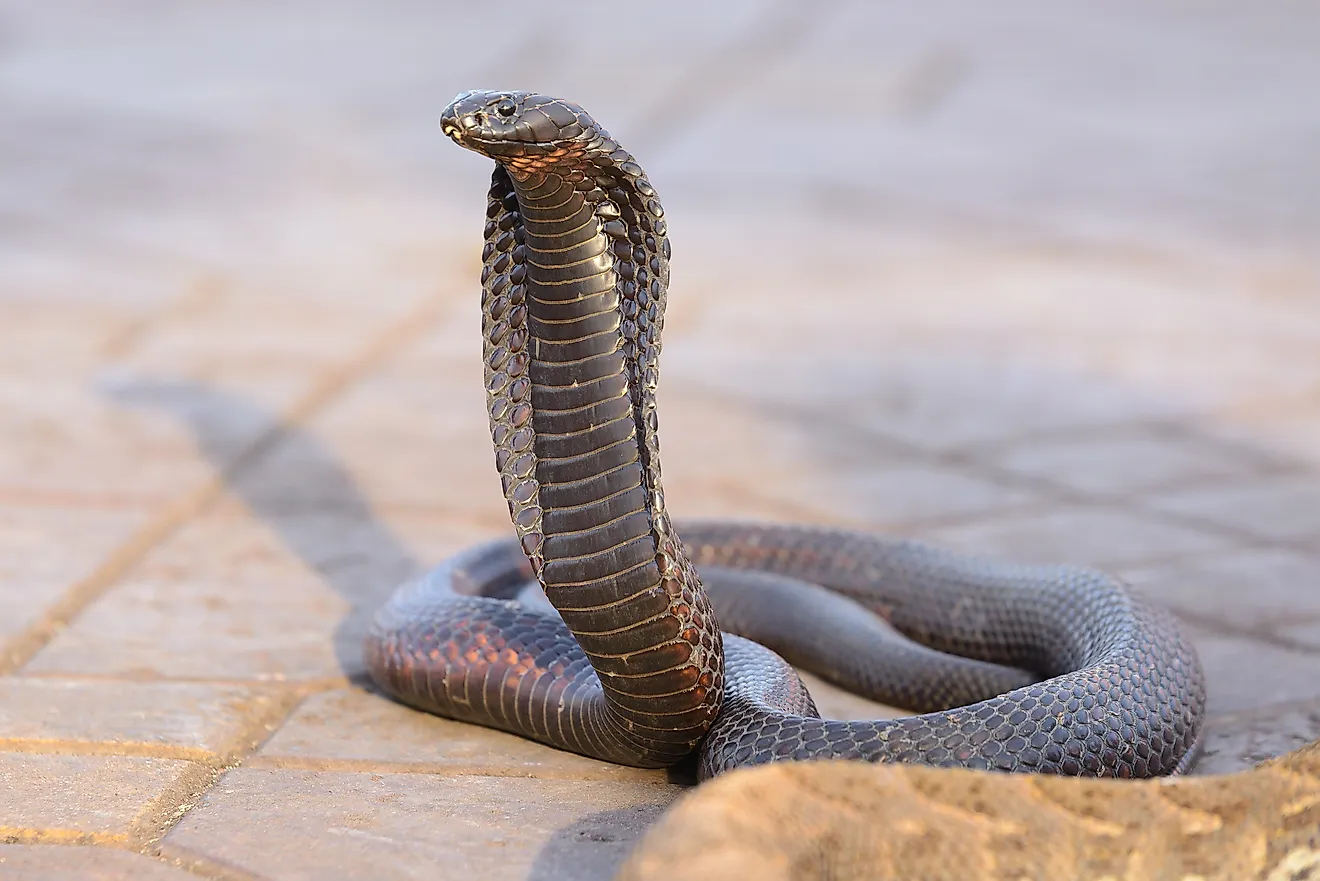
The very poisonous cottonmouth snake.
Cottonmouth snakes, aka water moccasins, are so named because of the stark white tissue inside their mouths (shown during aggressive encounters) and because of their propensity for the water. Texas lays claim to one native subspecies: the Western cottonmouth (Agkistrodon piscivorus leucostoma). "Piscivorus" is Latin for "fish eater," which again is an accurate description of one of its most identifiable traits. The one aspect of its title that, in this case, doesn't align is the directionality (the Western cottonmouth is actually found in the eastern half of the Lone Star State). Look for this heavy-bodied, 3.5-foot-long swimmer near streams, ponds, swamps, and other slow-moving bodies of water. It comes in a variety of colors – from almost solid black to various shades of brown to an olive-green.
Copperheads

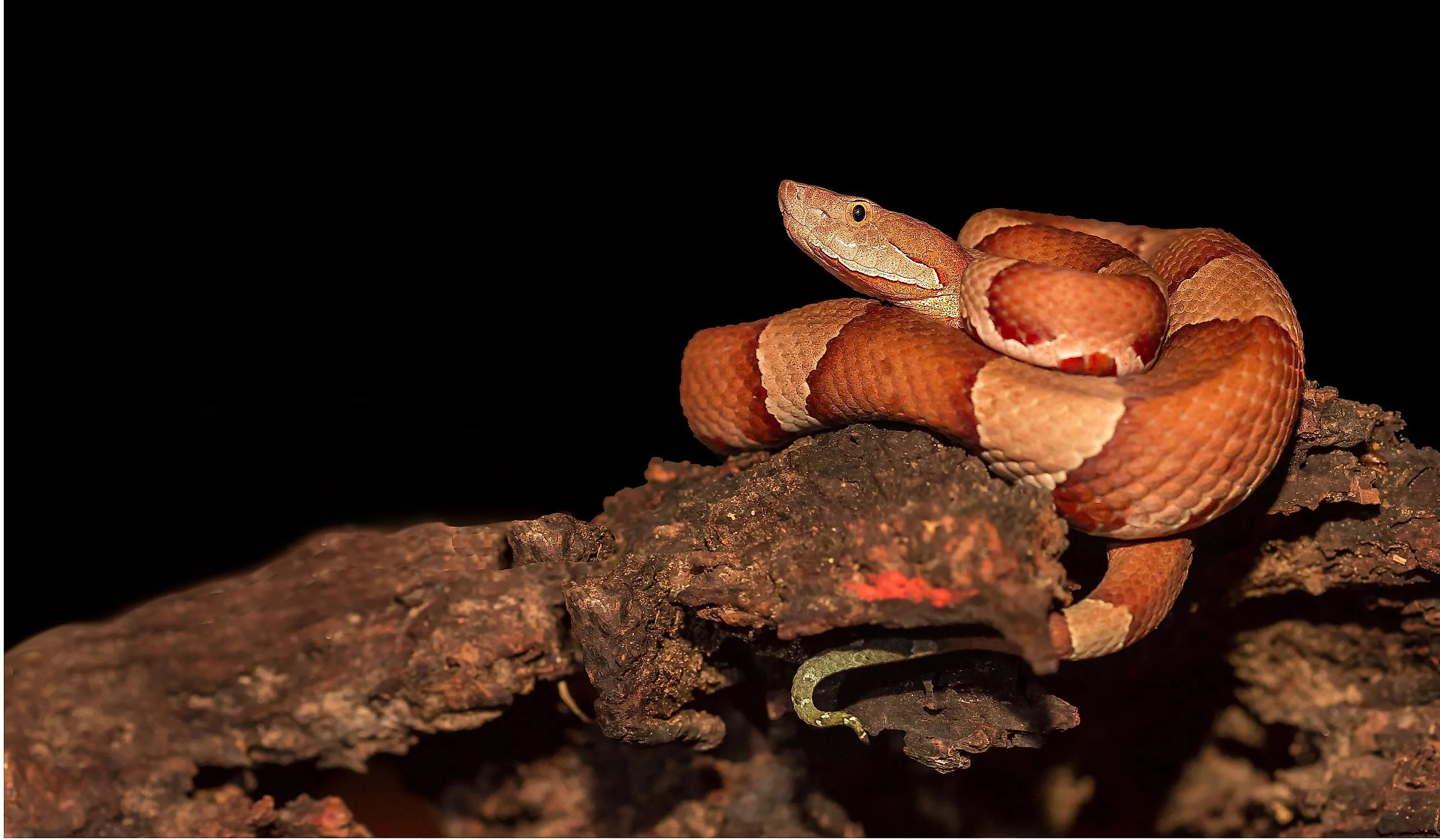
Three subspecies of copperheads have marked out distinct Texan territories for themselves. While individuals vary somewhat in appearance, generally speaking, they have tan or light-brown bodies, with wide, dark-brown (sometimes with a reddish hue) crossbands, and grow between 1.5 to 2.5 feet in length. The Trans-Pecos copperhead (Agkistrodon contortrix pictigaster) is confined to the southern part of Far West Texas (i.e., west of the Pecos River), the Broad-banded copperhead (Agkistrodon contortrix laticinctus) spans parts of central and western Texas, while the Southern copperhead, aka Eastern copperhead (Agkistrodon contortrix contortrix), slithers across the eastern third of the state.
Rattlesnakes

The distinctive rattle (actually, more of a buzzing sound caused by colliding tail scales) is emblematic of old Western movies and the arid Texan countryside as a whole. This makes sense since there are ten types of rattlesnakes that are native to the state. Of the Sistrurus genus, there is the Western massasauga (S. catenatus), the Desert massasauga (S.c. edwardsii), and the Western Pygmy rattlesnake (S. miliarius). And belonging to the Crotalus genus, there is the Western diamondback rattlesnake (C. atrox), Timber rattlesnake (C. horridus), Mottled Rock rattlesnake (C. lepidus), Banded Rock rattlesnake (C.l. klauberi), Blacktail rattlesnake (C. molossus), Mojave rattlesnake (C. scutulatus), and the Prairie rattlesnake (C. viridis viridis). Though they range in size and coloration, they all possess the organic alarm that warns us humans to stay back.
Venomous Snakes of Arkansas

Arkansas has around 39 native species of snakes, of which six are venomous: the Eastern copperhead, Northern cottonmouth, Western diamondback rattlesnake, Timber rattlesnake, Western Pygmy rattlesnake, and the Texas coral snake (which occurs only in the southwest corner of the state). You will notice that 5 of these overlap with the Texan entries, which is unsurprising given that they are neighbors (albeit with only a small section of overlapping border). The Northern Cottonmouth is the novel standout for The Natural State. But even though Texas has more venomous snakes, this does not diminish the intrigue and significance of Arkansas' roster.
The Northern Cottonmouth

While Texas's Western cottonmouth comes in some softer colorations, Arkansas's Northern cottonmouth (Agkistrodon piscivorus) tends to be very dark, if not black, in appearance. This semi-aquatic venomous snake can be found across the state (though less common in the Ozark Highlands and the Ouachita Mountains) in all kinds of gentle bodies of water, such as drainage ditches, streams, swamps, sloughs, and oxbow lakes. Along with the aforementioned preferred diet of fish, Northern cottonmouths (as with other subspecies) also use their flashy strike to procure rodents, birds, lizards, amphibians, and even other snakes.
The Eastern/Southern Copperhead

Whether referred to as an Eastern or Southern copperhead, this pit viper is found throughout Arkansas. Its distinctive dark-brown or rusty-brown hourglass-shaped bands contrast with its cream-colored body, visible in mixed pine-hardwood forests, bottomland hardwoods, and rocky or brushy fields and hillsides. Like the cottonmouth, this potentially dangerous snake is active from April to November, feeding mainly on rodents—highlighting its natural pest-control role—or on frogs, lizards, cicadas, and other snakes, depending on availability. Interestingly, juvenile copperheads have a yellow-tipped tail, which helps them lure prey while they grow toward their full, 3-foot length.
Rattlesnakes

Arkansas has three varieties of rattlesnakes – all of which are venomous and therefore, dangerous if provoked (thankfully, they will let you know when they're feeling feisty). The Timber rattlesnake (Crotalus horridus) can be found statewide, averages between 36 to 60 inches in length, and has dark, jagged-looking crossbands overlying its light-brown, gray, or yellowish body. The Western diamondback rattlesnake (Crotalus atrox) also grows upwards of 5 feet in length, this time with diamond-shaped blotches (go figure), and hangs out in the rocky areas and open pine-hardwood forests of west-central Arkansas. Finally, the relatively small (i.e., 15 to 20 inches) Western Pygmy rattlesnake (Sistrurus miliarius) is gray with black patterns and a reddish line running down the center of its back and also occurs statewide.
Texas has more venomous snakes than Arkansas, with 15 venomous species compared to Arkansas's 6, and a total of 105 native serpent species versus 39 in Arkansas. Nonetheless, when hiking, camping, or exploring rural areas in either state, it's important to stay vigilant: watch where you step, preferably wear protective footwear, and avoid handling or killing snakes. These wild animals are best left undisturbed, as engaging with them is risky. If bitten, stay calm, seek medical attention promptly, and remember that snake bites are rarely fatal here, with an average of about 5 deaths per year.