8 Small Towns in Arizona with the Best Downtowns
Arizona’s small towns were shaped by mining booms, railroad expansion, and early territorial planning in the late 1800s, and their downtowns still reflect those origins today. From the steep staircase-laced streets of Bisbee to the Spanish Colonial Revival plaza of Ajo, each place shows a different side of that development. In Prescott, a tree-shaded courthouse square anchors a walkable grid with roots in the 1864 territorial capital, while Jerome clings to the side of Cleopatra Hill with sweeping views across the Verde Valley. These are eight small towns in Arizona with the best downtowns.
Jerome

Jerome sits on a steep perch at around 5,000 feet on Cleopatra Hill, overlooking the Verde Valley and the distant red rocks near Sedona. Roughly 450 people live in this former copper boomtown, which nearly emptied after the mines closed in 1953 and spent decades as a near-ghost town before artists and entrepreneurs began reclaiming its buildings in the 1960s and 1970s.
The downtown stretches along a series of switchback roads where gravity is a constant companion. The Connor Hotel, built in 1898, anchors the upper commercial block, while the Jerome Grand Hotel, originally constructed as a hospital in 1926 in the Spanish Mission style, towers above the town from its position on the hill's upper slope. Between them, galleries, tasting rooms, and studios fill buildings that lean and settle with the terrain, a byproduct of the old mine tunnels that honeycomb the ground beneath. The 1918 Audrey Shaft Headframe, one of the largest wooden headframes still standing in Arizona, stands as a visible remnant of the industrial era.
Those looking to delve deeper into the past can visit Jerome State Historic Park. The site preserves the Douglas Mansion, built in 1916 by James S. Douglas of the United Verde Extension Mining Company, and its museum tells the story of the town's boom-and-bust arc. Before leaving, head to Main Street, where Rickeldoris Candy and Popcorn Company sells old-fashioned confections out of a storefront that captures the quirky, time-warped feel of the whole town.
Bisbee

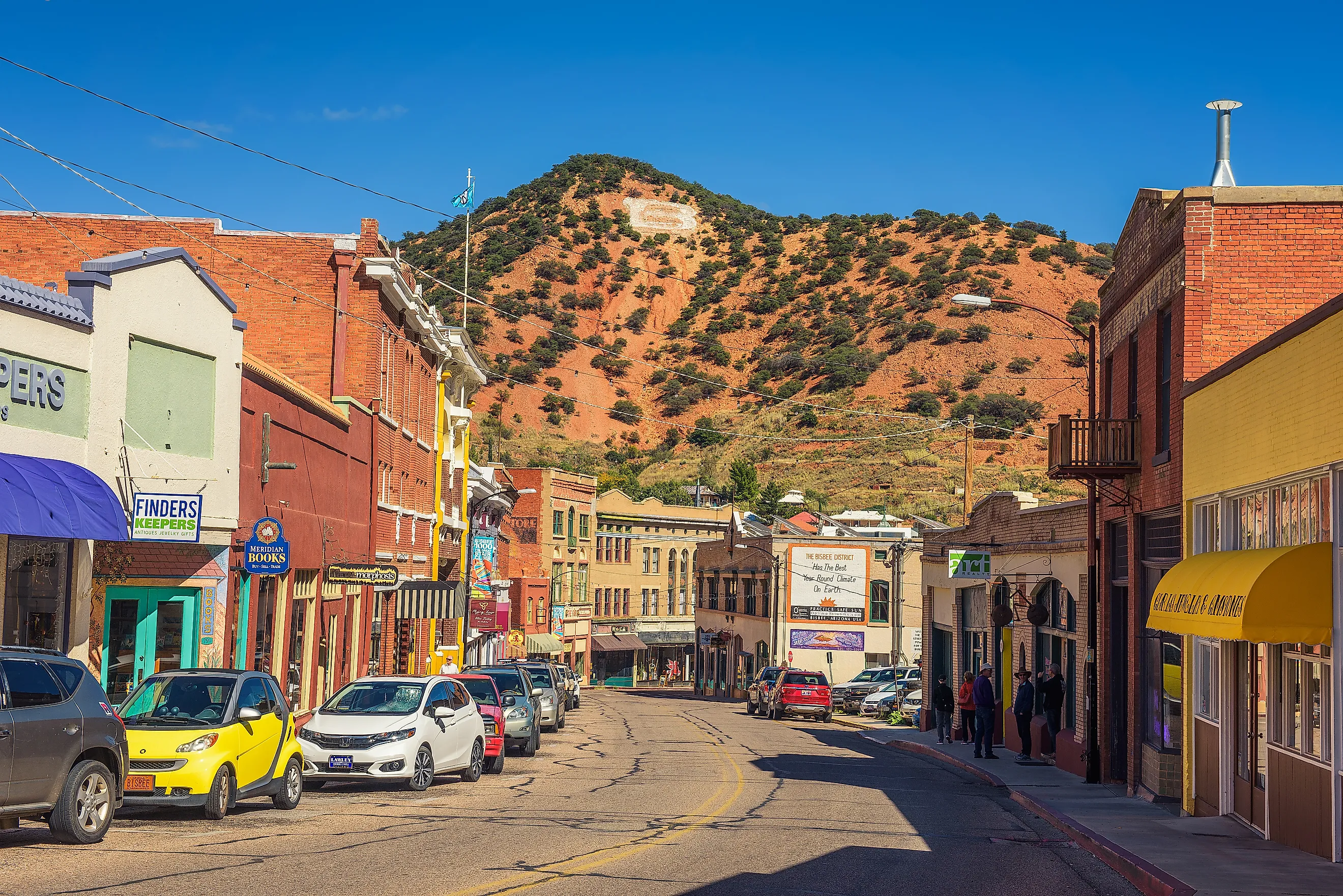
Colorful Victorian and European-style buildings climb the walls of Tombstone Canyon and Brewery Gulch in Bisbee, a former copper mining town of about 5,000 people in the Mule Mountains of southern Arizona. Unlike the flat grid layouts common across the state, Bisbee's downtown follows the canyon floor. Then it spills upward along hillside staircases, nine public stairways totaling just over 1,000 steps connecting the upper neighborhoods to the commercial center below. The annual Bisbee 1000 Great Stair Climb turns this vertical geography into a 4.5-mile race every October.
Along Main Street and Subway Street, former saloons and mining-era buildings now house galleries, vintage shops, and restaurants. The Old Bisbee Brewing Company occupies a narrow storefront on Brewery Avenue, while the Bisbee Breakfast Club draws a steady morning crowd. The Bisbee Mining and Historical Museum, a Smithsonian affiliate housed in the 1897 Copper Queen Consolidated Mining Company headquarters, traces the town's evolution from a copper camp to a creative enclave. For a look underground, the Queen Mine Tour takes visitors 1,500 feet into a retired copper mine aboard original mining cars. Back in downtown, the Copper Queen Hotel, open since 1902 and said to have hosted guests such as John Wayne and Theodore Roosevelt, provides lodging in the heart of Old Bisbee.
Prescott

A grassy, tree-lined plaza surrounds the 1916 Neoclassical Yavapai County Courthouse in the center of Prescott, a town of about 46,000 people that served as Arizona's first territorial capital in 1864. The courthouse square serves as a true town commons, hosting summer concerts, the annual Prescott Rodeo parade (the rodeo itself dates to 1888 and claims to be the world's oldest), and regular weekend gatherings year-round.
Whiskey Row runs along Montezuma Street on the west side of the square, named for the 40-plus saloons that once lined the block during the mining and ranching heyday of the late 1800s. A devastating fire leveled much of the row in 1900, but the rebuilt facades retain their Old West character, and today the strip remains lively with restaurants, bars, and live music venues. The Palace Restaurant and Saloon, which first opened in the 1870s and is often considered the oldest bar in Arizona, is housed in a rebuilt 1901 structure after patrons famously carried its hand-carved Brunswick bar to safety during the fire. Just off the square, the Hotel St. Michael provides period-restored lodging steps from the courthouse plaza.
Ajo

Ajo's downtown looks unlike any other in the state. Designed in the 1910s as a planned company town for the Phelps Dodge copper operation, the town center revolves around a Spanish Colonial Revival plaza lined with palm trees, arcaded storefronts, and a quieter atmosphere. The Curley School, a Spanish Colonial Revival landmark completed in 1919, terminates the view down Lomita Avenue from the plaza. After decades of abandonment following the mine's closure in the late 20th century, the International Sonoran Desert Alliance rehabilitated the school's eight buildings into affordable live-work spaces for artists, and the complex now houses roughly 30 resident artisans. Visitors can walk the corridors to view rotating exhibits and artwork.
Just outside downtown, the New Cornelia Mine overlook reveals an open-pit mine nearly a mile across and 1,100 feet deep, with bands of green, blue, and rust running across its terraced walls. Nearby, Organ Pipe Cactus National Monument offers hiking through pristine Sonoran Desert terrain.
Winslow

Winslow's downtown draws much of its identity from a single line in a 1972 Eagles song, but the stretch of Route 66 that runs through town has more to offer than the tribute alone. Standin' on the Corner Park, at the intersection of Kinsley Avenue and Route 66 (Second Street), features a life-size bronze statue and a mural depicting the scene from "Take It Easy," and the small plaza has become one of the most visited roadside stops in northern Arizona.
A block away, La Posada Hotel provides the downtown's architectural anchor. Designed in 1930 by Mary Colter, the acclaimed architect behind many of the Grand Canyon's landmark structures, La Posada operated as a Harvey House hotel for the Santa Fe Railway before falling into disuse for decades. A meticulous restoration beginning in the late 1990s brought the property back to life, and today its hand-painted murals, landscaped gardens, and Turquoise Room restaurant make it a destination in its own right. For more on the town’s history, the Old Trails Museum, housed in a former bank building built in 1921 on Kinsley Avenue, documents the town's ties to Route 66, the railroad, and the Navajo and Hopi communities of the surrounding region.
Cottonwood

Cottonwood's Old Town district underwent a quiet transformation in the early 2000s, as winemakers and restaurateurs filled vacant storefronts along Main Street, turning it into a hub of Arizona's Verde Valley wine region. About 12,000 people live in Cottonwood, and the Old Town area remains compact and walkable, with tasting rooms, antique shops, and cafes occupying early 20th-century commercial buildings.
The Jail Trail, a paved path that begins at the edge of Old Town, follows the Verde River through groves of cottonwood trees, offering a natural escape just steps from the commercial district. The Old Town Center for the Arts, built in 2008, hosts live music, film screenings, and gallery exhibitions. The town is also within range of the Verde Canyon Railroad, offering a four-hour scenic excursion that follows the Verde River through red rock canyons and riparian corridors where bald eagles nest during the cooler months. For overnight stays, the Tavern Hotel on Main Street offers boutique lodging, with a rooftop lounge offering views of the surrounding mesa country.
Tubac

Tubac operates as an open-air art village in southern Arizona’s Santa Cruz Valley, where dozens of galleries, studios, and shops fill low adobe buildings shaded by mesquite and cottonwood trees. Roughly 1,200 people live in the area, and the downtown's character comes less from a single main street than from the accumulated effect of pathways connecting gallery courtyards and garden patios. The artistic identity here has deep roots. Tubac Center of the Arts has anchored the creative community since the 1970s, hosting rotating exhibitions and an annual arts festival each February that draws visitors from across the Southwest. The galleries showcase a wide range of work, from contemporary painting and sculpture to handcrafted jewelry, ceramics, and textiles by regional and Native American artists.
Tubac Presidio State Historic Park preserves the site of Arizona’s oldest European settlement, established as a Spanish presidio in 1752. The park’s museum displays artifacts from the Spanish colonial and Indigenous periods, and ongoing excavations have revealed parts of the original foundations. Nearby, Tumacácori National Historical Park protects the remains of an 18th-century Spanish mission along the Santa Cruz River, adding another layer of history within a short drive.
Globe

Globe's downtown spreads across a hilly grid of early-20th-century buildings, whose architectural variety sets it apart from many Arizona towns of similar size. About 7,300 people live here, and the Globe Downtown Historic District preserves a concentrated collection of Georgian Revival, Neoclassical, and Beaux-Arts facades built primarily between 1900 and 1920, reflecting a period when copper mining brought economic growth and regional significance to the area. The 1906 Gila County Courthouse anchors the streetscape with its formal proportions, while long-standing businesses like Pickle Barrel Trading Post add to the district’s continuity.
A short drive from downtown, Besh-Ba-Gowah Archaeological Park preserves and partially reconstructs a Salado pueblo dating to around 1225 CE. The site's museum displays pottery, tools, and textiles recovered from the village, and visitors can walk through reconstructed rooms that show how the Salado people lived in this valley. The nearby Cobre Valley Historical Society Museum adds further context with exhibits on the town's mining and ranching eras.
Where Arizona's Sidewalk Tells The Story
Each of these eight downtowns reflects a different chapter of Arizona's layered past, from the Spanish colonial roots of Tubac and the Spanish Colonial Revival design of Ajo to the mining-era canyon streets of Bisbee and Jerome, from the Route 66 nostalgia of Winslow to the territorial-capital heritage of Prescott. What connects them is the way the built environment and the landscape work together to create settings that reward walking, looking, and lingering. The best Arizona downtowns are not just commercial centers but open-air records of the communities that shaped them, and each one offers a distinct reason to pull off the highway and stay a while.