6 Underrated New Jersey Towns Worth the Drive in 2026
A 157-foot lighthouse, the site of one of America's most important dinosaur discoveries, and an 1811 prison designed to be nearly fireproof all sit in New Jersey communities small enough to miss on a state map. Best of all, each of these forgotten gems is within roughly two hours of a major New Jersey city or airport.
Clinton puts two converted mills and a rare 1870 iron bridge within a few hundred feet of one another. Frenchtown has an unusually ambitious contemporary arts campus for a community of roughly 1,500. Mount Holly preserves a jail that operated for more than 150 years. These are places with attractions difficult to duplicate elsewhere in New Jersey.
Clinton

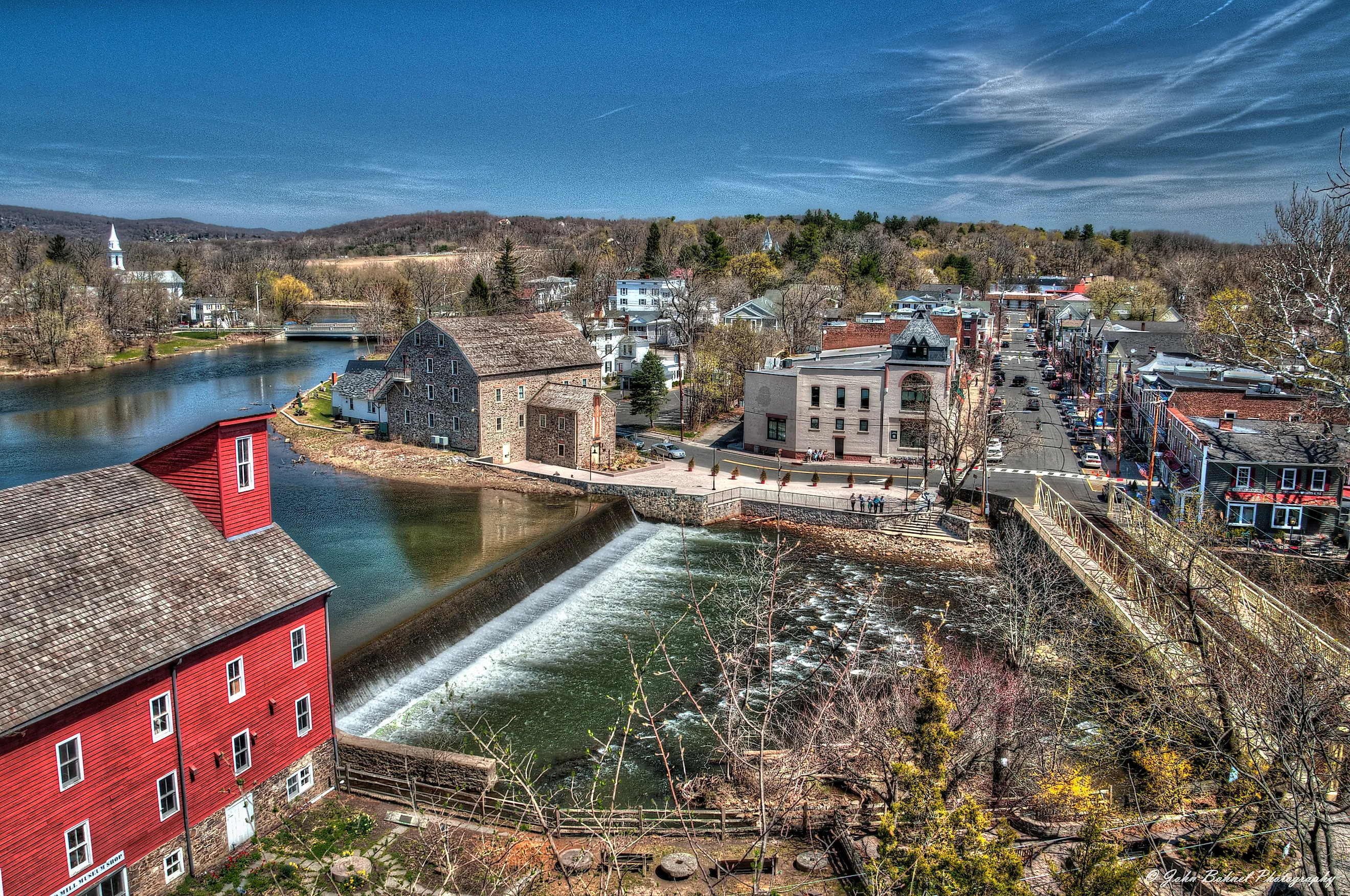
About an hour west of Newark Liberty International Airport, Clinton has roughly 2,800 residents and one of New Jersey's most distinctive riverfronts. Its centerpiece is the Red Mill Museum Village, whose four-story mill dates to 1810. The 10-acre museum grounds contain a dozen historic structures, including buildings associated with the former Mulligan limestone quarry, a schoolhouse, log cabin, and blacksmith shop.
A visit becomes more interesting when you cross the Main Street Bridge rather than simply photographing the mill. Built in 1870, the bridge is an unusually early surviving example of a pony-truss structure made with cast and wrought iron. The Town of Clinton notes that very few bridges of its type survive in the United States. Directly across the river is another former mill with an entirely different purpose. The Hunterdon Art Museum occupies the 19th-century Dunham-Parry Mill and presents changing exhibitions of contemporary art, craft, and design.
Frenchtown

Frenchtown has only about 1,500 residents and sits roughly 30 road miles, or about 53 minutes, from Trenton. Its size makes ArtYard all the more unexpected. The interdisciplinary contemporary art center occupies a four-building campus near the Delaware River, with exhibition galleries, a theater, artist residencies, and performance spaces. Its 2026 program has included residencies by Yo-Yo Ma, Lonnie Holley, and Brian Sanders' JUNK,
A few blocks away, the Uhlerstown-Frenchtown Bridge crosses the Delaware River into Pennsylvania. The present steel bridge dates to 1931 and underwent a major rehabilitation during 2025 and early 2026, with work wrapping up in April. Crossing it on foot provides an easy way to see Frenchtown's position directly against the river rather than viewing the Delaware only between buildings. Frenchtown also connects directly with the Delaware and Raritan Canal State Park trail system. The state's park network includes more than 70 miles of flat multiuse paths, and six Delaware River bridges, including Frenchtown's, connect the New Jersey trail system with Pennsylvania's Delaware Canal State Park.
Lambertville

Lambertville sits only about 17 miles from Trenton, roughly a half-hour drive under normal conditions, but its location on the Delaware River gives it a markedly different setting. The city has approximately 4,200 residents and has developed a particularly strong concentration of antique dealers, galleries, and preserved 19th-century buildings. New Jersey's tourism office calls it the “Antiques Capital of New Jersey.”
Visitors can start with The People's Store in Lambertville proper. The 1839 landmark contains multiple floors of antiques, art, and collectibles offered by dozens of dealers. History here also has a direct connection to the California Gold Rush. The James Wilson Marshall House, built by Marshall's father in 1816, was the boyhood home of the man whose 1848 discovery of gold at Sutter's Mill helped trigger the rush to California. The building now houses the Lambertville Historical Society and contains period rooms and exhibits on local history.
The Delaware and Raritan Canal towpath provides the outdoor portion of the visit. Lambertville lies along the feeder canal, which once moved boats and supplied water to the main D&R Canal. Today the old transportation corridor is part of a continuous state-park trail network used for walking and cycling. The state specifically identifies Lambertville as one of six bridge locations where users can connect with trails on the Pennsylvania side of the Delaware.
Haddonfield

Haddonfield is the largest town on this list, but its estimated 2025 population of 12,740 remains well below the 50,000 cutoff. It is also only about a 38-minute drive from Trenton. Its strongest reason for making the trip has little to do with conventional colonial-town sightseeing: one of the most important dinosaur discoveries in American paleontology happened here.
In 1858, the remains of Hadrosaurus foulkii were excavated from a marl pit near what is now the eastern end of Maple Avenue. The Hadrosaurus Foulkii Leidy Site is now a National Historic Landmark. The discovery produced one of North America's earliest substantially complete dinosaur skeletons and helped establish that at least some dinosaurs walked on two legs. The original excavation area remains a wooded site near a small stream known as Hadrosaurus Run. Downtown, visitors can find “Haddy,” the bronze dinosaur sculpture commemorating the discovery.
Haddonfield's other exceptional attraction is the Indian King Tavern, where the New Jersey Legislature met during the Revolutionary War. New Jersey officially changed its status from colony to state while legislators were meeting there in 1777. The building remains a state historic site, although there is an important 2026 caveat: it is currently closed for restoration, and is expected to reopen in fall 2026. While the tavern is closed, Greenfield Hall, headquarters of the Historical Society of Haddonfield, provides another worthwhile stop.
Mount Holly

Mount Holly had an estimated 10,645 residents in 2025 and sits only about 19 road miles from Trenton, making it one of the easiest trips on this list. Start at the Burlington County Prison Museum on High Street. Architect Robert Mills designed the prison, which was completed in 1811 using thick stone, brick, vaulted ceilings, and other construction intended to make the building highly resistant to fire. The design worked well enough that prisoners remained there until 1965. Today it is a National Historic Landmark open as a museum, with preserved cells and other spaces showing what incarceration looked like during its more than 150 years of operation.
A short distance away, Mill Race Village preserves a different piece of Mount Holly's past. Its defining feature is the actual mill race, a hand-dug channel diverted from Rancocas Creek to power mills and industries during the 18th and 19th centuries. The waterway still runs through the district today, passing a collection of historic buildings now occupied by studios, shops, and small businesses.
Mount Holly also played a lesser-known role in the days immediately preceding Washington's attack on Trenton. The Battle of Iron Works Hill took place here on December 23, 1776. The fighting helped draw Hessian troops toward Mount Holly shortly before Washington's forces crossed the Delaware and attacked Trenton on December 26. A marker and historic area commemorate the episode.
Cape May Point

Cape May Point barely qualifies as a town in terms of size. Its population is only around 300, yet the borough sits about an hour's drive from Atlantic City and contains an unusual concentration of maritime, military, and natural landmarks. The obvious starting point is the Cape May Lighthouse in Cape May Point State Park. The present tower was built in 1859, stands 157 feet high, and remains an active aid to navigation. Visitors can climb 199 steps to the top for a view across the southern tip of the Cape May Peninsula.
The beach below contains a far less expected landmark. Battery 223, a World War II coastal-defense emplacement constructed as part of the Harbor Defense Project of 1942, originally stood about 900 feet inland beneath earth and sod. Decades of erosion have moved the shoreline toward it, leaving the concrete structure close to the water today. Its gun turrets can sometimes be seen at low tide. The surrounding Cape May Point State Park covers 244 acres of freshwater ponds, meadows, forest, dunes, and beach. Its location at the tip of the peninsula funnels migrating birds through a relatively small area, making it one of North America's noted bird-watching sites. Fall brings particularly heavy migration activity, along with monarch butterflies moving south.
For a more focused look at that migration, stop at the Cape May Bird Observatory's Northwood Center on East Lake Drive. New Jersey Audubon founded the observatory in 1976, and the center offers trails, birding information, naturalist-led walks, and programs around nearby Lily Lake. The renovated Northwood Center reopened in 2026 for the observatory's 50th anniversary and currently operates daily.
Small Towns With A Reason To Make The Drive
Driving to any of these leads to undiscovered treasure. Clinton has its pair of old mills and rare iron bridge. Frenchtown supports a contemporary arts institution that seems improbable for a community of its size. Lambertville ties its antiques district to the Delaware River and canal system, while Haddonfield combines Revolutionary history with one of the landmarks of American paleontology. Each of these towns shows you a different side of New Jersey, beyond tired tropes and tourist traps.