10 Small Towns on Florida's Emerald Coast With the Best Downtowns
Florida's Emerald Coast region has downtowns that are as recognizable as its shoreline. Seaside has pastel buildings around a broad lawn. Alys Beach took a completely different direction with white masonry, courtyards, and arches. DeFuniak Springs circles a spring-fed lake, while Milton’s historic district meets the Blackwater River. These towns have some of the region’s best downtowns, with memorable architecture and plenty to do within a compact area.
Seaside

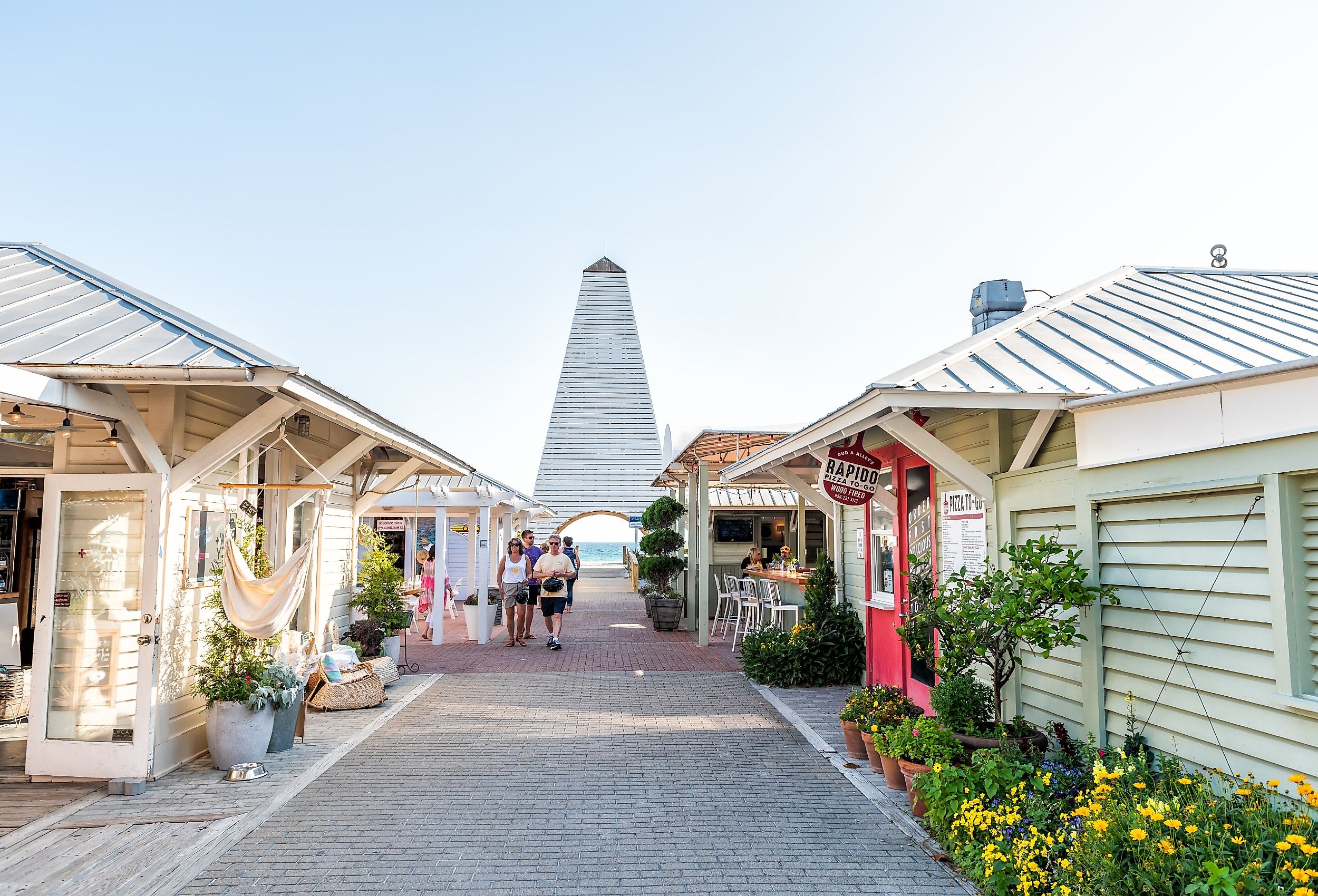
Pastel cottages, brick streets, white pavilions, and a grassy amphitheater make Seaside easy to recognize. Development began in the early 1980s, and the community became an influential example of New Urbanism, a planning approach centered on walkable neighborhoods. Its streets later became even more recognizable when Seaside played the fictional town of Seahaven in the 1998 film The Truman Show.
Central Square is the logical place to spend most of an afternoon. The Seaside Amphitheater sits in the middle of the action and regularly hosts concerts and community events. The Seaside Farmers Market also takes place nearby.
Sundog Books has been part of Seaside for more than 30 years and remains one of the best stops around the square. Down the street, Modica Market has been serving the community since 1989. Its shelves are packed with groceries, wine, prepared foods, and the sort of things beachgoers realize they forgot to bring. Before leaving downtown, look for the tiny white Seaside Post Office. It is only a few hundred square feet, yet it has become one of the community's most recognizable buildings.
Rosemary Beach

Rosemary Beach feels denser than Seaside even though the two communities sit along the same stretch of Scenic Highway 30A. Buildings stand close to narrow pedestrian lanes, balconies overlook the streets, and cobblestone paths lead between courtyards and public squares. The town plan dates to 1995, with architecture drawing inspiration from places including the West Indies, New Orleans, and St. Augustine.
Much of the commercial district surrounds North and South Barrett Square. The Hidden Lantern Bookstore at 84 North Barrett Square carries thousands of books along with puzzles and games. Curate brings contemporary art to Main Street, while Rosemary Beach Trading Company stocks clothing and goods bearing the community's familiar logo.
Town Hall is worth seeing even when nothing is happening inside. Completed in 1999, the white stucco building has a Dutch West Indies parapet roof and stands out among the surrounding shops and residences. Boardwalks and pedestrian paths continue beyond the commercial center, connecting the squares with neighborhood parks and the Gulf.
Alys Beach

The white walls give Alys Beach away immediately. Houses and commercial buildings use masonry construction, with arches, courtyards, towers, palms, and carefully placed openings breaking up the otherwise bright facades. Its designers drew on Bermudian architecture as well as Moorish and Guatemalan influences.
Even the entrance makes a statement. Two white structures known as the butteries stand beside 30A at the western edge of the community. Inside town, Fonville Press Market + Café at 23 North Somerset works well for coffee or breakfast before walking the surrounding streets and courtyards.
Alys Beach has also turned those white walls into an art surface. During the annual Digital Graffiti festival, artists project digital work directly onto buildings throughout the community. The effect temporarily changes facades, courtyards, and blank walls that already make Alys Beach one of the easiest places on 30A to identify in a photograph.
Grayton Beach

Grayton Beach was around long before the master-planned communities that now line 30A. Its center shows its age in a good way. Sandy lanes do not follow a rigid grid, old cottages sit under mature trees, and brightly painted businesses appear around Hotz Avenue.
The Red Bar is hard to miss at 70 Hotz Avenue. Its red exterior is almost as recognizable as the densely decorated interior, where live music has long been part of the experience. Nearby, The Zoo Gallery has sold art in the Florida Panhandle since 1979. Its Grayton Beach location carries paintings, pottery, jewelry, prints, and other work by artists from around the country.
There is also a major natural area right outside town. Grayton Beach State Park contains Western Lake, one of South Walton's coastal dune lakes. Canoes, kayaks, and paddleboards can be used on the lake, and the park has four miles of trails through coastal forest.
Destin

The Destin Harbor Boardwalk follows the waterfront for nearly a quarter mile. Charter fishing boats line the docks, and restaurants overlook vessels traveling between the harbor and East Pass. Visitors who want to get onto the water have plenty of choices. Fishing charters and sightseeing cruises depart from the harbor, while HarborWalk Village has restaurants, shops, and entertainment beside the boardwalk. The Destin History & Fishing Museum puts the harbor scene into context. Exhibits cover early Destin families, fishing methods, boats, marine life, and the industry that shaped the community.
Fort Walton Beach

A 17-foot prehistoric temple mound rising beside modern downtown streets makes Fort Walton Beach one of the more unusual entries on this list. Indigenous people constructed the mound between approximately 800 and 1400, centuries before the commercial district developed around it. It became a National Historic Landmark in 1964.
The mound is now part of Heritage Park & Cultural Center. One admission covers several sites, so this is a downtown worth saving for a day when there is time to go inside rather than simply passing through. The Indian Temple Mound Museum covers Indigenous history and archaeology in Northwest Florida. Visitors can also see the Camp Walton Schoolhouse Museum and Garnier Post Office Museum.
Brooks Street leads toward another side of downtown. The Landing faces Santa Rosa Sound and regularly serves as the setting for festivals and local events. Benches and an open lawn along the water make it an easy final stop after a few hours inside the museums.
DeFuniak Springs

Downtown DeFuniak Springs wraps around Lake DeFuniak instead of following a conventional Main Street layout. Circle Drive passes Victorian houses, churches, old public buildings, and enormous trees. The railroad tracks and historic commercial blocks are close by.
Much of what survives around the lake dates to the Florida Chautauqua era. Educational assemblies began drawing visitors here in the 1880s. One remnant is the Chautauqua Hall of Brotherhood, built in 1909. Its auditorium once seated 4,000 people before Hurricane Eloise destroyed that portion of the structure in 1975.
The Walton-DeFuniak Library is even older. It opened in 1887 and is Florida's oldest continuously operating library, still housed in its original structure. The former railroad depot now contains the Walton County Heritage Museum. A self-guided historic district tour connects these buildings and other sites around the former Chautauqua grounds.
Milton

Downtown Milton meets the Blackwater River at the end of several historic streets. The river is dark with tannins, which makes it a dramatic backdrop for the boardwalk and bridges crossing through town.
The Milton Riverwalk follows the Blackwater through the historic district. A gazebo sits at its north end, with a picnic shelter at the other. The boardwalk is also used during Riverfest and other community events.
Railroad history is just as visible. The West Florida Railroad Museum occupies a former Louisville & Nashville freight and passenger depot built between 1907 and 1909. Displays include railroad photographs, documents, equipment, model trains, and historic railcars. Admission is free, though current opening hours are limited to Friday and Saturday.
Crestview

Crestview grew alongside the Pensacola and Atlantic Railroad during the late 19th century. That transportation history is covered at the Crestview History Museum on Wilson Street. The museum occupies the Bush House, an American Craftsman home built in 1925, with displays covering local newspapers, government, the Louisville & Nashville Railroad, and Crestview's early years.
Back on Main Street, Old Time Antiques & More fills a downtown storefront with antiques and collectibles. Hub City Station serves a different purpose as a maker space and learning center. Crestview has participated in the Florida Main Street program since 1997, and preservation efforts have kept the old commercial core recognizable even as development spread beyond downtown.
Panama City

Murals have become part of the streetscape in historic downtown Panama City. They cover exterior walls and alleyways around Harrison Avenue, where older commercial buildings now house restaurants, galleries, shops, and arts organizations. The city has organized many of the works into an official Mural Trail.
The Panama City Center for the Arts occupies a historic building at 19 East Fourth Street. Four galleries hold rotating exhibitions, and admission is free. Classes, film screenings, workshops, and other events take place there throughout the year.
Harrison Avenue is worth seeing on foot because many of the murals are easy to miss from a car. The historic downtown clock stands near Fourth Street, and more painted walls appear on surrounding blocks and alleys. For lunch, History Class Brewing Company at Four Points Plaza leans heavily into local history, with Panama City photographs, artifacts, and references worked into the restaurant and brewery.
More Than One Version Of Downtown Florida
There is no standard downtown template along the Emerald Coast. Seaside was deliberately planned around Central Square, while Destin's working harbor became its gathering place. DeFuniak Springs still carries the imprint of the Chautauqua movement, and Milton's old depot points to the railroad that once brought people and goods through town.
The visual differences are just as pronounced. Few visitors would confuse the white masonry of Alys Beach with the sandy lanes around Hotz Avenue in Grayton Beach. Fort Walton Beach has a centuries-old temple mound near its downtown streets, while Panama City has turned blank walls and alleys into public art. These are places where leaving the beach for a few hours means seeing another part of the Emerald Coast's story.