Feed Florida Alligators From Their Side Of The Fence
I recently returned from spending a glorious day at Gatorland in Florida, and boy, was I impressed. Opened in 1949 on a roadside plot near Kissimmee, a whole 22 years before Walt Disney World launched, this family-run attraction is full of surprises. Not only was there enough to do here to keep me busy for a full day, but I came away with a whole new appreciation for the amazing animal this fun attraction's dedicated to: the American alligator.
And if you'd have told me that by the end of my visit, my fellow travelers and I not only got to hold an alligator (ok, it was a baby, only a foot long nose-to-tail) but would also be feeding fully grown adults while standing just six feet away, no fence or barricade between us, I'd have said you were crazy. But it's all true.
Up to that moment, I'd always lumped alligators in with grizzlies and sharks: animals that saw me as food, not friend. But after seeing these creatures up close and learning more about alligators and their Florida habitat, we learned not to fear them, but to respect them. And it was a heck of a lot of fun, too.
Central Florida's First Big Attraction

But first things first. Before visiting, it's worth knowing at least a little bit about Gatorland's fascinating story, and how feeding alligators from their side of the fence is even possible. It all started back in 1949 when founder Owen Godwin bought a plot of land near Kissimmee on the Orange Blossom Trail, a popular mid-century tourist route running between the Georgia state line and Miami.
It was here that Godwin and his wife Pearl set up their Florida Wildlife Institute, giving passing motorists a close look at the state's reptiles. It consisted of a simple stockade-style roadside gift shop with a sawdust-covered dirt floor, plus just a handful of alligators and snakes.

The name it's now known by came in 1954, and by the time Walt Disney World opened in 1971, Gatorland had been welcoming visitors for 22 years, which is why the park bills itself as Central Florida's first major attraction.
It's still a family affair, too. Gatorland remains privately owned by the Godwin family. And yes, you still walk in through its famous gator mouth entrance, so have your camera ready for a great selfie. Once inside, you'll see many of the preserve's more than 2,000 American alligators along with crocodiles, wild cats, tortoises, snakes, and a free-flight aviary. It's a lot to take in, so pace yourself, and be prepared to stay a while.
Feeding Alligators Without a Fence

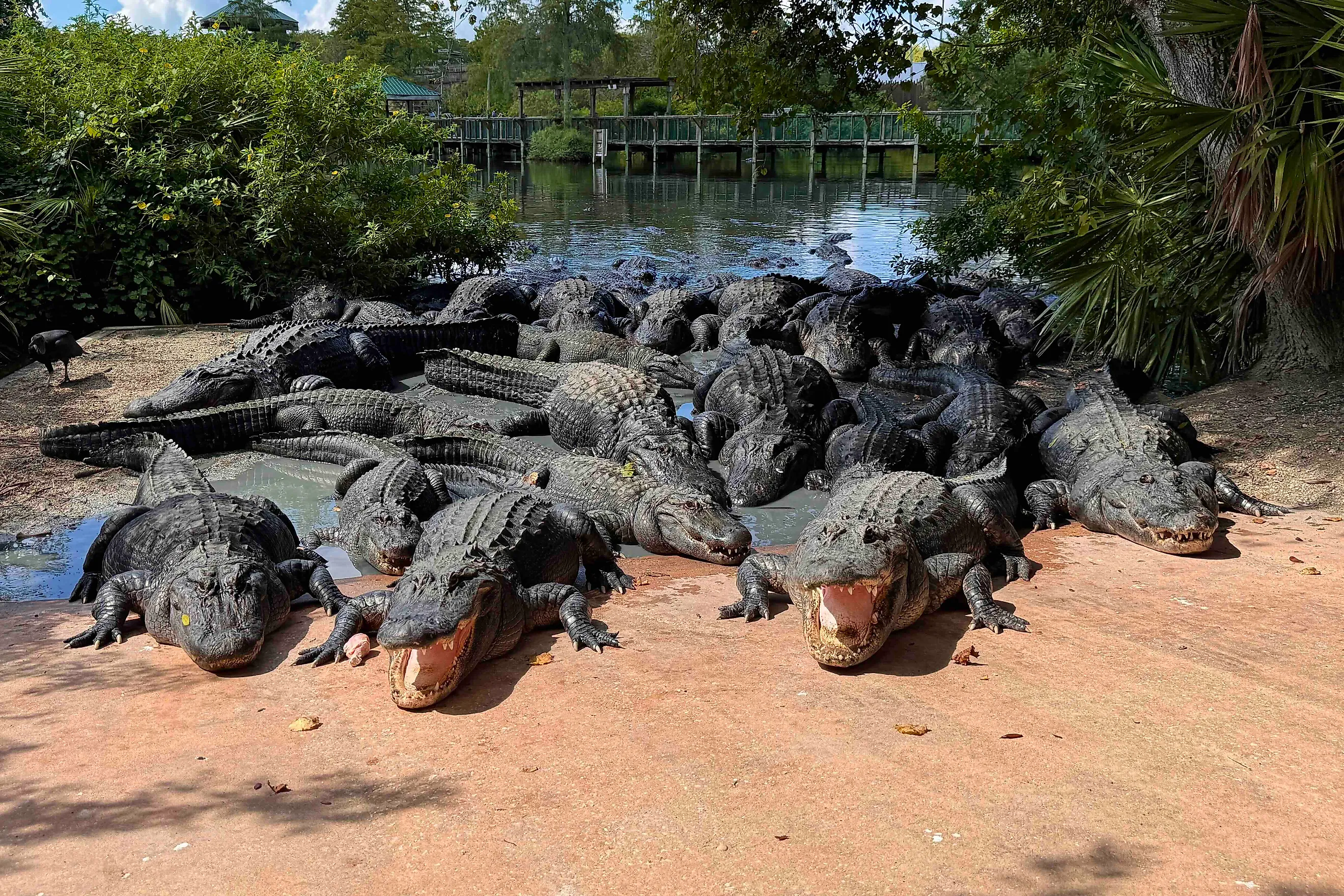
Our group signed up for Adventure Hour, a guided feeding session inside the Alligator Breeding Marsh, a section of the park that's closed to regular visitors and is home to hundreds of alligators. Our Gatorland guide swung open the heavy fence that separated us from the alligators and, with nothing more than gloves to handle the food, we were ushered in. I have to confess it took plenty of coaxing and encouragement before I entered, as my natural instinct was, honestly, to scarper in the other direction. My colleagues needed far less.
But in I went, and to say I felt a little nervous as the gate closed behind us would be an understatement. Like a scene from Indiana Jones and the Temple of Doom, alligators, some well over 10 feet in length, were lumbering out of the water onto the cement ramp that leads into the marsh. The film's "crocodiles" beneath the rope bridge were actually alligators filmed in this very marsh.

I gave up counting at 20. The closest were just 6 feet from where we stood. All of them, including the stragglers at the back, seemed to know to stay at the water's edge. And watch. And wait.
What they were waiting for were the chunks of chicken we'd been provided in buckets. And there was plenty of it, so even the alligators at the back got lucky. Were they docile? Possibly. Were they well fed? Certainly, and I couldn't shake the feeling that a full stomach was the real reason for their good manners. Either way, watching adult alligators feed at such a close range, with nothing between us but six feet of air, was a remarkable experience.
Other Gatorland Experiences

Don't miss the park's rarest residents, either. At the White Gator Swamp, brothers Feros Zonbi and Trezo Je are leucistic alligators, two of only 12 known to exist with a partial loss of pigment that turns the skin white. The rarity of these alluring creatures stems from the fact that the lack of pigment means they lack the dark pigment that gives other alligators their camouflage, making them easy targets for predators, so few survive in the wild. They also sunburn easily. Three albino alligators are also on view.
If standing beside the alligators isn't enough, you can fly over them, too. The park's Screamin' Gator Zip Line covers 1,200 feet across five lines, the shortest 230 feet and the longest more than 500 feet. Its launch towers stand more than seven stories tall, and you'll reach speeds of up to 30 miles per hour. The course also includes a swinging bridge over the park's main walkway.

Adding to the experience is the fact that the route passes above Cuban and Nile crocodiles before crossing the breeding marsh, where the park counts 130 large alligators below. Seeing that marsh and its reptile residents from above is an entirely different experience from standing next to them.
My travel companions had to do far less cajoling to get me aboard the Gatorland Express than they did for the feeding. This family-friendly choo-choo makes a slow circuit of the grounds, and a highlight is that it passes parts of the park you wouldn't otherwise see. Three shows also run through the day. These are Gator Jumparoo, Alligators: Legends of the Swamp, and Up-close Encounters.

Then there's the newest addition, and one aimed squarely at us adults. Opened in May 2026, the Guzzlin' Gator Beverage Barn is an open-air bar with picnic tables and views of the zip line. Its house beer, Grinnin' Gator Lager, is a must-try and a well-deserved treat. Brewed especially for the park by the Crooked Can Brewing Company out of the Orlando suburb of Winter Garden, this delicious Munich-style lager certainly helped steady our nerves as we reflected on our alligator encounters.
Changing My Mind About Gators

It wasn't just seeing a different side to alligators at Gatorland that helped change my view about creatures I once worried about. The park does a superb job of educating folks about them, too. I learned that Floridians share their state with an estimated 1.3 million alligators, living in all 67 counties and in every wild area that can support them. I was surprised to learn that American alligators were listed as endangered in 1967 due to poaching. They were removed from the list in 1987 after a successful recovery.
Kissimmee, it turns out, is in prime alligator country. In fact, Lake Kissimmee is ranked the second most alligator-filled lake in the state, with 16,184 alligators calling it home. Lake Tohopekaliga, or Lake Toho to locals, is where you'll find Kissimmee's downtown waterfront and is listed as having 5,716 gators. The wild ones, in other words, are never far from the park's residents.
And the fear factor? Serious incidents are rare, with an average of eight unprovoked bites a year that require professional medical treatment. All of which means the odds of being seriously injured in an alligator incident are around one in 3.1 million.
Know Before You Go
While I'm confident this doesn't really need to be said, I'm going to say it anyway. Never try feeding an alligator in the wild. Ever. The Florida Fish and Wildlife Conservation Commission warns that feeding wild alligators is both dangerous and illegal, because it teaches them to associate people with food.
While Gatorland has an Orlando mailing address, the park describes its location as just north of the Orlando and Kissimmee line, and both the Kissimmee and Osceola chambers of commerce list it as a member. Starting from Kissimmee also means you can avoid Interstate 4. I've visited the theme parks here many times since 2005, and honestly, I can't remember a single trip without a traffic jam.
Kissimmee also makes a sensible base for its countless vacation homes. Rentals here include everything between two-bedroom condos and 15-bedroom mansions, and Kissimmee is just 25 minutes from Orlando International Airport. Our rental was managed by Kissimmee-based Jeeves by Casago, and the drive to Gatorland took under 30 minutes.