7 Snake Infested State Parks In Virginia
Virginia has 44 parks, which provide residents and visitors of the state with ample outdoor recreational opportunities. Altogether, Virginia’s parks offer thousands of campsites, hundreds of cabins, over 700 miles of hiking and biking trails, and access to Virginia’s rivers and lakes for kayakers, canoers, and stand-up paddleboarders. However, it is more than just vacationers who enjoy Virginia’s state parks. The parks also provide habitat for some of the state’s 32 species of native snakes.
First Landing State Park

First Landing State Park is located on Virginia Beach and spans 2,888 acres. It is one of Virginia’s most visited state parks, and for good reason. The park contains 1.5 miles of Chesapeake Bay shoreline, 20 miles of trails laced throughout the park, and opportunities for camping, picnicking, and boating. Its name originates from the first English colonizers who landed on the shores in 1607.
The Plain Bellied Water Snake (Nerodia erythrogaster) is most commonly seen in the ponds of First Landing State Park. These snakes are adapted to wetland environments, and as a result, are seldom found far away from a permanent freshwater source, including lakes, ponds, rivers, creeks, and swamps. Although they are nonvenomous, they are willing to strike at anything that they perceive as a threat if they are unable to flee into the water or otherwise cornered.
Pocahontas State Park

Pocahontas State Park is located 20 miles from Richmond and offers plenty of outdoor-based opportunities spread across its 90 miles of trails, three lakes for fishing and boating, and its camping and picnic sites. However, it has more than just outdoor activities. There is a 2,000-seat amphitheater on site, a Civilian Conservation Corps Museum that preserves the history of the workers who built the park, an aquatic center, and two dining halls, which can be rented for events.
The Eastern Worm Snake (Carphophis amoenus amoenus) is one of the most abundant species observed in the park. They were observed close to the ground, underneath, or inside of logs and pieces of bark. This is characteristic behavior of this secretive species, which favors habitats with soil that allows for burrowing, or debris like rocks, moist logs, and tree stumps that provide adequate cover. As their name suggests, their prey is primarily composed of worms. They are small snakes that are unlikely to bite, but may try to burrow between your fingers if they are picked up.
Shenandoah River State Park

Shenandoah River State Park is located on the south fork of the Shenandoah River. The park comprises 1,600 acres which stretches across 5.2 miles of shoreline, and has 25 miles of trails for hiking, biking, and horse riding. There is a large riverside picnic area with views of Massanutten Mountain. The picnic area has access to trails, the water via a boat ramp for boaters and fishers, and picnic shelters, making it popular among families.
One of Virginia’s venomous snakes, the Northern Copperhead (Agkistrodon contortrix mokasen), has been observed within the state park. One study observed a specimen on the forest floor, by the edge of a stream; however, they can be found in a wide variety of terrestrial habitats, such as wetlands, forests, fields, or any area that has rocks and debris for shelter.
Douthat State Park

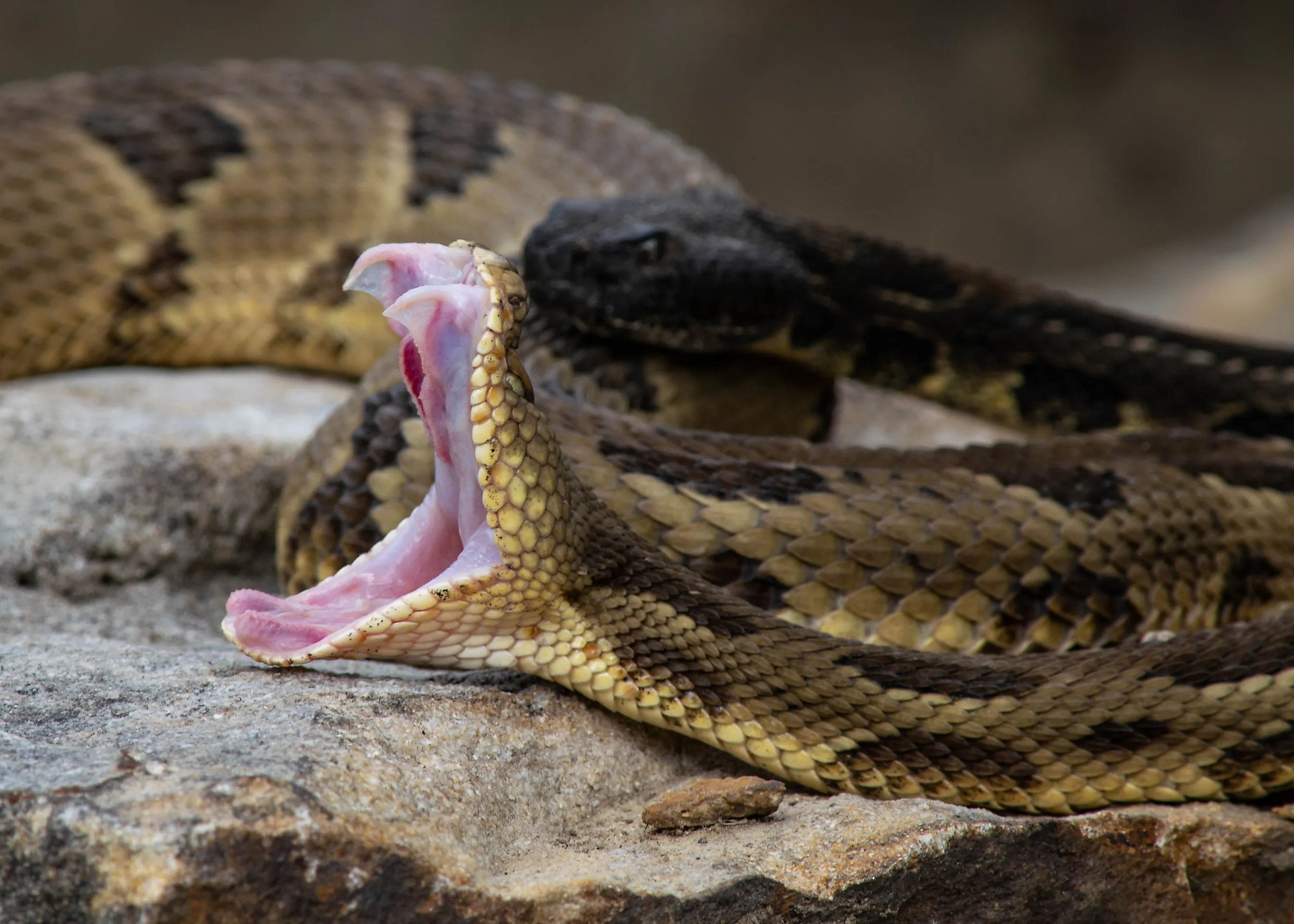
Douthat State Park is a 4,545-acre park nestled amongst the Appalachian Mountains and provides many opportunities to hike in and explore forest-covered mountains and valleys. Visitors can explore 53 miles of hiking and biking trails, relax on the beach, or fish at a 50-acre lake stocked with trout, or simply enjoy lunch at one of the picnic areas. Douthat State Park is a diverse ecosystem, home to many different kinds of wildlife, including the venomous Timber Rattlesnake (Crotalus horridus).
Timber Rattlesnakes can be found in mountainous regions and on hilly slopes, especially where there are rocky outcrops and ledges that they will use as dens to hibernate communally in the winter months. When alarmed or trying to make someone aware of their presence, Timber Rattlesnakes will rattle their tail, making bites rare. Snakes have to produce venom, and they would rather use it to immobilize prey items rather than waste it on a human they cannot eat.
Sky Meadows State Park

Sky Meadows State Park gets its name from the Blue Ridge Mountains visible to the west. The park is laced with 10.5 miles of horseback riding trails, 22 miles of hiking trails, and 9 miles of biking trails. The park hosts nature and history programs routinely throughout the year and offers unique primitive hike-in camping opportunities for families and large groups, which take them into the backcountry area of the 1,860-acre park.
Common Ribbon Snakes (Thamnophis saurita saurita) have been observed in Sky Meadows State Park. They are a small, slender-bodied snake, similar to garter snakes, and, like Garter Snakes, can survive in a variety of different habitats, such as woodlands, wetlands, grasslands, swamps, and marshes. They will wriggle furiously if caught, but are unlikely to bite, but may release musk from glands at the base of their tail.
Powhatan State Park

Powhatan State Park is situated on the James River, offering three car-top boat launches that provide water access. The park has both a full-service campground and a canoe-in or hike-in campground. Other amenities include a picnic area, playground, multi-use trails, and wildlife observation areas. Many species of snakes have been recorded in Powhatan State Park, including the Northern Black Racer (Coluber constrictor constrictor).
Northern Black Racers are a large species of snake attaining lengths of over 70 inches. They often occupy open grassy area habitats or forests close to open grassy areas, so long as it is dry. They are most active during the day and will seek shelter under rocks or logs during the night or on cool days. Being such a large species of snake, they prey on a wide variety of animals. Young racers may eat prey items as small as larvae of butterflies or moths, whereas larger adults of the species have been known to take down flying squirrels.
Mason Neck State Park

Mason Neck State Park is only a short drive from the District of Columbia, offering a diverse range of outdoor activities and programs. The park features multi-use trails, a picnic area for families and large groups to enjoy, a playground for children, as well as a small watercraft launch for kayaks and canoes, which are also available to rent from the visitor center. The park boasts a diverse environment featuring woodlands, wetlands, ponds, and open fields, which makes it a promising location to observe wildlife.
The Northern Ringneck Snake (Diadophis punctatus edwardsii) was once thought to be limited in the park, but has since been found to have larger numbers than initially believed. Not only is it a small species of snake, but it is also very elusive in nature. It frequents moist woodlands that have an abundance of debris for seeking shelter, such as leaf litter, logs, tree stumps, and bark, and is seldom encountered out in the open.
Snakes in Virginia's Parks
Virginia’s State Parks offer a diverse range of activities, ranging from backcountry camping, recreation on the water, trail exploration, or simply enjoying a picnic with the family. While there are snakes present in Virginia’s wilderness, most of them are nonvenomous and live solitary, elusive lives, away from people. Most encounters with snakes are brief, with snakes fleeing under rocks or logs for cover, out of sight of people.