The Largest High School Stadiums in the US
"High school stadium" turns out to be a slightly slippery category. Some of the largest venues that host high school football in the United States are dedicated school-district facilities built specifically for Friday-night football (this is the strict reading). Others are multi-use municipal or professional venues whose primary tenant happens to be a high school team, or whose biggest annual events happen to be high school championships (this is the looser reading). The ranking that follows uses the looser reading, the one most often used by Wikipedia and aggregated stadium lists, and notes the multi-use caveat where it applies. Eight of the eleven entries are in Texas, which is roughly the proportion the state holds across all "large high school stadium" lists. The other three are split between Ohio, Louisiana, and Hawaii.
1. Tad Gormley Stadium - 26,500

Tad Gormley Stadium in New Orleans City Park is the largest venue regularly used for high school football in the United States, with a capacity of 26,500. It was built in 1937 (originally called City Park Stadium), funded by the Works Progress Administration during the Great Depression, and renamed in 1965 for Francis Thomas "Tad" Gormley, City Park's longtime athletic director. The Louisiana High School Athletic Association has used it for high school football since the 1930s; the stadium also hosts University of New Orleans, Tulane, and Xavier track meets, plus concerts and other events. Brother Martin and Holy Cross drew 34,345 spectators here in 1940, the stadium's attendance record. After Hurricane Katrina flooded the field in 2005, then-New Orleans Saints running back Reggie Bush donated $80,000 to help repair it. The "multi-use" nature is the reason some lists do not count it as a high school stadium at all.
2. War Memorial Stadium - 23,000
War Memorial Stadium in Wailuku, on Maui, has a capacity of 23,000. It was built in 1969 with an original capacity of 7,000 and expanded over the following decades. The stadium sits directly next to H. P. Baldwin High School, which is the primary local tenant; the venue also hosts the Maui Interscholastic League and the Hula Bowl college all-star game when it returns to the island. It is the largest stadium in Hawaii by capacity and one of the few "high school stadiums" outside the continental United States that consistently appears on these rankings. The multi-use Hula Bowl history is the reason some lists rank it below Tom Benson Hall of Fame Stadium even though its raw seating number is higher.
3. Tom Benson Hall of Fame Stadium - 22,400

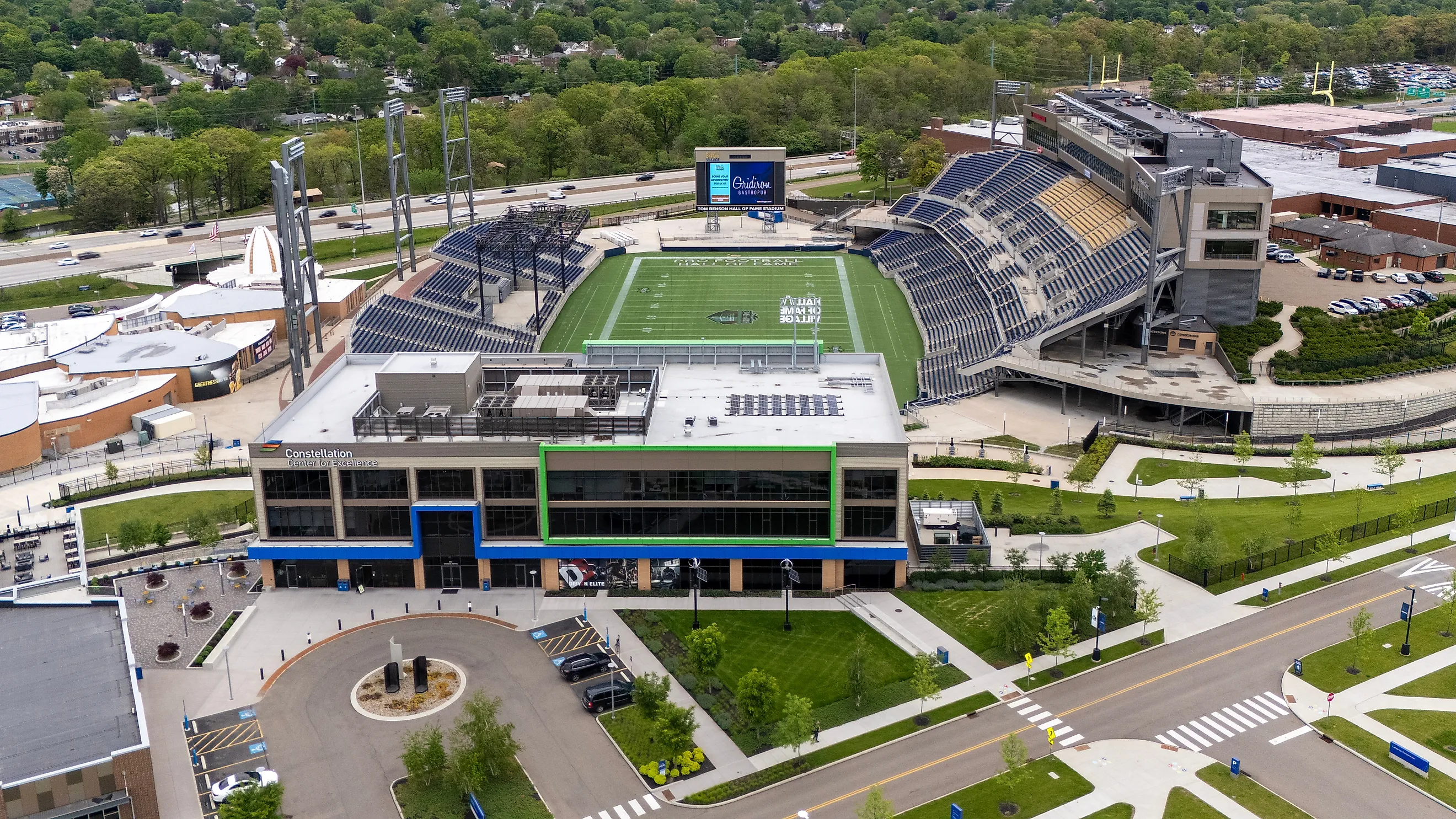
The Tom Benson Hall of Fame Stadium in Canton, Ohio, has a capacity of 22,400 and is best known as the venue for the National Football League's annual Hall of Fame Game, played the week of the Pro Football Hall of Fame's induction ceremony. The stadium has been the home field of Canton McKinley High School since 1939, when it opened as Fawcett Stadium (named after John H. Fawcett, a longtime member of the local board of education). A $139 million renovation completed in 2017 added permanent seating, premium boxes, and the new name; Tom Benson, then owner of the New Orleans Saints and Pelicans, contributed roughly $11 million toward the project. The Bulldogs won state football titles in 1981, 1997, and 1998.
4. BREC Memorial Stadium - 21,500

BREC Memorial Stadium in Baton Rouge has a capacity of about 21,500 and has been the primary venue for Louisiana High School Athletic Association football in East Baton Rouge Parish since 1956. The stadium opened in 1952 and was dedicated to local residents who served in the two World Wars and the Korean War. It is owned by BREC, the parks and recreation commission for East Baton Rouge Parish. The venue also hosted the Grantland Rice Bowl, a small-college bowl game, from 1969 to 1973, but its near-continuous use has been for prep football and other community athletics including track and field, plus the occasional concert.
5. Happy State Bank Stadium - 20,000
Happy State Bank Stadium in Canyon, Texas, holds 20,000 and is the largest stadium in the country that exists primarily as a high school venue, with no professional or major college tenant. Three Canyon Independent School District high schools share it: Canyon High School, Randall High School, and West Plains High School. The stadium opened in 1959 as the Buffalo Bowl on Canyon Hill, was renamed Kimbrough Memorial Stadium in 1971 for the late West Texas A&M football coach Frank Kimbrough, and took its current name in 2020 when Happy State Bank bought the naming rights for a reported $2 million in renovation funds. West Texas A&M (NCAA Division II) used the stadium from 1959 until 2018, when the university built its own on-campus venue.
6. Memorial Stadium, Mesquite - 19,400
Memorial Stadium in Mesquite, Texas, has a capacity of 19,400 and is shared by all five high schools in the Mesquite Independent School District. It was completed in 1976 on the campus of West Mesquite High School, and the district has used it as a centralized football venue ever since; it also serves regularly as a neutral site for Texas University Interscholastic League playoff games. The stadium underwent an $11 million renovation between November 2014 and August 2015, which added new locker rooms, expanded concourses, an updated press box, and accessibility upgrades.
7. Alamo Stadium - 18,500

Alamo Stadium in San Antonio has a capacity of 18,500 and is the centralized football and track venue for the San Antonio Independent School District. It serves eight SAISD high schools: Brackenridge, Burbank, Edison, Fox Tech, Highlands, Jefferson, Lanier, and Sam Houston. The stadium opened in 1940, was built into a former limestone quarry on the city's north side (which earned it the nickname "The Rockpile"), and underwent a $35 million restoration completed in 2014 that addressed extensive structural and accessibility issues with the original WPA-era construction.
8. Farrington Field - 18,500
Farrington Field in Fort Worth shares the number-seven capacity figure at 18,500 and opened on November 3, 1939, with Works Progress Administration funding and a local school-district contribution. It is owned by the Fort Worth Independent School District, designed in the PWA Moderne style by architect Preston M. Geren, and serves as one of three stadiums used by FWISD high schools. The stadium is named for E. S. Farrington, a longtime FWISD superintendent. Its attendance record (24,836) was set on November 23, 1944, in a North Side High School versus Paschal High School game that exceeded the listed permanent capacity. The district has been considering selling the property since 2022 for potential redevelopment.
9. Eagle Stadium - 18,000

Eagle Stadium in Allen, Texas, opened in August 2012 at a cost of approximately $60 million and is the largest single-school high school stadium in the country, used only by Allen High School. The Allen Eagles famously won 54 consecutive home games at the stadium from its opening through 2021, a streak that included future first-overall NFL Draft pick Kyler Murray's three-state-championship run from 2012 to 2014. The stadium briefly closed in 2014 for repairs to concrete cracks in the concourse area, which delayed the start of that season. It features luxury suites, a 38-foot video board, and amenities more typical of mid-major college football venues than high schools.
10. Ratliff Stadium - 17,931
Ratliff Stadium in Odessa, Texas, holds 17,931 and is shared by Odessa High School and Permian High School, the two schools in the Ector County Independent School District. It opened in 1982 for $5.6 million and is the venue most viewers recognize from the 2004 film Friday Night Lights, which was filmed there and which adapted H. G. Bissinger's 1990 book on Permian's 1988 football season. The stadium is also the home field of the University of Texas Permian Basin Falcons (NCAA Division II), which began play in 2016.
Just Outside The Top Eleven: Paul Brown Tiger Stadium
Paul Brown Tiger Stadium in Massillon, Ohio, has 16,600 permanent seats and expands to roughly 19,000 with temporary seating. It is the home field of the Massillon Washington Tigers, one of the most historically successful high school football programs in the country: the program has won nine Associated Press national championships (1935, 1936, 1939, 1940, 1950, 1952, 1953, 1959, 1961) and ended a 53-year state championship drought in 2023. The stadium is named for Paul Brown, the Massillon native who coached the Tigers in the 1930s before founding the Cleveland Browns and later the Cincinnati Bengals.
A Note On What Was Omitted
Several venues sometimes appear on "largest high school stadium" lists but were excluded here for category reasons. Toyota Stadium in Frisco, Texas, has a capacity of 20,500, but it is a Major League Soccer venue and the permanent home of FC Dallas; while Frisco Independent School District is a junior co-tenant and the stadium does host the Texas state high school football championships in a "high school configuration," the venue is fundamentally a professional soccer stadium. McKinney ISD Stadium (Texas), opened in 2018 for $70 million, draws crowds for high school games but holds only 12,000. Legacy Stadium in Katy, Texas, opened in 2017 for $72 million but holds 12,000. Neither makes the top-eleven cutoff on capacity even though both attract attention for cost-per-seat.
| Rank | Stadium | Location | Capacity | Opened |
|---|---|---|---|---|
| 1 | Tad Gormley Stadium | New Orleans, LA | 26,500 | 1937 |
| 2 | War Memorial Stadium | Wailuku, HI | 23,000 | 1969 |
| 3 | Tom Benson Hall of Fame Stadium | Canton, OH | 22,400 | 1939 (reopened 2017) |
| 4 | BREC Memorial Stadium | Baton Rouge, LA | 21,500 | 1952 |
| 5 | Happy State Bank Stadium | Canyon, TX | 20,000 | 1959 |
| 6 | Memorial Stadium | Mesquite, TX | 19,400 | 1976 |
| 7 | Alamo Stadium | San Antonio, TX | 18,500 | 1940 |
| 8 | Farrington Field | Fort Worth, TX | 18,500 | 1939 |
| 9 | Eagle Stadium | Allen, TX | 18,000 | 2012 |
| 10 | Ratliff Stadium | Odessa, TX | 17,931 | 1982 |
| 11 | San Angelo Stadium | San Angelo, TX | 17,550 | 1956 |
| 12 | Paul Brown Tiger Stadium | Massillon, OH | 16,600 | 1939 |
What This List Says
Texas dominates because of how its school districts structure stadiums: rather than each high school building its own field, many large districts (Mesquite ISD, San Antonio ISD, Fort Worth ISD, Canyon ISD) built one central facility shared by every school in the district. That model concentrates the capacity in a few large stadiums rather than spreading it across many smaller ones. Single-school stadiums like Allen's Eagle Stadium are the exception rather than the rule. The non-Texas entries (Tad Gormley, BREC Memorial, War Memorial, Tom Benson Hall of Fame, Paul Brown Tiger) were nearly all built between the late 1930s and early 1950s, mostly with federal WPA funding or its postwar successors, in cities where one or two high school football programs developed reputations large enough to justify what were, at the time, college-scale venues. The largest dedicated single-school high school stadium built in the past quarter-century is Eagle Stadium in Allen, opened 2012.