The 10 Largest Soccer Stadiums in the World
Soccer's biggest stadium holds about 114,000 fans, sits on an island in the Taedong River in Pyongyang, and was rebuilt in 2014 by an estimated 10,000 soldiers. The second largest is in Ann Arbor, Michigan, where 109,318 fans watched Real Madrid play Manchester United on August 2, 2014, the largest soccer crowd ever recorded in the United States. The 2026 FIFA World Cup, jointly hosted by the U.S., Mexico, and Canada from June 11 through July 19, 2026, opens at the eighth-largest stadium on this list. These ten venues span six continents and a century of construction. Most were built for soccer; a few were built for other sports and have hosted soccer's biggest matches anyway.
1. Rungrado 1st Of May Stadium, North Korea | Capacity: ~114,000

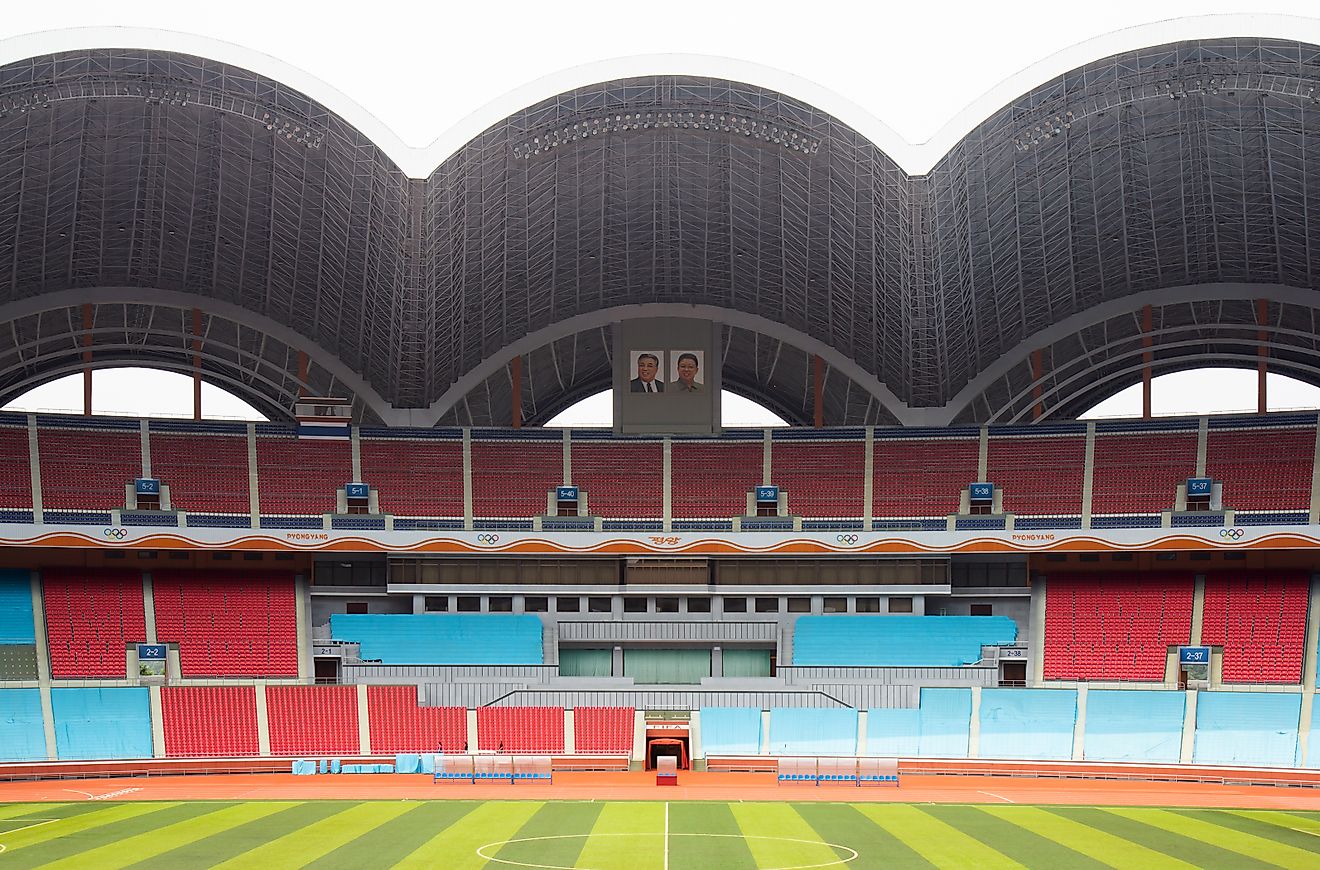
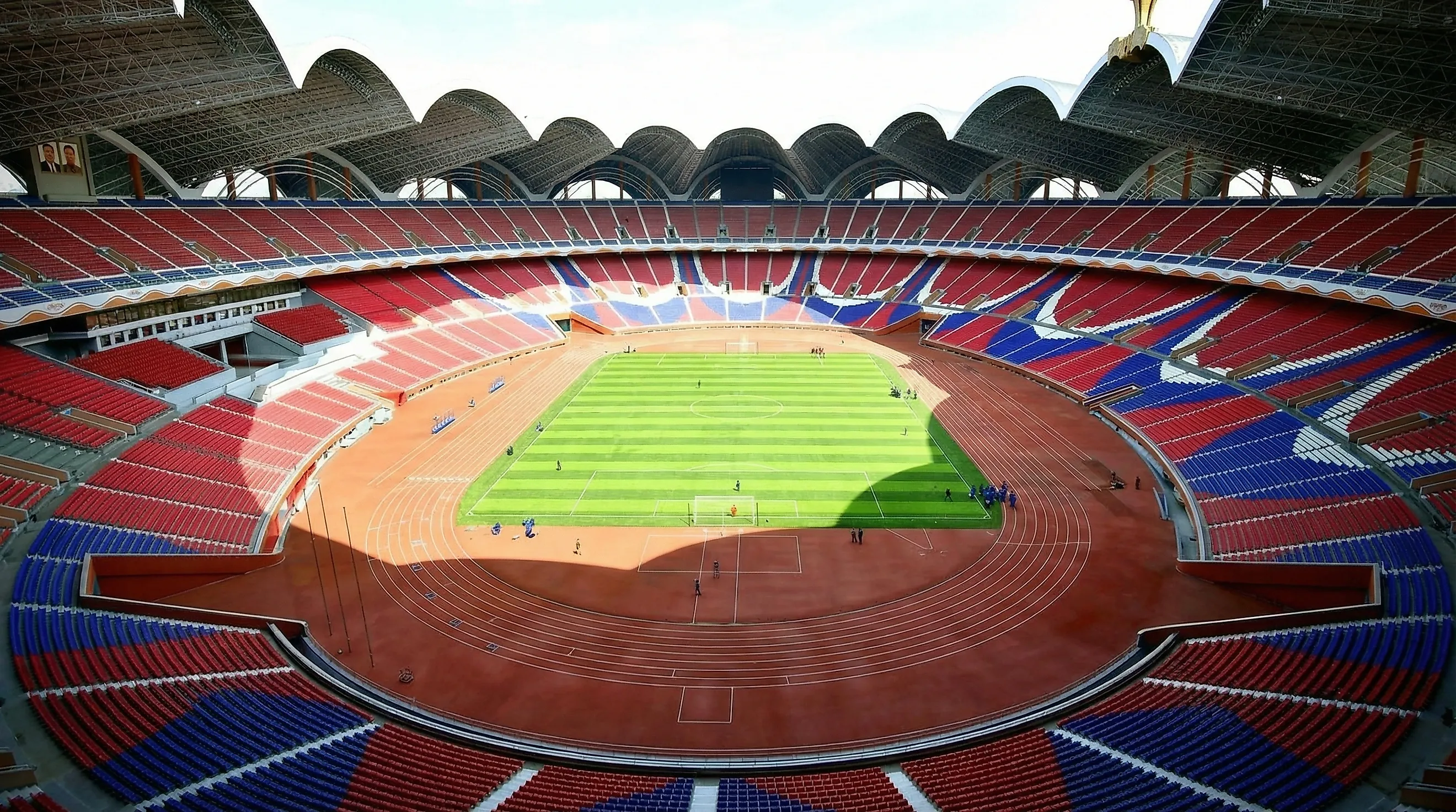
Built on Rungra Island in the Taedong River in Pyongyang, the Rungrado 1st of May Stadium opened on May 1, 1989, the international Labour Day. North Korea still officially lists the capacity at 150,000, but a 2014 renovation that replaced bench seating with individual seats cut the actual count to roughly 114,000 per independent estimates. The renovation was reportedly carried out by 10,000 soldiers and finished in time for the stadium's October 28 reopening ceremony.
The stadium covers 51 acres. Sixteen arches form a roof that resembles a magnolia or a parachute, peaking at 197 feet above the field. The main pitch alone can fit three full-size soccer fields. North Korea uses the venue mostly for the Arirang Mass Games and other state events; international soccer fixtures are rare. After the Narendra Modi Stadium in Ahmedabad, India was expanded to 132,000 in 2020 for cricket, the Rungrado fell to second-largest among all stadium types in the world, but it remains the largest soccer-capable venue.
2. Michigan Stadium, United States | Capacity: 107,601

Michigan Stadium in Ann Arbor, nicknamed "The Big House," is the largest stadium of any kind in the Western Hemisphere. Built in 1927 for the University of Michigan with original capacity of 72,000, it has been expanded several times to its current 107,601. The venue is primarily home to the Michigan Wolverines, the most-attended college football program in the country, but it has hosted some of the most important soccer events ever held on U.S. soil.
On August 2, 2014, the International Champions Cup match between Manchester United and Real Madrid drew 109,318 spectators, the largest soccer crowd in U.S. history. Michigan Stadium has also hosted other major international friendlies. Outside soccer, the 2014 NHL Winter Classic between the Toronto Maple Leafs and Detroit Red Wings drew 105,491 fans, the largest hockey crowd in NHL history. Snow fell throughout the game.
3. Spotify Camp Nou, Spain | Target Capacity: 105,000

FC Barcelona's home is in the middle of the largest stadium renovation in European soccer history. The original Camp Nou, opened in 1957, sat 99,354 fans and hosted a 120,000-person crowd during the 1982 FIFA World Cup before modern seating restrictions. Barcelona left the stadium after the May 28, 2023 home match against Mallorca to begin a €1.5 billion ($1.6 billion) demolition-and-rebuild project officially called "Espai Barça," with a target capacity of 105,000.
During construction, Barcelona played its home matches at the 1992 Estadi Olímpic Lluís Companys on Montjuïc. The club returned to a partly reopened Camp Nou on November 22, 2025, with capacity initially limited to 45,401 by Barcelona City Council licensing. As of March 2026, Phase 1C of the licence pushed available capacity to 62,652. Full completion, originally planned for 2026, has slipped to the end of 2027 with the installation of the cable-net roof. When finished, the Spotify Camp Nou will reclaim its place as the largest stadium in Europe.
4. Melbourne Cricket Ground, Australia | Capacity: 100,024

The Melbourne Cricket Ground, locally known as "the G," has been in operation in some form since 1853, predating Australian federation by 48 years. The current 100,024 capacity includes 95,000 seats and roughly 5,000 standing places. The MCG is primarily a cricket and Australian rules football venue, but it has hosted Olympic soccer matches at the 1956 Melbourne Games and Australia's national team for major fixtures, including World Cup qualifiers.
The 1956 Melbourne Olympics opening ceremony was held here. So was the 1992 Cricket World Cup final, the 2006 Commonwealth Games, and the 2015 Cricket World Cup final. Outside sport, U2, Paul McCartney, and Madonna have all played the ground. The MCG is the oldest international cricket stadium still in continuous use.
5. FNB Stadium, South Africa | Capacity: 94,736

The First National Bank Stadium in Johannesburg, more commonly called "Soccer City" or "The Calabash" (for its resemblance to an African gourd), originally opened in 1989 with capacity of 80,000. The 2009 expansion ahead of the 2010 FIFA World Cup pushed it to its current 94,736. Spain beat the Netherlands 1-0 in the World Cup final here on July 11, 2010, with Andrés Iniesta scoring in the 116th minute.
The stadium has hosted moments larger than soccer. Nelson Mandela gave his first public speech after release from prison here on February 13, 1990, and his memorial service was held in the same venue on December 10, 2013. South Africa's national team and Premier Soccer League club Kaizer Chiefs play home matches at FNB.
6. Rose Bowl, United States | Capacity: 92,542

The Rose Bowl in Pasadena, California, opened in 1922 and is best known as the postseason home of college football's Rose Bowl Game. The current 92,542 capacity makes it the second-largest stadium in the U.S. behind Michigan. The venue's place in American soccer history is unmatched: it hosted the men's 1994 FIFA World Cup final on July 17, 1994 (Brazil over Italy on penalties after a 0-0 draw), the 1984 Olympic soccer gold medal match, and the 1999 FIFA Women's World Cup final on July 10, 1999, where the United States beat China on penalties and Brandi Chastain's celebration produced the most-reproduced sports photograph of the decade.
The Rose Bowl was also the home stadium of the LA Galaxy from 1996 to 2002, before the club moved to its current Carson venue. UCLA Bruins football is the primary current tenant.
7. Wembley Stadium, England | Capacity: 90,000

Wembley Stadium in London opened in 1923 and was rebuilt between 2002 and 2007 at a cost of £798 million (about $1.5 billion). The 90,000 capacity makes it the largest stadium in the United Kingdom. The defining feature is the Wembley Arch, a 436-foot steel structure that supports more than 60% of the roof's weight and is the world's longest unsupported roof structure. The arch is visible across most of London on clear days.
Wembley is England's national stadium and hosts the men's and women's national soccer teams, the FA Cup final every May, the EFL Cup final, and English Premier League playoff matches. It also hosted the 2012 Olympic men's soccer gold medal match, the 2013 and 2024 UEFA Champions League finals, and Euro 2020's final on July 11, 2021 (Italy over England on penalties).
8. Estadio Azteca, Mexico | Capacity: 87,523 (90,000 after 2026 renovation)

The Estadio Azteca in Mexico City, opened in 1966, is being modernized for the 2026 FIFA World Cup at a reported cost of about $113 million. In March 2025, the stadium was renamed Estadio Banorte under a sponsorship deal with the Mexican bank. FIFA naming rules will require the venue to be called "Estadio Ciudad de México" or "Mexico City Stadium" during the 2026 World Cup. The renovation will push capacity to approximately 90,000.
On June 11, 2026, the stadium will host the 2026 World Cup opening match between Mexico and South Africa, becoming the first stadium in history to host games at three FIFA World Cups (1970, 1986, and 2026). The 1970 final saw Brazil beat Italy 4-1 with the Pelé-led squad still regarded as one of the greatest teams in soccer history. The 1986 final saw Argentina beat West Germany 3-2. Diego Maradona's "Hand of God" goal and "Goal of the Century" against England were both scored here on June 22, 1986. The stadium is the home of Liga MX clubs Club América and Cruz Azul, and Mexico's national team.
9. Bukit Jalil National Stadium, Malaysia | Capacity: 87,411

Bukit Jalil National Stadium opened in Kuala Lumpur in 1998 as the centerpiece of the Malaysia National Sports Complex, built ahead of the 1998 Commonwealth Games. It is the largest stadium in Southeast Asia and home to the Malaysia national soccer team. The venue regularly fills for AFF Championship matches and other regional competitions.
Outside soccer, Bukit Jalil is one of the largest concert venues in the region. Ed Sheeran, Taylor Swift, Coldplay, and BTS have all played sold-out stadium shows here. The stadium also hosted the 2003 FA Premier League Asia Cup featuring Newcastle United and other English Premier League clubs.
10. Borg El Arab Stadium, Egypt | Capacity: 86,000

Borg El Arab Stadium sits in the port city of Alexandria, Egypt, and was completed in 2007 by the Egyptian Armed Forces Engineering Authority. It is also known as El-Geish Stadium. The 86,000-seat venue is the largest in Egypt and the second-largest in Africa after FNB Stadium.
The infrastructure built to support the stadium is notable in itself. Parking accommodates 5,000 cars and 200 buses. There are 136 electronic entrances designed to clear the stands quickly after major events. The stadium has been used by Egypt's national team during World Cup qualifying campaigns and serves as a frequent neutral venue for Egyptian Premier League matches and the Egypt Cup final.
What Ties These Ten Together
The ten stadiums on this list share a job description and not much else. The Rungrado was built by an army for state ceremonies and seats 114,000. Michigan Stadium was built for college football and holds the US soccer attendance record. The Melbourne Cricket Ground has been operating since 1853. Camp Nou is being torn down and rebuilt while FC Barcelona plays elsewhere. The Estadio Azteca will host its third FIFA World Cup opening match in 2026 under a third different name. The other nine will be watching the 2026 World Cup from a distance, while three of them (the Rose Bowl, Michigan, and MetLife Stadium in New Jersey) sit inside the host country for the tournament's final on July 19, 2026.
Full Top 25 By Capacity
The full top 25 largest soccer-capable stadiums in the world by current or post-renovation capacity. Five are in the United States, two of them (MetLife and AT&T) confirmed as 2026 FIFA World Cup venues. Lusail Stadium in Qatar, which hosted the 2022 World Cup final between Argentina and France, will eventually have its capacity reduced to 40,000 in a planned conversion to a community sports complex.
| Rank | Stadium | Country | Capacity |
|---|---|---|---|
| 1 | Rungrado 1st of May Stadium | North Korea | 114,000 |
| 2 | Michigan Stadium | United States | 107,601 |
| 3 | Spotify Camp Nou | Spain | 105,000 |
| 4 | Melbourne Cricket Ground | Australia | 100,024 |
| 5 | FNB Stadium | South Africa | 94,736 |
| 6 | Rose Bowl | United States | 92,542 |
| 7 | Wembley Stadium | England | 90,000 |
| 8 | Estadio Azteca | Mexico | 90,000 |
| 9 | Lusail Stadium | Qatar | 88,966 |
| 10 | Bukit Jalil National Stadium | Malaysia | 87,411 |
| 11 | Borg El Arab Stadium | Egypt | 86,000 |
| 12 | Salt Lake Stadium (Vivekananda Yuba Bharati Krirangan) | India | 85,000 |
| 13 | Estadio Más Monumental | Argentina | 84,567 |
| 14 | MetLife Stadium | United States | 82,500 |
| 15 | Croke Park | Ireland | 82,300 |
| 16 | Signal Iduna Park (Westfalenstadion) | Germany | 81,365 |
| 17 | Stade de France | France | 81,338 |
| 18 | Santiago Bernabéu | Spain | 81,044 |
| 19 | Luzhniki Stadium | Russia | 81,000 |
| 20 | Estadio Monumental U | Peru | 80,093 |
| 21 | San Siro (Giuseppe Meazza) | Italy | 80,018 |
| 22 | Stade des Martyrs | DR Congo | 80,000 |
| 23 | AT&T Stadium | United States | 80,000 |
| 24 | Maracanã Stadium | Brazil | 78,838 |
| 25 | Azadi Stadium | Iran | 78,116 |