Holy Sites of Christianity
Christianity is the world's largest religion, with about 2.3 billion adherents, close to a third of everyone alive, according to the Pew Research Center. It centers on the life and teachings of Jesus of Nazareth, and the places where that life is said to have unfolded, almost all of them within a small stretch of the modern Middle East, remain among the most visited pilgrimage destinations on Earth. The sites below trace the Gospel narrative across the Holy Land, including the town of Jesus's birth and the city of his death, and each still draws pilgrims who come to pray, study, and walk where the events they have read about are believed to have happened.
Jerusalem
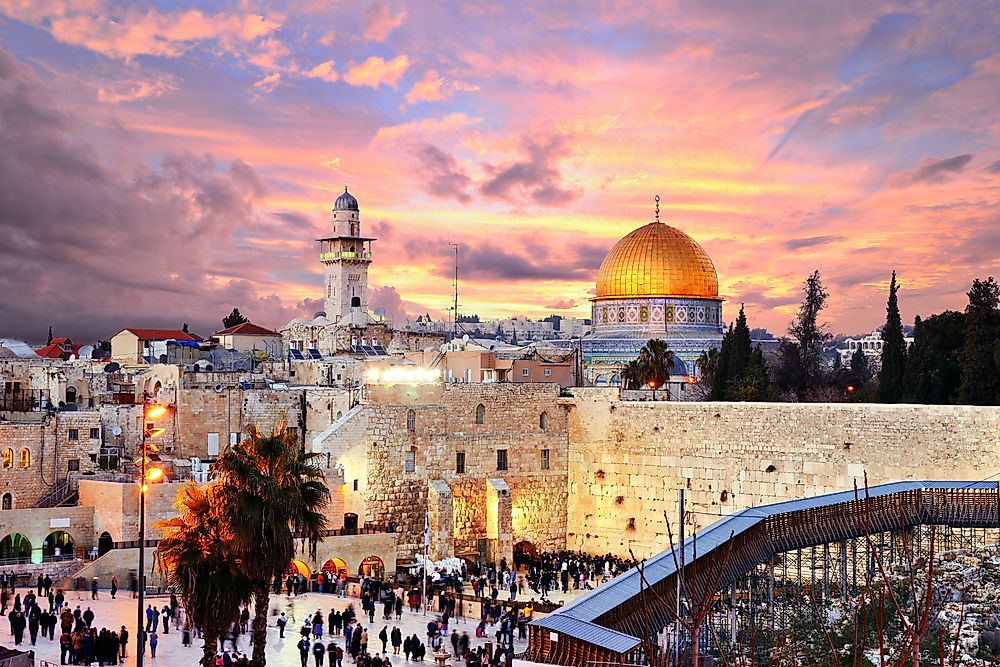
Jerusalem, one of the oldest continuously inhabited cities in the world, is sacred to Judaism, Christianity, and Islam alike. For Christians, its holiest place is the Church of the Holy Sepulchre, raised over the ground traditionally identified as both Calvary, also called Golgotha, the hill where the Gospels say Jesus was crucified, and the tomb where he was buried and, Christians believe, rose again. When Jesus was condemned, that hill lay just outside the city walls, though centuries of expansion have since enclosed it within the Old City. On the slopes of the nearby Mount of Olives, the Garden of Gethsemane still holds olive trees of great age, marking the spot where, according to the Gospels, Jesus prayed on the night he was betrayed by his disciple Judas and arrested. On Mount Zion stands the Cenacle, the upper room venerated as the setting of the Last Supper. Together these places anchor the final days of the Gospel account, and they remain the focus of Christian pilgrimage to the city.
Bethlehem

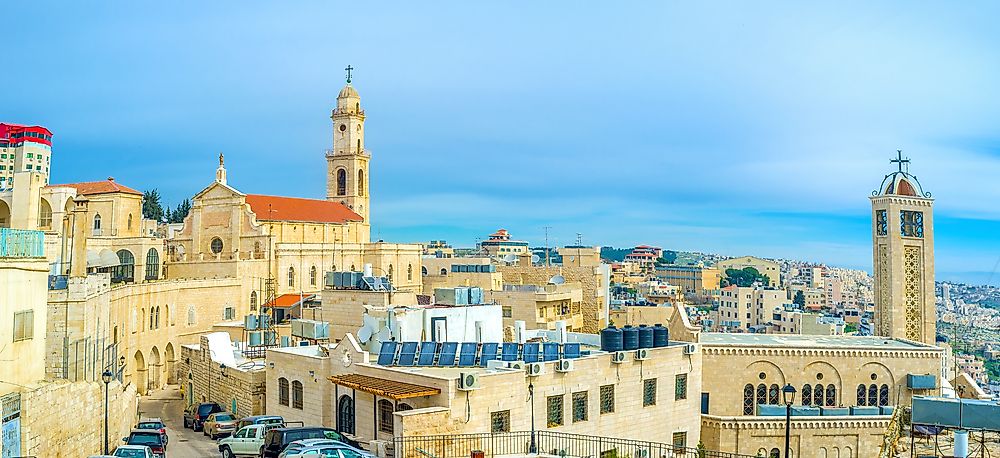
About six miles south of Jerusalem, Bethlehem is revered as the birthplace of Jesus. The Gospel of Luke recounts that a Roman census required Joseph and Mary to travel to Joseph's ancestral town, where Mary gave birth and laid the child in a manger. The Church of the Nativity, a cross-shaped basilica first built in the fourth century and rebuilt in the sixth under the emperor Justinian, stands over the grotto honored as that birthplace, and it ranks among the oldest churches still in continuous use anywhere in the world. A short walk away is the Milk Grotto, a chalk-white cave where, by tradition, the Holy Family sheltered during their flight from King Herod's order to kill the infants of Bethlehem. Pilgrims have long associated its pale stone with blessings of fertility, and many carry away a little of the powder. The old city's Star Street, by local tradition, follows the route the family took into town, and it remains part of the Christmas pilgrimage each year.
Sepphoris

Sepphoris, a Roman city set on a hilltop about four miles northwest of Nazareth, is never named in the New Testament, yet it sits close to the heart of the Gospel story. Herod Antipas made it the capital of Galilee and rebuilt it on a grand scale in the years around Jesus's childhood, and because Joseph worked as a builder in nearby Nazareth, many scholars suspect that he, and perhaps Jesus, found work on its construction. Christian tradition also holds that Mary's parents, Joachim and Anne, lived here. Today the ruins include a fifth-century synagogue paved with mosaics that depict the binding of Isaac and the angels' visit to Abraham and Sarah, alongside the celebrated portrait mosaic known as the "Mona Lisa of the Galilee." Standing on the region's Roman trade routes, Sepphoris gives pilgrims a detailed picture of the prosperous world in which Jesus grew up, even though the city itself goes unmentioned in scripture.
Sea of Galilee

The Sea of Galilee, the freshwater lake that modern Israelis call the Kinneret, was the setting for much of Jesus's ministry. Its shores drew fishermen and traders along the ancient Via Maris route, and the Gospels place Jesus's base at the lakeside town of Capernaum. Several sites around the water mark events from his ministry. At Tabgha, on the northwestern shore, the Church of the Multiplication commemorates the feeding of five thousand people with five loaves and two fish, while the adjoining Church of the Primacy of St. Peter marks where, by tradition, the risen Jesus appeared to his disciples. The octagonal Church of the Beatitudes crowns the hillside where the Sermon on the Mount is said to have been delivered. A short distance away at Cana, identified with the Arab town of Kafr Kanna, the Gospel of John places Jesus's first miracle, the turning of water into wine at a wedding feast. The Jordan River, where John the Baptist baptized Jesus, flows out of the lake toward the Dead Sea.
Nazareth

Nazareth, in the hills of northern Israel, is remembered as the town where Jesus grew up, and the modern city is layered over the village of his day. Its centerpiece is the Basilica of the Annunciation, one of the largest churches in the Middle East, built above the site venerated as the home of Mary, where the Gospel of Luke says the angel Gabriel announced that she would bear Jesus. The nearby Synagogue Church marks the traditional spot where Jesus taught and, according to Luke, was driven out by an angry crowd who led him to a clifftop now called Mount Precipice. The summit looks out over the Jezreel Valley toward Mount Tabor. The Church of St. Joseph stands on ground long honored as the location of Joseph's carpentry workshop. For pilgrims, Nazareth is where the Gospel story begins, in the ordinary setting of a working family's home.
Walking the Gospel Story
For all the centuries that separate a modern visitor from the events the Gospels describe, these sites share a single appeal: they let pilgrims stand in the physical landscape of the story they have read. Most lie within a short distance of one another across present-day Israel and the West Bank, and many are marked by churches built, destroyed, and rebuilt across more than fifteen hundred years. Not every location can be fixed with archaeological certainty. The Church of the Holy Sepulchre and the Garden Tomb, for example, both claim the place of the burial. What the sites offer is less a matter of proof than of continuity, a chain of devotion reaching back to the earliest Christian pilgrims, who came, as travelers still do, to walk where the story is said to have happened.