The Longest Bridges in Europe
Europe's longest bridges span half a century of construction and several engineering categories. The Crimean Bridge across the Kerch Strait took the top spot in 2018 at roughly 19 km of combined road and rail crossing. Before that Portugal's Vasco da Gama Bridge held the title for twenty years after opening for Expo '98 in Lisbon. Older entries reach back to Sweden's Öland Bridge of 1972 while the newest is Germany's Saale-Elster Bridge from 2015. The list runs through cable-stayed estuary crossings and suspension bridges as well as long railway bridges. Russia and Portugal each have two entries on the list ahead, with Denmark, Germany, and Sweden filling the rest.
1. Crimean Bridge (Russia) - 19 km

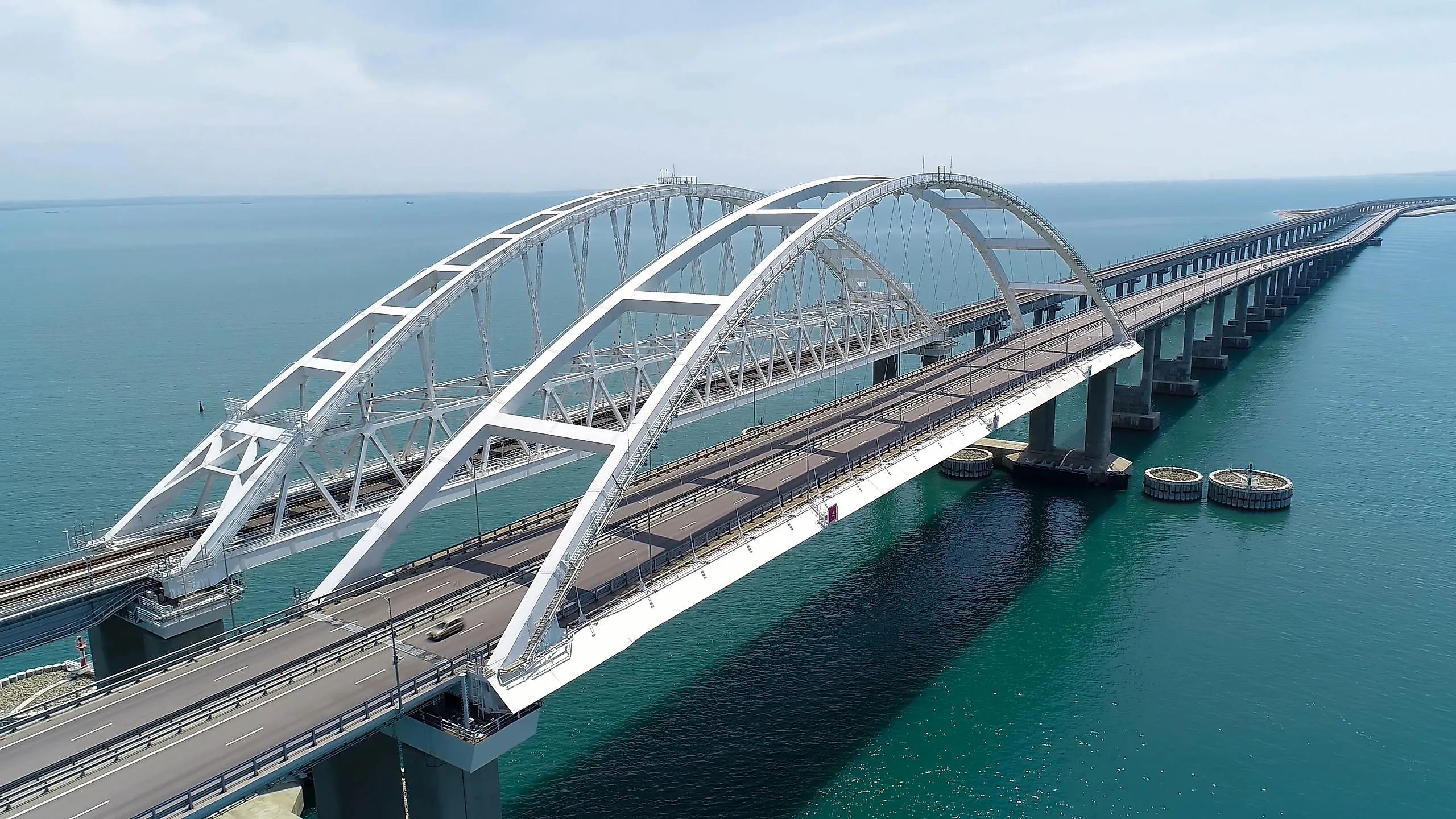
The Crimean Bridge is the longest bridge in Europe. It comprises a 16.9 km (10.5 mi) road bridge and a parallel 18.1 km (11.25 mi) railway bridge that together carry four road lanes and two rail tracks across the Kerch Strait between the Taman Peninsula in Russia's Krasnodar region and Kerch on the Crimean Peninsula. The longest span is 227 m (745 ft) over the Kerch-Yenikale navigation channel, with a clearance of 35 m for vessel passage. Construction began in February 2016 under contractor Stroygazmontazh and the Saint Petersburg-based Giprostroymost design institute. President Vladimir Putin inaugurated the road bridge on May 15, 2018, and the rail bridge opened on December 23, 2019, at a total cost of approximately 228 billion rubles (about $3 billion).
The bridge is the only direct land link between mainland Russia and Crimea, which Russia annexed from Ukraine in 2014, and has been a strategic target since the start of the full-scale Russia-Ukraine war in 2022. A truck bomb on October 8, 2022 destroyed several spans of the road bridge and ignited fuel tanks on an adjacent freight train, killing four people. Russia restored the road bridge in February 2023, well ahead of the July 2023 deadline, and reopened the second rail track in May 2023. Subsequent attacks include a July 2023 marine drone strike and a June 3, 2025 underwater explosives operation by Ukraine's SBU using 1,100 kg of TNT-equivalent charges, each followed by temporary closures and repairs.
2. Vasco da Gama Bridge (Portugal) - 17.2 km

The Vasco da Gama Bridge crosses the Tagus River estuary northeast of Lisbon and was the longest bridge in Europe from its opening on March 29, 1998 until the Crimean Bridge surpassed it twenty years later. The total length of 17.2 km (10.7 mi) includes 12.3 km of bridge over the water plus approach viaducts on both banks. The cable-stayed main span, where steel cables connect the deck directly to tall pylons rather than draping in catenary curves between supports, measures 420 m between two 148 m pylons. The bridge carries six road lanes with a 120 km/h speed limit. Designed by Michel Virlogeux, Alain Montois, Charles Lavigne, and Armando Rito, it was built in 36 months by a consortium led by VINCI and Mota-Engil at a cost of about €890 million.
Construction was timed for Expo '98, the World's Fair commemorating the 500th anniversary of Vasco da Gama's 1498 sea voyage to India. The bridge was built primarily to relieve the 25 de Abril suspension bridge, which by the mid-1990s could not handle the volume of north-south traffic through Lisbon. Design specifications required resistance to winds of 250 km/h and an earthquake 4.5 times the magnitude of the 1755 Lisbon earthquake. Toll concession is held by Lusoponte through 2030.
3. Lezíria Bridge (Portugal) - 11.67 km

The Lezíria Bridge, officially Ponte da Lezíria, runs 11.67 km (7.25 mi) between Carregado and Benavente, northeast of Lisbon, and crosses both the Tagus and the smaller Sorraia rivers along the A-10 motorway. Construction took 23 months using the balanced cantilever method, where the deck is built outward in segments from each pier so that the cantilevered arms meet at midspan. The bridge opened on July 9, 2007 at a total cost of €220 million. The structure is a box-girder design with a 972 m central main bridge over the river itself, flanked by long northern and southern viaducts. The longest individual span is 133 m.
The bridge carries six lanes of motorway traffic with a 120 km/h speed limit and is operated by Brisa under an electronic toll system. Foundation work used approximately 400,000 cubic meters of concrete and 45,000 tons of steel.
4. Öresund Bridge (Denmark/Sweden) - 7.845 km

The Öresund Bridge, designed by Danish architect Georg Rotne and opened on July 1, 2000, carries four road lanes and two rail tracks 7.845 km (4.87 mi) between the artificial island of Peberholm off the Danish coast and Lernacken near Malmö, Sweden. The cable-stayed main span over the Flintrännan navigation channel is 490 m between two 204 m pylons, with a clearance below of 57 m for shipping. Beyond Peberholm, the link continues to Copenhagen via the 4 km Drogden Tunnel, giving the full Øresund Fixed Link a total length of about 16 km.
The crossing is operated jointly by the Danish and Swedish governments through Øresundsbro Konsortiet, and it carries both road traffic and direct rail service between Copenhagen and Malmö. The Danish-Swedish border runs across the bridge, and identification checks at the Swedish end have been routine since border controls were reintroduced in 2015.
5. Great Belt East Bridge (Denmark) - 6.79 km

The Great Belt East Bridge (Storebæltsbroen Østbro) is a suspension bridge carrying four road lanes 6.79 km (4.21 mi) between the islands of Zealand and Sprogø in central Denmark. It opened on June 14, 1998 as the final road element of the Great Belt Fixed Link, which also includes the 6.6 km West Bridge for road and rail and an 8 km undersea rail tunnel. The bridge's main suspension span of 1,624 m was the second-longest in the world from 1998 until the 2022 opening of Turkey's 1915 Çanakkale Bridge (2,023 m). As of 2026 it ranks third, behind 1915 Çanakkale and Japan's Akashi-Kaikyō (1,991 m). Its two 254 m pylons are the highest fixed structures in Denmark.
The bridge has a navigation clearance of 65 m above mean sea level. Daily traffic averages around 27,000 vehicles, rising to 40,000 in peak summer periods. Tolls are collected at the Sprogø end of the link rather than on the bridge itself.
6. Great Belt West Bridge (Denmark) - 6.61 km

The Great Belt West Bridge (Storebæltsbroen Vestbro) is the third-longest bridge in Denmark at 6.611 km (4.1 mi), carrying road and rail traffic between Sprogø and Funen. It is a beam bridge of prestressed concrete, meaning the concrete deck is reinforced with internal steel tendons under tension to handle bending loads. The deck rests on 62 piers across 63 spans, with 51 spans of 110 m and 12 spans of 82 m, and the deck is 25 m wide. Construction ran from 1988 to 1994. The rail line opened in 1997 and road traffic followed in 1998 with the completion of the East Bridge.
Both the superstructure and substructure were prefabricated as concrete elements at a dedicated yard at Lindholm on Funen and floated to the bridge by a purpose-built heavy-lift crane named Svanen, meaning "the Swan." The small island of Sprogø between the East and West bridges, with its 19th-century lighthouse, hosts occasional guided walking tours of the link.
7. Saale-Elster Viaduct (Germany) - 6.465 km

The Saale-Elster Viaduct (Saale-Elster-Talbrücke) is the longest railway bridge in Germany at 6.465 km (4 mi), carrying ICE high-speed trains across the floodplain of the Saale and Weiße Elster rivers south of Halle in Saxony-Anhalt. The structure is part of the Erfurt-Leipzig/Halle high-speed line that opened in 2015 as the central link of the Berlin-Munich high-speed rail corridor. It consists primarily of prestressed concrete spans of 44 m, with a 110 m network-tied arch span at the confluence of the two rivers, where the arch carries the deck with inclined steel hangers crossing each other in a mesh pattern. The arch section was the first of its type on the German rail network.
Construction ran from 2006 to 2013. The line was designed for a 300 km/h running speed and was routed to avoid disturbing nature reserves, bird sanctuaries, and the Halle-Beesen waterworks protection zone along the Saale floodplain. A 2.112 km branch connects the main viaduct to the parallel Halle-Bebra route, bringing the total bridge structure length to over 8.6 km.
8. Öland Bridge (Sweden) - 6.072 km

The Öland Bridge (Ölandsbron) opened on September 30, 1972, providing the first permanent link between Sweden's mainland city of Kalmar and the island of Öland in the Baltic Sea. At 6.072 km (3.77 mi), it was the longest bridge in Europe for the next 26 years until the Vasco da Gama Bridge surpassed it in 1998, and it remains the longest bridge located entirely within Sweden, since the longer Öresund Bridge crosses the Danish border.
The bridge has 155 spans of reinforced concrete plus six central spans of 130 m each across the deeper section of Kalmar Sound. The deck is 13 m wide, vertical clearance above the navigation channel is 36 m, and the highest point of the deck reaches 41.7 m above sea level. The bridge carries Sweden's national road 137 connecting the mainland E22 to Öland's road 136, and is toll-free. The bridge celebrated its 50th anniversary in September 2022.
9. President Bridge (Russia) - 5.825 km

The President Bridge crosses the Volga at Ulyanovsk, connecting the city center on the right bank with the eastern districts on the left bank. At 5.825 km (3.62 mi) it is the second-longest bridge in Russia after the Crimean Bridge. The truss bridge has 25 spans, the longest measuring 221 m, and carries four road lanes plus pedestrian walkways. Combined with its approach highway, the total structure runs nearly 13 km.
The bridge was originally designed in 1980 to replace the aging Imperial Bridge of 1916, though construction did not begin until February 1986 and was repeatedly suspended through the dissolution of the Soviet Union and the economic disruptions that followed. Work continued in fits and starts for 23 years before the bridge finally opened on November 24, 2009 in a ceremony attended by President Dmitry Medvedev and Azerbaijani President Ilham Aliyev. Total cost was approximately 38 billion rubles. Daily traffic now exceeds 40,000 vehicles.
Special Case: Emsland Transrapid Test Facility (Germany) - 31.5 km

Some lists of Europe's longest bridges include the Emsland Transrapid Test Facility, an elevated 31.5 km maglev guideway running between Dörpen and Lathen in Lower Saxony with turning loops at each end. At more than 12 km longer than the Crimean Bridge, it would top a strict length ranking. Most authoritative lists exclude it because the structure was a single-purpose test track rather than a transportation bridge, and it has carried no traffic since 2011. The concrete guideway nonetheless remains physically intact as one continuous engineered structure.
Construction began in 1980, the line entered operation in 1984 as the proving ground for the Transrapid magnetic-levitation system developed jointly by Siemens and ThyssenKrupp, and by the late 1980s the facility was carrying paying passenger excursions with trains routinely reaching 420 km/h. The facility's speed record of 450 km/h was set on June 10, 1993 by the Transrapid 07.
A fatal accident on September 22, 2006 ended scheduled operations. The Transrapid 08 struck a 60-ton diesel maintenance vehicle at 162 km/h after the dispatcher failed to clear the maintenance team from the track. Twenty-three people died and ten were seriously injured. The operating license expired in 2011 and demolition was approved in 2012, but the guideway remains standing as of 2026, with periodic proposals to repurpose the site for hyperloop research or for testing Chinese CRRC maglev systems. A 2025 announcement set 2034 as the new dismantling target.
How Europe's Longest Bridges Compare
The ranking reflects three different categories of crossing rather than a single class of structure. The first two entries, the Crimean and Vasco da Gama, are long combined road-and-rail bridges spanning wide salt-water straits and estuaries, dominated by their approach viaducts more than by their cable-stayed main spans. The next group, the Lezíria, Öresund, and both Great Belt bridges, are mixed-mode road and rail crossings of major sounds or river estuaries. The Saale-Elster Viaduct is the longest of the inland railway viaducts, and the Öland and President bridges are highway crossings of large bodies of inland or sheltered water. The Emsland Transrapid Test Facility is a special case at 31.5 km, an elevated maglev guideway still listed by length on some sources because the concrete structure remains intact even though it has carried no traffic since 2011. Length alone is an imperfect ranking metric when the structures span such different functions, regions, and engineering eras.