The Largest Government Buildings In The United States
The average American home covers around 2,400 square feet. The Pentagon covers about 6.5 million, roughly the footprint of 2,700 of those homes stacked into one building, and it clears the next-largest federal building by more than 2.6 million square feet. Scale like that is the price of running a government that employs nearly three million civilian workers spread across thousands of facilities. A handful of those buildings are large enough to function as small cities in their own right. Here is a closer look at the biggest government buildings in the United States, ranked by gross floor area.
The Pentagon (Appx. 6.5 million square feet)

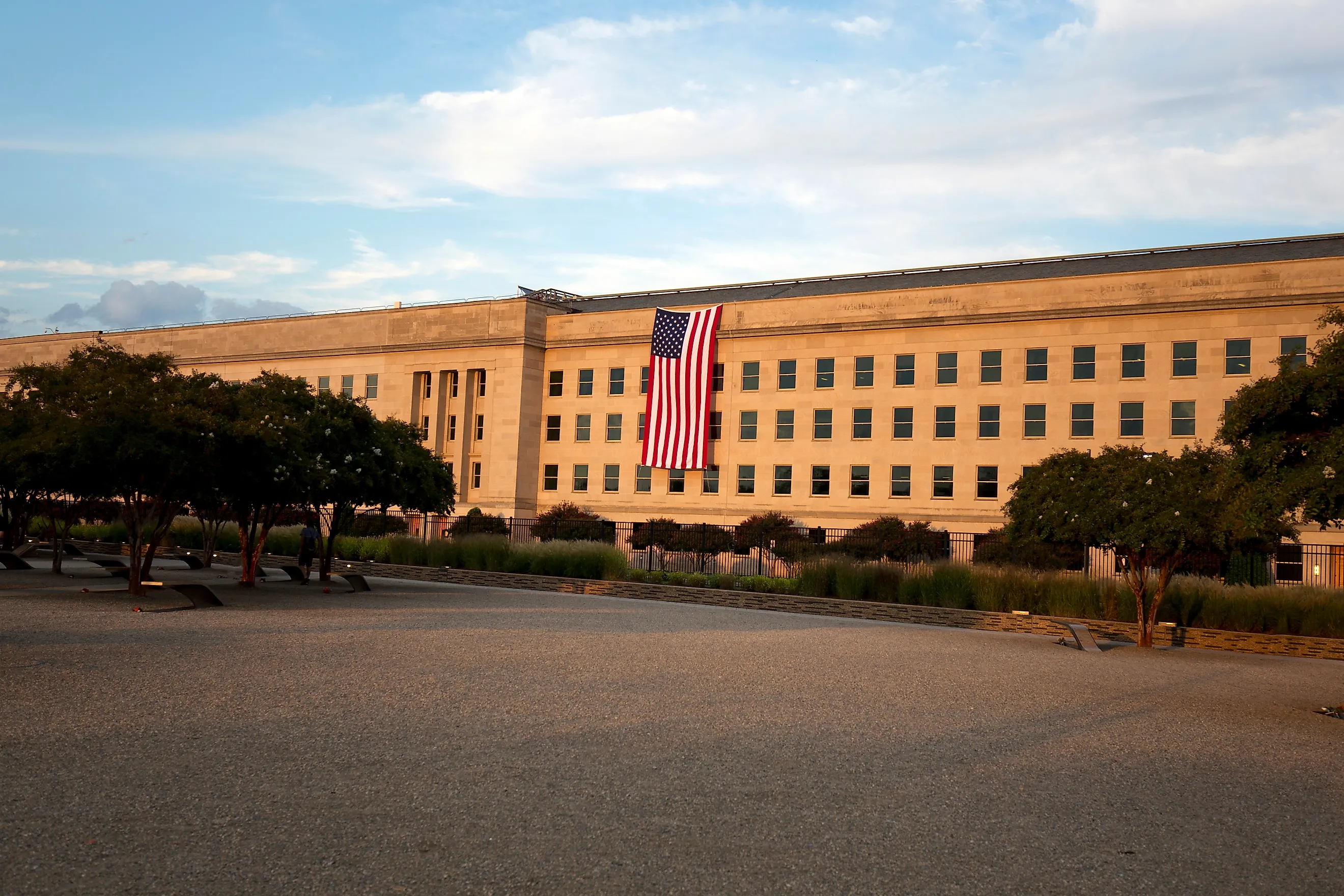
At about 6.5 million square feet, the Pentagon in Arlington, Virginia, is the clear No. 1. Department of Defense records give the building a gross floor area of 6.5 million square feet, and the department calls it the world's largest low-rise office building. Construction began on September 11, 1941, and finished on January 15, 1943, just 16 months later. Until 2006, a hot dog stand stood in the middle of the central courtyard, and Cold War lore held that Soviet planners, watching officers gather there daily, mistook it for a secret bunker entrance and kept missiles trained on the spot.
Five concentric rings connect through spoke-like corridors, adding up to 17.5 miles of passageways. Despite that scale, the Department of Defense says the longest walk between any two points takes about seven minutes. Reinforced concrete conserved steel during wartime construction. The Pentagon is still the headquarters of the Department of Defense. A 17-year renovation wrapped up in 2011 and included the section damaged in the September 11, 2001, attack.
Ronald Reagan Building and International Trade Center (Appx. 3.1 million square feet)

At about 3.1 million square feet, the Ronald Reagan Building and International Trade Center in Washington, DC, ranks second. The GSA describes the complex as a 10-story mixed-use office building, with five office towers linked by an atrium and public concourse, plus a public parking garage counted in its reported area. Construction filled the last open site in the Federal Triangle, and the building was dedicated in 1998.
The mix of government offices and publicly accessible space sets it apart from more restricted federal facilities. Current tenants include Customs and Border Protection, the Environmental Protection Agency, and the GSA. That role is now changing. In July 2025, the GSA and the FBI announced that the Reagan Building had been selected as the FBI's new headquarters, with renovations for the move planned through fiscal year 2030.
J. Edgar Hoover Building (Appx. 2.8 million square feet)

At approximately 2.8 million gross square feet, the J. Edgar Hoover Building in Washington, DC, ranks third, though official sources disagree. A GSA historic review gives the area as 2,800,876 gross square feet, while a 2011 Government Accountability Office report used the lower figure of about 2.4 million usable square feet. This ranking uses the GSA's fuller gross-area figure. The building is instantly recognizable, having turned up in countless establishing shots for FBI-themed movies and TV shows such as The X-Files.
The Brutalist concrete building has held the FBI since its completion in 1974. The Pennsylvania Avenue side rises seven stories, while the E Street side reaches 11, wrapped around an interior courtyard. After more than 50 years of service, it remains the FBI's headquarters in 2026, though the GSA's current plan calls for the bureau to relocate to the Reagan Building once renovations are done.
Harry S. Truman Federal Building (Appx. 2.6 million square feet)

Fourth on the list is the Harry S. Truman Building, a roughly 2.6-million-square-foot structure in Washington, DC, that serves as the headquarters of the Department of State. Its origins are unusual. The oldest portion was designed for the War Department and completed in 1941, but the military had already outgrown the planned facility and shifted its headquarters to the newly built Pentagon instead.
The State Department has occupied the building for over 80 years, through an extension authorized in 1955 and completed in 1961 that added more than a million square feet. That addition set much of the building's present size and scale, blending its International-style design with the more traditional limestone of the original. The building was renamed for President Truman in 2000.
Rayburn House Office Building (Appx. 2.4 million square feet)

At about 2.4 million square feet, the Rayburn House Office Building in Washington, DC, takes fifth place under the individual-building criteria used here. The Architect of the Capitol calls it the largest of the three House office buildings. Construction was authorized in 1955, and representatives and committees began moving in during early 1965, with the building fully occupied by that April.
Named for former House Speaker Sam Rayburn, the design paired a mid-century office plan with a marble exterior meant to relate to the older buildings on Capitol Hill. One of its more distinctive features is an underground subway connection to the Capitol. The tunnel opened to pedestrians in February 1965, followed by electric subway service that April. Rayburn is still a working center of House activity, with congressional offices and committee rooms filling much of the space.
Scale Built to Match the Job
For anyone used to a home measured in the low thousands of square feet, the reach of these buildings is hard to picture. Each one exists because the work inside demands it, whether that means directing the armed forces, housing the diplomats who manage foreign policy, or seating the representatives who write federal law. They differ sharply in design and purpose, but they share the same basic cause: a government large enough to need floor space measured by the million.