The American Towns With A Nuclear Plant Inside Town Limits
Commercial nuclear plants are almost always built on large, thinly populated tracts of land, but a number of American towns are directly identified with a working reactor. In some cases the plant sits squarely within the municipal limits; in others it stands just beyond the edge of a small town that lends the facility its name and its identity. Either way, these communities live in close company with some of the most powerful machines in the country, and the plant is typically the area's single largest taxpayer and employer. Here are several American towns tied to a currently operating nuclear power plant, from the borough that launched the industry to the site of the newest reactors in the nation.
Shippingport, Pennsylvania

Shippingport is a small borough on the Ohio River in Beaver County, Pennsylvania, with a 2020 population of just 160. It holds a foundational place in American energy history: in 1957, the Shippingport Atomic Power Station became the first full-scale commercial nuclear plant in the United States built solely to generate electricity for the public grid. That original reactor operated until 1982 and was fully decommissioned by 1989. The borough remains an active nuclear site today, home to the Beaver Valley Nuclear Power Station, whose two Westinghouse pressurized water reactors entered commercial operation in 1976 and 1987 and continue to run on the Ohio River, generating roughly 1,800 megawatts.
Waynesboro, Georgia

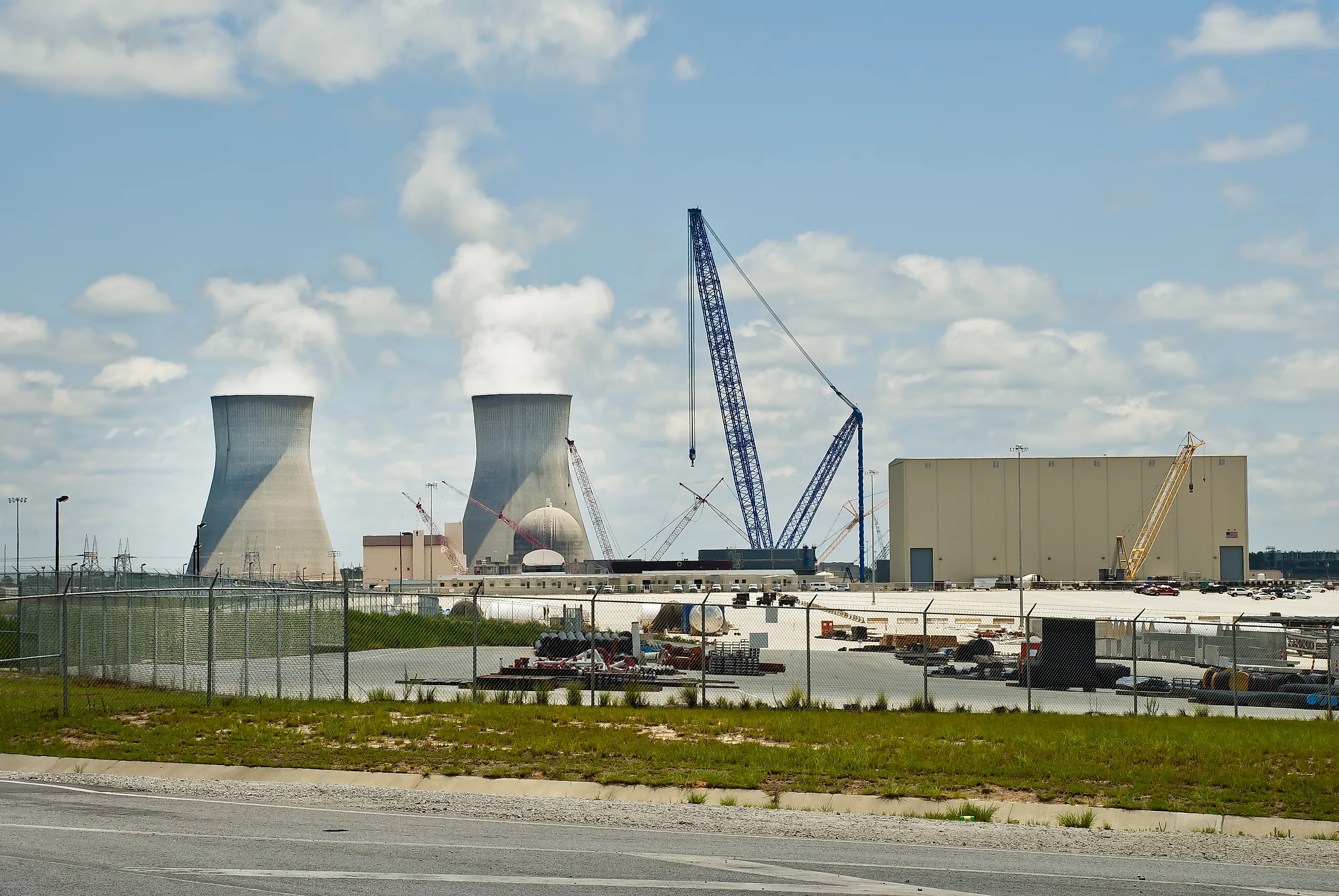
The Burke County seat of Waynesboro, Georgia, is the town most closely associated with Plant Vogtle, which sits nearby along the Savannah River, about 26 miles southeast of Augusta. Vogtle is now the largest nuclear power plant in the United States. Its original two Westinghouse reactors began commercial operation in 1987 and 1989, and in 2023 and 2024 they were joined by Units 3 and 4, the first newly built nuclear reactors completed in the United States in roughly three decades. Those two AP1000 units alone cost tens of billions of dollars and ran years behind schedule, but with all four reactors running, the plant produces around 4,500 megawatts, making it the single largest generator of electricity of any kind in the country. It is operated by Southern Nuclear and employs more than 1,600 people.
Seabrook, New Hampshire

The coastal town of Seabrook, New Hampshire, about 40 miles north of Boston, gives its name to Seabrook Station, which occupies a site within the town near the Atlantic marshes. Its single Westinghouse reactor produces about 1,250 megawatts, making it the largest individual generating unit on the entire New England power grid. The plant's construction was one of the most contested in American history: through the late 1970s the site drew mass demonstrations organized by the anti-nuclear Clamshell Alliance, resulting in thousands of arrests. Financing problems and regulatory delays meant that only one of the two originally planned reactors was ever completed, and the station did not reach full commercial operation until 1990. It is now operated by NextEra Energy.
Waterford, Connecticut

On the shore of Long Island Sound, the town of Waterford, Connecticut, hosts the Millstone Nuclear Power Station, built on the site of a former granite quarry. With two operating pressurized water reactors, it is the second-largest nuclear plant in New England and supplies roughly half of Connecticut's electricity, along with a significant share of the region's carbon-free power. Millstone has operated since the early 1970s; its original Unit 1, a boiling water reactor, was shut down in 1998, while Units 2 and 3 remain in service under Dominion Energy. For Waterford, the station is a central part of the local economy and one of the largest contributors to the town's tax base.
Port Gibson, Mississippi
The town of Port Gibson, Mississippi, lies about five miles from the Grand Gulf Nuclear Station, which sits on a wooded site in Claiborne County beside the Mississippi River. Grand Gulf is notable for a specific superlative: its single General Electric boiling water reactor is the most powerful commercial reactor in the United States, with a nameplate capacity of about 1,443 megawatts, and it ranks among the most powerful reactors in the world. The plant began commercial operation in 1985, draws cooling water from the river through a 520-foot natural-draft cooling tower, and is operated by Entergy. It employs several hundred people and is one of the economic anchors of this corner of southwestern Mississippi.
Red Wing, Minnesota

The river town of Red Wing, Minnesota, southeast of the Twin Cities, is associated with the Prairie Island Nuclear Generating Plant, which sits on the Mississippi River next to the lands of the Prairie Island Indian Community. The plant's two pressurized water reactors, which entered service in the early 1970s, are, by generating capacity, the two smallest operating commercial reactors in the entire country, at roughly 520 megawatts each. That proximity to the tribal community has kept questions of spent-fuel storage and long-term safety unusually prominent here for decades. Operated by Xcel Energy, the plant remains an important source of both electricity and employment for the region.
The Broader Picture
These towns are only part of a wider pattern. Elsewhere in Minnesota, the city of Monticello hosts an operating single-reactor plant of the same name, while communities such as Two Rivers, Wisconsin, and Russellville, Arkansas, sit alongside working reactors of their own. The common thread is economic: a nuclear plant is frequently the largest taxpayer and one of the largest employers for miles around, funding local schools and services on a scale few other facilities could match. The trade-off is that a town's fortunes become tied to distant decisions about license renewals and closures. After a stretch of retirements across the industry, the completion of the new reactors at Waynesboro's Plant Vogtle marked the first major expansion of American nuclear capacity in a generation, and a reminder that these host communities remain central to the country's energy future.