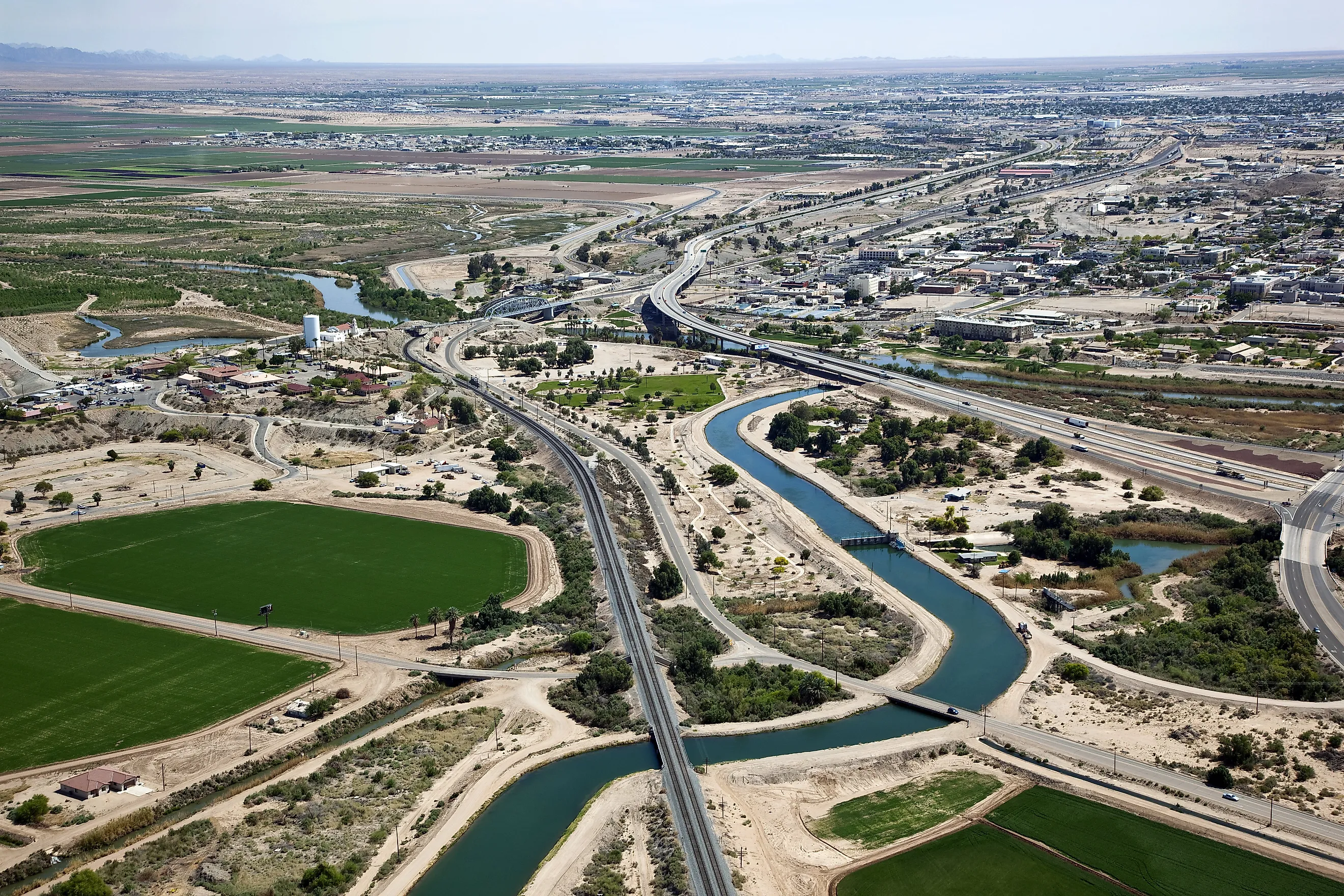
The 250 Million Desalting Plant America Built And Never Turned On
The Yuma Desalting Plant sits on 78 acres of former farmland in southwestern Arizona, cost around $250 million in 1992 money, and is one of the largest reverse-osmosis facilities ever constructed. It can treat 73 million gallons a day, roughly 100,000 acre-feet a year, which is a serious volume of water in a basin currently arguing over every drop. In more than thirty years of existence it has operated three times, for a combined total of well under two years. And the reason it stays switched off is not incompetence or forgetfulness, it is that turning it on would destroy a 12,000-acre wetland in Mexico that exists only because the plant was never turned on in the first place.
Here is how the United States managed to build a solution that created a problem by never being used.
The Problem It Was Built To Solve

Under a 1944 treaty the United States guarantees Mexico 1.5 million acre-feet of Colorado River water a year. The treaty did not initially say much about what condition that water had to arrive in, and by the 1960s that had become a serious diplomatic problem.
Farms in the Wellton-Mohawk Irrigation and Drainage District, about thirty miles east of Yuma, were returning heavily salted drainage water into the Colorado just north of the border. Mexican farmers found the water was killing their crops, and the complaint escalated to the level of international agreement.
The fix agreed in the 1970s was to build a plant that would strip the salt out of that drainage before it reached the river, so the water could count toward the treaty obligation rather than ruin it. It was a sound piece of engineering logic and it took fifteen years to build.
Congress Authorized It In 1974

The Colorado River Basin Salinity Control Act was signed by President Nixon on June 24, 1974, roughly six weeks before he resigned, and it directed the Interior Secretary to build, operate and maintain a desalting plant in Arizona for exactly this purpose.
Construction ran from the late 1970s into 1992, a span long enough that the situation it was designed for changed underneath it. The final cost of around $250 million would be somewhere over a billion dollars in today's money.
One Reclamation official quoted at the time was unusually candid about the reasoning. The plant, he said, was never looked at or justified on an economic basis. It was a political decision made with the Mexican government.
The Canal That Made A Wetland

Here is the decision that produced everything that followed. The plant took fifteen years to build, and throughout that time the salty drainage still had to go somewhere other than the river.
So the United States extended a canal, the Main Outlet Drain Extension, to carry the water past the Colorado entirely and dump it in the Sonoran desert south of the border. It was explicitly a temporary measure to be abandoned once the plant came online.
Water arriving continuously in a desert does what water does. The outfall created a wetland where there had been dry ground, and the Cienega de Santa Clara grew into a marsh of roughly 12,000 to 15,000 acres depending on which survey you read, in the middle of a delta that the Colorado had stopped reaching decades earlier.
Then Nobody Needed It

The plant was finished in 1992 and ran from May of that year until January 1993, when major flooding on the Gila River destroyed sections of the canals feeding it. That was the longest continuous operating stretch in its history, and it lasted eight months.
By then the argument for running it had weakened considerably. The Colorado was in surplus, the treaty obligation to Mexico was being met without any desalting at all, and Congress responded by cutting appropriations to the level required to keep the plant in standby rather than in operation.
It has been in standby ever since, running at around one hundredth of capacity to support research, at a cost of maintaining a quarter-billion-dollar facility that produces essentially nothing.
Three Runs In Thirty Years

The operating record is remarkably short for a facility of this scale, and an Arizona legislative memorial laid it out precisely. There were the limited initial operations that ended with the 1993 flood. There was a demonstration run completed in 2007, conducted partly to prove the equipment still worked. And there was a nine-month pilot run at about one-third capacity completed in 2011.
That is the entire operational history. For most of its existence the largest inland desalting plant in the country has been a building with the lights on.
Why Turning It On Is Not Simple
The obvious response to a water shortage is to use the water treatment plant you already own, and the reason that has not happened is the wetland. If the plant runs at capacity, the drainage water currently flowing to the Cienega gets desalted and sent into the Colorado instead. What reaches the wetland is the leftover brine concentrate, which amounts to roughly a third of the current flow carrying about twice the salt.
A National Audubon Society scientist put the arithmetic plainly: you continue sending all the salt while sending less fresh water. The plants growing there tolerate only so much salinity, and the wetland in its present form would not survive it.
Mexico has since designated the surrounding region as a biosphere reserve, and the Cienega is now the largest remaining wetland in the Colorado delta and habitat for the endangered Yuma clapper rail. An accidental byproduct of a construction schedule has become an internationally recognized conservation site.
What It Would Cost Now
Restarting properly is not a matter of flipping a switch. Bringing the plant to full capacity has been estimated at more than $55 million on top of the original construction cost, and that figure excludes the environmental compliance the wetland question would trigger.
There is also a live opportunity cost sitting against it. Interior currently uses around 100,000 acre-feet a year out of Lake Mead to satisfy the same water-quality obligation the plant was built to handle. That is water coming out of a reservoir hovering near a quarter full, spent annually to do a job a paid-for facility could do instead.
That tension is why the plant keeps reappearing in Colorado River negotiations, and why it never quite gets restarted.
What The Plant Actually Demonstrates

The Yuma Desalting Plant is usually written up as a boondoggle, and it is considerably more interesting than that. It was built to solve a genuine diplomatic problem, using sound technology, by a competent agency. What defeated it was time. Fifteen years of construction was long enough for the river's condition to change, for a temporary canal to become a permanent ecosystem, and for the political calculation behind the project to be overtaken by a new one nobody had anticipated.
The facility also produced something durable. The Water Quality Improvement Center at the site is one of six national centers for water treatment technology and the only one focused specifically on inland brackish water, so the plant that never desalted much has spent three decades teaching people how to do it.
The Position Today
The plant stands, maintained and operable, in a basin that has spent twenty years short of water and still cannot straightforwardly use it. Running it recovers around 100,000 acre-feet a year for the American side of the ledger and puts a biosphere reserve at risk. Leaving it idle protects the wetland and keeps Lake Mead paying the bill. Nobody has found a version that does both, though proposals to supply the Cienega with an alternative water source have circulated for years.
Which leaves one of the largest desalting plants ever built sitting on 78 acres of Arizona farmland, fully functional, waiting for an answer to a question that did not exist when it was designed.