10 Queensland Towns Where Time Stands Still
In Queensland, the gold rushes, maritime landings, and railway boom towns of the 1800s left a specific kind of landscape behind: wide main streets, sandstone courthouses, old tin sheds, mining museums, and the occasional cannon dredged up from Captain Cook's Endeavour. Ten towns across the state have held on to that character. Some grew out of coastal trade, others out of cattle country, tin, or gold. What they share is the sense of having stopped changing when the railway stopped running.
Montville

Montville, in the Blackall Range hinterland of the Sunshine Coast, was settled in the late 1800s and has kept much of its timber cottage architecture. Main Street runs along the ridgeline with galleries, cafes, and craft shops. Tina Cooper Art & Glass Gallery is a working glass-blowing studio where visitors can watch the glassblowing from the public floor. Nearby Kondalilla National Park protects a 90-meter waterfall that drops into a natural swimming hole surrounded by rainforest, with wallabies and platypuses occasional sights along the walking trails. For wine, Flame Hill Vineyard sits a few kilometers south with estate-grown wines and a cheese board.
Herberton

Tin was discovered at Herberton on the Atherton Tableland in 1880, and the mining boom that followed built the town almost overnight. Historic Village Herberton preserves a 16-acre stretch of that era with dozens of relocated timber buildings, tearooms, antique stores, and pioneer-era shopfronts. The Herberton Mining Centre Museum covers the same period from the industrial side, with old steam engines, mine-shaft walk-throughs, and tin-panning displays. The Great Northern Mines Walk runs less than a mile past the remaining mineshafts outside town.
Maryborough

Maryborough, south of Hervey Bay, dates to the mid-1800s and was the birthplace of P.L. Travers, the author of Mary Poppins, in 1899. The Story Bank on Richmond Street is her preserved childhood home, now a museum covering her life and work. The Maryborough City Markets take over the town center every Thursday with jewelry, antiques, artwork, flowers, and food stalls. Queen's Park, a few blocks over, is 12 acres of gardens and heritage trees along the Mary River.
Charters Towers

Gold was discovered at Charters Towers in 1871 by Jupiter Mosman, a twelve-year-old Aboriginal stockman traveling with a prospecting party. The boomtown that grew around the discovery became one of the richest goldfields in Queensland for nearly three decades. The Wall of History on Gill Street is an 80-meter-long mural covering that period, painted by local artists. The Zara Clark Museum covers the rest. Towers Hill Lookout rises above the town and is the standard sunset spot. The on-site amphitheater also hosts the "Ghosts After Dark" screenings.
Cooktown

Cooktown was established in 1873 at the mouth of the Endeavour River, the spot where Captain Cook beached the Endeavour in 1770 to repair hull damage sustained on the Great Barrier Reef. The Cooktown Museum, housed in a restored 1889 convent, holds an original cannon and anchor recovered from the Endeavour, along with Guugu Yimithirr artifacts documenting the seven weeks Cook spent ashore. Grassy Hill Lookout at the edge of town has a 360-degree view of the river, the ocean, and the nearby ranges. Isabella Falls, half an hour outside town, is a low cascade over granite with a swimming pool at the base.
Charleville

Charleville was established on the Warrego River in 1868 and became a major coach stop on the western route. The largest Cobb & Co. factory in the country operated there, producing and servicing the coaches that carried mail and passengers across inland Queensland. The Historic House and Museum, in a 19th-century bank building, holds a restored Cobb & Co. coach, a steam engine, and a rail ambulance from that era. The Warrego River Walk handles the daylight hours. The Charleville Cosmos Centre runs night-sky sessions using research-grade telescopes; the low humidity and minimal light pollution of the outback make it one of the best stargazing spots in Australia.
Seventeen Seventy

Seventeen Seventy, on a small peninsula at the southern end of the Great Barrier Reef, is named for the year Captain Cook made his first Queensland landing there. It's the only town in the state named for a date. The 1770 Captain Cook Festival runs each May with landing reenactments and music events. Bustard Bay Lookout gives the clearest view of the coastline, where red rocks meet white sand and clear water. 1770 Reef runs 90-minute glass-bottom-boat tours of the reef with manta rays, dolphins, and humpback whale sightings in season.
Warwick

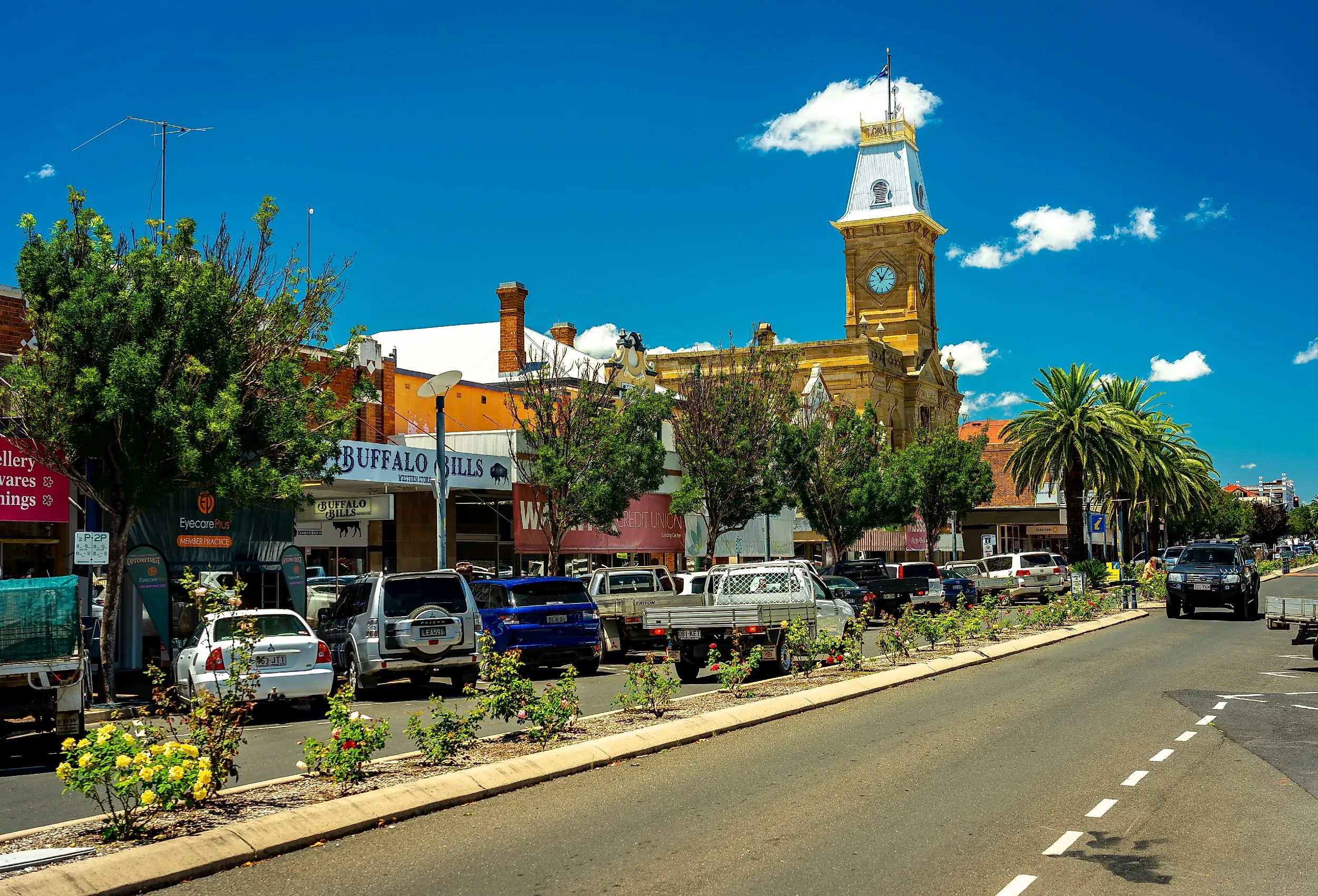
Warwick was settled in 1847 by Patrick Leslie, part of the Leslie brothers who established Canning Downs pastoral station nearby in 1840. It's one of the oldest towns in inland Queensland, with a downtown core of sandstone commercial buildings from the 1870s and 1880s. The Australian Rodeo Heritage Centre covers the town's rodeo culture, including the Warwick Rodeo and Gold Cup each October. The Downs Explorer runs heritage steam trains on scenic day trips across the Granite Belt. Main Range National Park sits just to the west, protecting a section of the Great Dividing Range with walking tracks and escarpment lookouts.
Barcaldine

Barcaldine, nicknamed the Garden City of the West, was founded with the arrival of the Great Western Railway in 1886. Five years later it became the headquarters of the 1891 shearers' strike, a labor dispute widely credited with giving rise to the Australian Labor Party. The Tree of Knowledge, the ghost gum under which striking shearers met, was poisoned and killed in 2006. Its preserved stump is now displayed inside a dramatic timber memorial at the center of town. The Barcaldine and District Historical Museum covers the strike and the town's wider railway history. Lloyd Jones Weir on the edge of town is the local spot for fishing, kayaking, and summer cooling off.
Southport

Southport began as a timber-milling center in the 1870s and became a seaside resort for wealthy Brisbanites by the end of the century. It's now part of the Gold Coast, but a few older buildings and the long foreshore along the Broadwater still speak to the turn-of-the-century holiday town. GC Aqua Park is the biggest draw for families. Southport Park Shopping Centre handles the day-to-day retail, and the Gold Coast Little Theatre, in a heritage building, has run community plays and musicals for decades.
What these ten Queensland towns preserve is a specific stretch of the state's history, from Cook's 1770 landing through the gold and tin rushes of the late 1800s to the railway expansion that followed. Each one keeps a piece of that story anchored in place: in a cannon, a coach factory, a tree stump, a convent museum, a mural along a main street. Taken together, they make Australia's past feel closer than the guidebook version of modern Queensland usually suggests.