You Won't Believe This Town Is In Western Australia
Denmark sits on Western Australia's southwestern shore, about 260 miles south of Perth, and it is not what most people expect from the state. Instead of red dirt and spinifex, the town is surrounded by dense temperate eucalyptus forest, the kind of old-growth canopy that feels more like British Columbia or New Zealand than anywhere in Australia. The forests here trace back 65 million years to the Gondwana supercontinent, and several of the tree species growing around Denmark grow nowhere else on the planet.
Is This Really Australia?

A modestly-sized town of just over 6,000 residents, Denmark is centered around Wilson Inlet, a large, sheltered estuary where the Denmark River meets the Southern Ocean. Named in 1829 after Dr. Alexander Denmark (and not the Scandinavian country), the landscape here looks like something you might see in New Zealand or the Pacific Northwest rather than on Australia's west coast.
Much of this disparity stems from the ancient forests that surround Denmark, which can be traced as far back as 65 million years to the supercontinent Gondwana, when Australia was still joined to Antarctica, Africa, and India. The predominant tree species here are the giant tingle trees, a type of eucalypt that grows nowhere else on the planet.

These otherworldly red tingles can reach heights of up to 200 feet with circumferences of 52 feet and have even been known to live for more than 400 years. They're easy to spot, too, with enormous hollowed-out trunks big enough to stand inside. Other species here include karri, jarrah, and marri eucalypts, as well as the distinctive red-flowering gum, a species whose blossoms attract rainbow lorikeets and honeyeaters in large numbers each spring.
Denmark's Unique Ecosystems

The best place to see the largest tingle trees is in the Valley of the Giants. A short drive west of Denmark along the South Coast Highway, the Tree Top Walk here is a world-class attraction that consists of a nearly 2,000-foot-long steel walkway suspended 130 feet above the tingle forest. On the forest floor, the Ancient Empire Walk loops through a grove of the oldest trees, including Grandma Tingle, one of the largest specimens, along a pleasant boardwalk.
The Walpole Wilderness Area protects more than 890,000 acres of national parks and nature reserves surrounding Denmark, as well as the neighboring town of Walpole. One of only 36 global biodiversity hotspots boasting concentrations of species found nowhere else on the planet, unique wildlife here includes western grey kangaroos, southern brown bandicoots, brushtail possums, and over 169 bird species.

To see them (or at least some of them), a portion of the 600-mile Bibbulmun Track, one of the world's best long-distance walking trails, passes right through the region on its way from Perth to Albany.
Boulders And Beaches

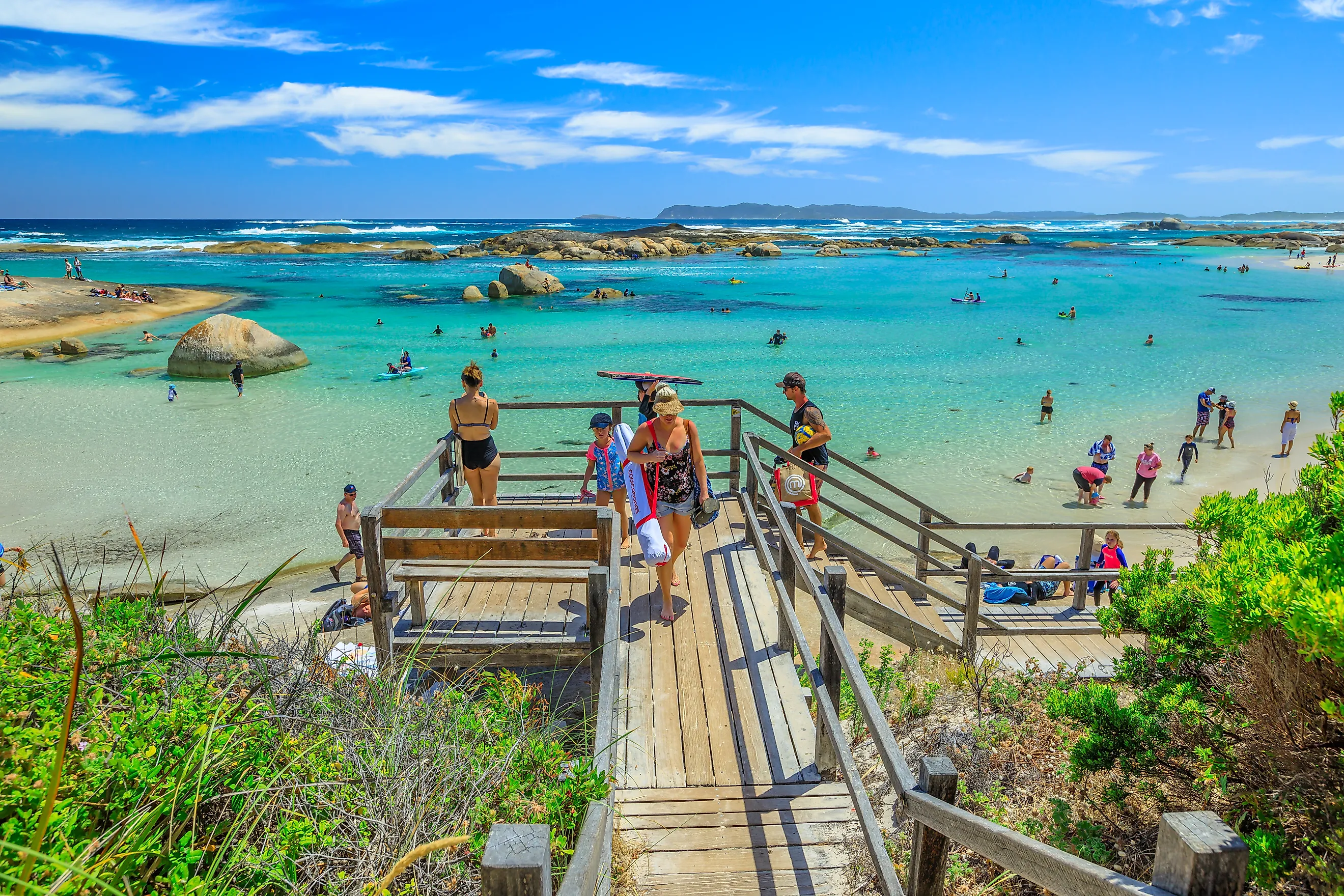
The forests aren't the only surprise in Denmark. A few miles west of town, William Bay National Park is home to two of Western Australia's most photographed beaches: Greens Pool and Elephant Rocks.
At Greens Pool, a line of massive granite boulders forms a natural breakwater against the Southern Ocean, creating a calm, sheltered lagoon with white sand and water so clear it shifts between aquamarine and jade, depending on the light. It's consistently rated one of the country's best beaches for snorkeling, with zebrafish, stingrays, and other reef species in the shallows.

Just a 10-minute walk away, Elephant Rocks is a collection of huge, smooth, round granite boulders that look remarkably like a herd of elephants wading into the surf. A staircase leads down to Elephant Cove, a more exposed beach that local tradition says was an Aboriginal birthing place for centuries.
Rare Birds And Rare Wines

A little closer to town, Ocean Beach is where surfers go in Denmark, while the inlet itself is a popular spot for kayaking, fishing, and birdwatching. Over 240 bird species have been recorded around Wilson Inlet, including pelicans and the Australian black swan. It's also where southern right whales pass during their annual migration north; bottlenose dolphins are a common sight in the estuary year-round.

Denmark is also unusual in Western Australia for its local wine scene. Part of the Great Southern wine region, the cool maritime climate here is ideal for growing varieties like Riesling, Pinot Noir, and Chardonnay. Forest Hill Vineyard is the oldest vineyard in the Great Southern region and has been producing highly regarded vintages since 1965. Still family-owned, it's open seven days a week for tastings.
Not Your Typical Western Australian Town
Denmark surprises people who expect Western Australia to look like Western Australia. From Perth, the drive south takes around five hours. The nearest airport is Albany, 40 minutes to the east. Once you're standing in a hollow tingle trunk in the Valley of the Giants, or on the granite slabs at Greens Pool, the rest of the state feels several thousand miles away.