7 Ideal Destinations For A 3-Day Weekend In the Mid-Atlantic
The Mid-Atlantic packs more good weekend material into a small radius than almost any region of the country. The seven destinations ahead spread across Virginia, Maryland, and the District of Columbia and can be strung together in three days. Each rewards an unhurried half-day. The geography is tight enough to make the schedule work without burning the trip on driving time.
Staunton, Virginia

Staunton sits in the Shenandoah Valley about 150 miles southwest of Washington and was the first Virginia community to win the Great American Main Street Award, in 1995. The walkable downtown holds five historic districts on the National Register, and Frederick House on East Frederick Street is a 23-room inn made of five connected 19th-century houses just off the main commercial corridor. The Woodrow Wilson Presidential Library and Museum on Coalter Street covers the birthplace and presidency of the 28th president, who was born in Staunton in 1856.
The American Shakespeare Center on Market Street runs year-round performances in the Blackfriars Playhouse, a 300-seat reconstruction of the original Blackfriars Theatre in London. The Blackfriars is the only working replica of a Shakespearean indoor playhouse in the world. The Frontier Culture Museum on the western edge of town covers about 200 acres of living-history reconstructions of the European farms the Shenandoah's early settlers built before crossing the Atlantic.
Shenandoah Valley Wine Trail

The Shenandoah Valley Wine Trail runs through Augusta, Rockingham, and Page counties between the Blue Ridge and the Allegheny Mountains. The trail covers about 25 wineries growing vinifera grapes in the valley's limestone soils, which are similar in character to the limestone-based terroirs of Burgundy and the Loire Valley. Barren Ridge Vineyards in Fishersville, about 12 minutes northeast of Staunton, runs its tasting room out of a restored 1880s dairy barn with views east across the valley to the Blue Ridge.
Bluestone Vineyard in Bridgewater works the eastern slopes of Massanutten Mountain with petit manseng and chambourcin grapes that handle the cooler valley climate. CrossKeys Vineyards near Mount Crawford runs the most ambitious tasting-room operation on the trail with a full Mediterranean-revival winery building and seasonal restaurant. The trail can be covered in a half day by picking three tasting rooms, or stretched to a full day with lunch on the way.
Monticello

Monticello sits on a hilltop about 40 miles east of Staunton just outside Charlottesville. Thomas Jefferson designed and rebuilt the house over a 40-year span between 1769 and 1809, and the result is the only private residence in the United States designated a UNESCO World Heritage Site, recognized in 1987 along with the University of Virginia. The main house holds 33 rooms across three floors and the cellar level.
The Thomas Jefferson Foundation has operated Monticello as a museum since 1923. The standard tour covers the main floor of the house, while specialty tours cover the upper floors, the cellars, the gardens, and the slavery-focused Mountaintop Tour developed since the 2010s as part of the foundation's expanded interpretive work, which now centers the lives of the more than 600 enslaved people who lived and worked on Jefferson's plantation. The 5,000-acre original plantation is now 2,500 acres of preserved grounds. Jefferson is buried in the family cemetery on the property along the path back down to the visitor center.
Washington, D.C.

Washington, D.C. is the anchor of any Mid-Atlantic trip. The National Mall runs about two miles between the U.S. Capitol and the Lincoln Memorial with the Smithsonian's free museums lining both sides. The Smithsonian National Museum of Natural History holds the largest natural history collection on Earth at about 148 million specimens, and the National Gallery of Art runs the country's most ambitious public European and American collection.
The Lincoln Memorial sits at the west end of the Mall on the spot where Martin Luther King Jr. delivered the "I Have a Dream" speech on August 28, 1963. The Vietnam Veterans Memorial just north of it lists the names of more than 58,000 American war dead on a black granite wall designed by Maya Lin in 1981 when she was a 21-year-old undergraduate at Yale. A half-day on the Mall covers two museums and the central monuments at a sustainable pace.
Annapolis

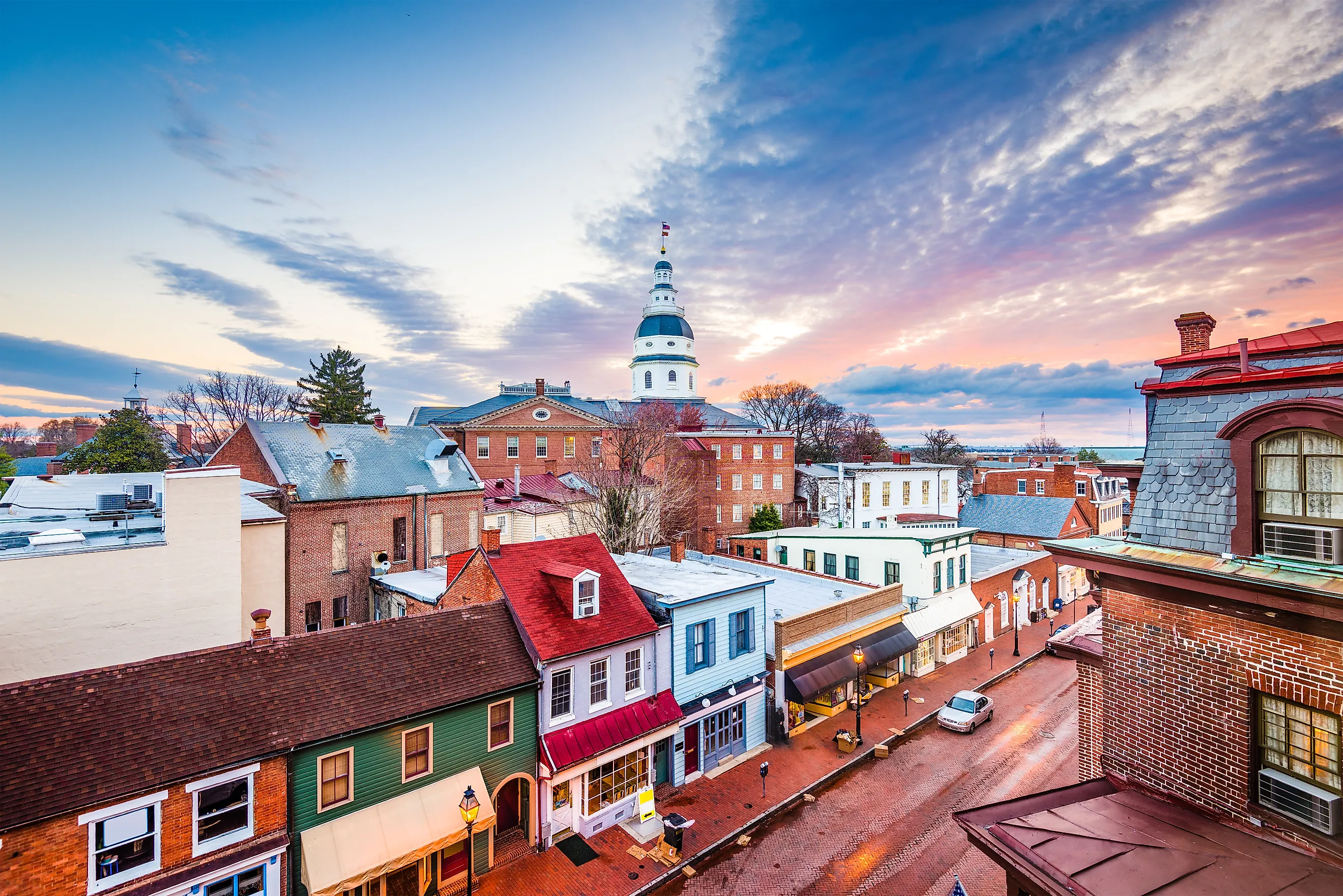
Annapolis sits about 30 miles east of Washington on the Severn River where it meets the Chesapeake Bay. The Maryland State House on State Circle is the oldest U.S. state capitol still in continuous legislative use, with the central section completed in 1779. The Continental Congress met in the building from November 1783 through August 1784, making Annapolis the temporary capital of the United States during that period, and George Washington resigned his commission as commander of the Continental Army in its Old Senate Chamber on December 23, 1783.
The United States Naval Academy occupies 338 acres on the east side of Annapolis along the Severn. The Academy was founded in 1845 and is open to the public for guided walking tours through Bancroft Hall and the Chapel, where Admiral John Paul Jones rests in a marble sarcophagus in the chapel crypt. Main Street in the historic district runs about half a mile from the State House down to the City Dock with restaurants and shops occupying 18th-century brick buildings.
Tilghman Island

Tilghman Island sits at the southwestern tip of Talbot County on the Maryland Eastern Shore, reached by the Knapps Narrows Bridge from the mainland. The bridge is often cited as one of the busiest drawbridges in the United States, opening and closing about 10,000 times a year for the working oyster, crab, and recreational boat traffic between the Chesapeake Bay and the Choptank River system.
The island holds about 760 residents and a working watermen's economy that still runs oyster tonging and crab potting out of Dogwood Harbor on the south end. The skipjack Rebecca T. Ruark, built in 1886 and based at Dogwood Harbor, is the oldest working skipjack on the Chesapeake and runs sailing charters during the season. Phillips Wharf Environmental Center at the Knapps Narrows end of the island runs an aquarium and crab-and-oyster education center. The Tilghman Island Inn handles the seafood-and-water-view dining.
Cape Charles

Cape Charles sits at the south end of the Delmarva Peninsula on the Chesapeake Bay side, about an hour north of Norfolk by way of the 17.6-mile Chesapeake Bay Bridge-Tunnel. The town was platted in 1884 as the southern terminus of the New York, Philadelphia & Norfolk Railroad and the rail-to-ferry transfer point for cargo and passengers heading south. The historic district holds about 500 turn-of-the-century buildings on the National Register.
The Cape Charles public beach is one of the few on the Chesapeake side of the bay with sand stretching for nearly a mile and west-facing sunsets over the water. The town grid above the beach holds Mason Avenue's restored commercial corridor with Cape Charles Coffee House, the Shanty for seafood on the harbor, and the Palace Theatre (a restored 1941 cinema). Kiptopeke State Park four miles south covers 562 acres of bayfront with the famous "concrete fleet" of nine World War II concrete ships sunk offshore as breakwaters in 1948.
Building The Itinerary
The seven destinations split into a natural route. Day one runs Staunton and the Shenandoah Valley Wine Trail with an overnight at Frederick House. Day two covers Monticello in the morning and Washington in the afternoon. Day three runs Annapolis, then crosses the Bay Bridge to Tilghman Island and continues south down the Eastern Shore to Cape Charles. The full loop covers roughly 600 miles by car. Each destination earns its half-day on the schedule, and the region holds more good material than a single weekend can absorb.