7 Best Natural Wonders To Visit In Ohio This Year
Ohio is packed with unexpected natural wonders, from ancient rock formations carved into limestone to towering cliffs and colorful caverns. Geology enthusiasts must visit the Glacial Grooves Geological Preserve to admire the ancient grooves created by glacial scouring on limestone rocks. Magee Marsh is a paradise for birdwatchers as it attracts thousands of migratory birds to its wetland habitat every springs Clifton Gorge is another beautiful location for nature lovers. It provides the opportunity to hike or bike through miles of trails running through primitive forests and waterfalls. These seven natural wonders highlight some of the state’s most spectacular scenery that you’ll have to see to believe.
Glacial Grooves

The Glacial Grooves on Kelleys Island are one of the best examples of a process known as “glacial scouring,” which occurred during the last Ice Age about 18,000 years ago, when moving glaciers dragged rocks, soil, and debris across limestone like sandpaper. Designated a National Natural Landmark in 1967, the grooves are 430 feet long, 35 feet wide, and up to 15 feet deep in places. Ideal for geology enthusiasts and natural history buffs, you can hop on a 20-minute ferry ride from Marblehead to Kelleys Island with your bicycle to see this natural phenomenon for yourself.
The Glacial Grooves Geological Preserve is considered one of the most accessible examples in the world of this geological phenomenon, attracting tens of thousands of visitors annually who can walk along the raised viewing platforms and read interpretative signs along the way. Plan on spending about 30 minutes exploring the grooves, then visit the haunting remnants of the Kelleys Island Lime and Transport Company in Kelleys Island State Park to learn about the once-world’s-largest producer of limestone and lime and Columbus Lime. Late spring or early fall is the best time of year for a Kelleys Island getaway if you want to avoid summer crowds or experience limited ferry service in winter.
Ash Cave

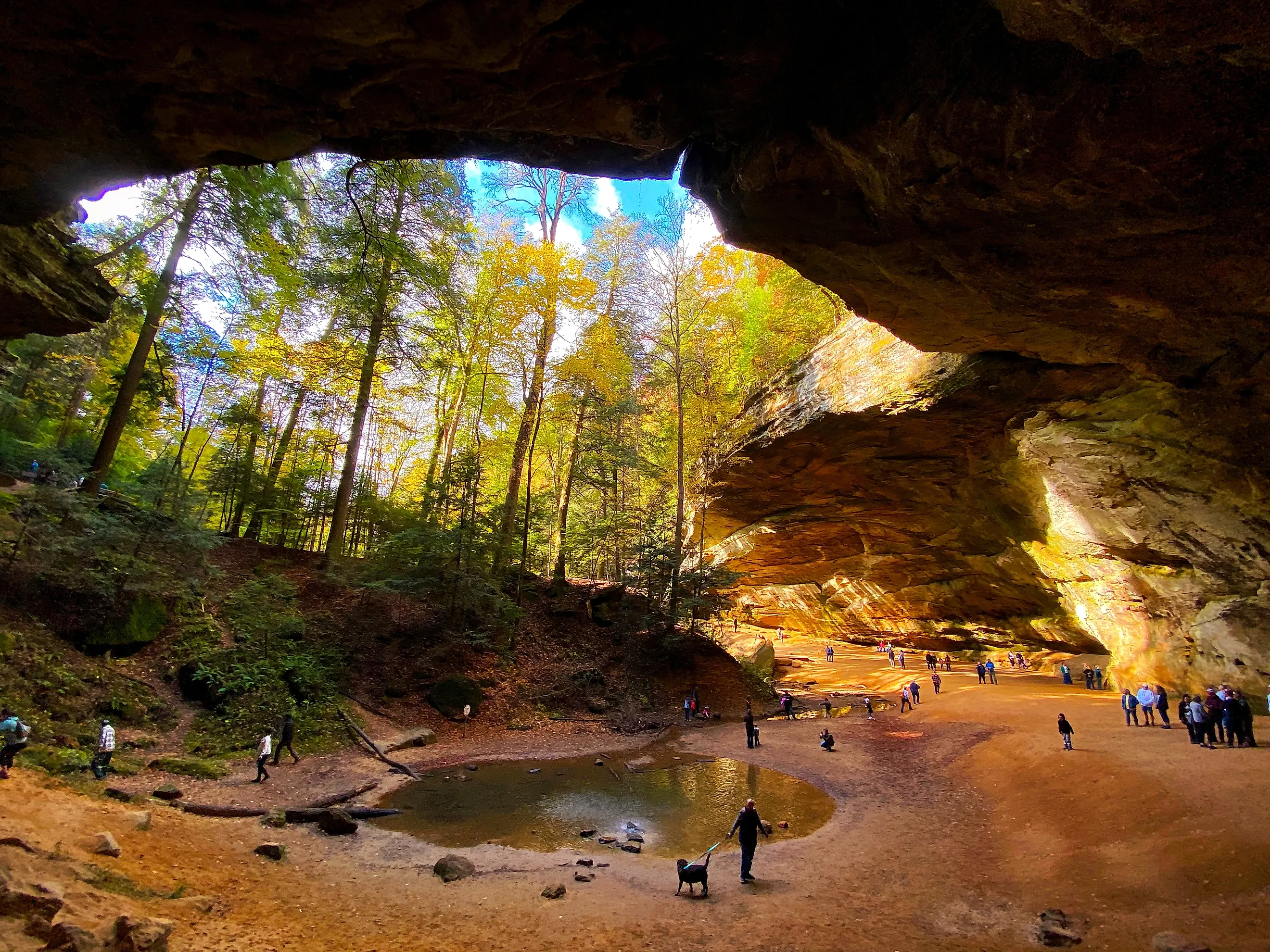
Ash Cave is the largest recess cave in the Buckeye State. Unlike a classic limestone cave with its long, winding tunnels and chambers, a recess cave is typically a shallow cave or rock shelter. In southeastern Ohio, Ash Cave in Hocking Hills State Park is one of the most famous examples of recess caves in the US, with other less concentrated similar caves in the Red River Gorge in Kentucky, Zion National Park, and in the Ozarks. The horseshoe-shaped cave measures 700 feet from one end to the other, 100 feet deep, and rises 90 feet at the entrance. You can reach the cave after navigating the around 0.3-mile Ash Cave Rim Trail through a narrow, hardwood-tree-lined gorge that opens onto the spectacular, amphitheater-like cave and a seasonal waterfall cascading over it.

The cave is named after a pile of ashes found by early settlers, believed to be the remains of repeated campfires built by Indigenous people over the years. Over time, excavations of the ashes revealed tools, arrows, animal bones, bits of pottery, and corn cobs. A striking sandstone formation called Pulpit Rock sits in front of the cave, traditionally thought to have served as a platform for sermons delivered by traveling preachers.
Other stunning rock formations to check out in the Hocking Hills State Park include Old Man’s Cave, Rock House, which is more like a tunnel-style recess cave, and the carved sandstone Cantwell Cliffs. For nature photographers, leaf peepers, and fall foliage enthusiasts, autumn is the most spectacular time of year to visit the recess caves and rock shelters in Hocking Hills State Park.
Serpent Mound

Part natural wonder, part archaeological oddity, the Serpent Mound is a snake-shaped mound built by Indigenous Adena peoples in Peebles, Ohio. The giant prehistoric attraction is 1,348 feet long, four feet high, and built on what is known as the Serpent Mound crater plateau. Several theories have been put forward regarding the significance of the mound, including that it is a symbol of the spiritual world, an astronomical marker pointing to celestial events, such as those at Stonehenge, or a ceremonial place. Still, to date, the Serpent Mound remains an archaeological mystery.
Europeans discovered the mound in the late 18th century, and in 1919, it became one of the first archaeological sites to be preserved as a state park. It was designated a National Historic Landmark in 1964. Visitors to the site can walk along the path, explore the on-site Serpent Mound Museum and visitor center, and climb the observation tower for a bird’s-eye view and a better appreciation of the full scale of this wonder.
Magee Marsh

More than one of the most famous birdwatching sites in North America (called the “Warbler Capital of the World”), the Magee Marsh Wildlife Area becomes a living natural wonder every spring as thousands of migratory birds use the Lake Erie shoreline as a critical stopover. The 300+ species include bald eagles, owls, osprey, tundra swans, and 36 species of warblers alone that use the marsh to rest and refuel before continuing the journey across the lake.
Start at the Magee Marsh Visitor Center for exhibits and dioramas on migration and bird life, and get the latest news from local birders, then meander along the 1.2-mile Magee Marsh Boardwalk Trail. The best time to visit the marsh is during the last two weeks of April and the first two weeks of May, but arrive early in the morning, as avid birdwatchers often arrive as early as 4 AM. In addition to the wide variety of birds, wildlife spotters can see beavers, deer, turtles, and groundhogs along the trails.

Outdoor enthusiasts will want to tack on a visit to the nearby Ottawa National Wildlife Refuge, which offers additional birding opportunities, as well as biking, nature photography, picnicking, and over 10 miles of hiking trails. Stop at the visitor center and borrow a pair of binoculars and a field guide to help you dig a bit deeper into the refuge’s natural wonders.
Oak Openings Preserve Metropark

The nearly 5,000-acre Oak Openings is a natural area in northwestern Ohio renowned for its rare concentration of sand dunes, wetlands, prairie, and oak savanna ecosystems all in one place. The unique wonder is about 30 minutes from Toledo, making it an ideal day trip for city dwellers. Its name is thought to come from early settlers who welcomed the sight of open stands of tall oak trees after trudging through the thick Great Black Swamp, the vast forested marshland that once covered much of the region. Today, the much-photographed destination is loved by hikers for its 70+ miles of wide, flat trails, plant enthusiasts for its orchids and rare carnivorous plants like pitcher plants and sundews, and bird and wildlife watchers. There’s also a network of horse trails that attract riders from all over the state, along with a Horse Riders’ Center, hitching posts, and picnic shelters.
Spend a night under the stars at Oak Openings at one of the primitive camping sites like White Oak and Springbrook Campgrounds, or check out the Cannaley Treehouse Village, the largest treehouse campsite in the U.S., that offers elevated platforms for hammock and tent camping, or glamping-style treehouses with electricity, air-conditioning, and composting toilets. Late spring is the best time of year to visit to see wildflowers in bloom, but fall brings fewer insects, cooler temperatures, and more atmospheric light.
Ohio Caverns

Ohio Caverns are one of the most popular underground natural attractions in Ohio. Billed as “America’s Most Colorful Caverns,” the caverns are the largest in the state, with about 1 mile of mapped passageways ranging in depth from 30 feet to 103 feet. The caverns were discovered by a curious 17 year old farmboy, Robert Noffsinger, in 1897, who went to investigate why rainwater was rapidly disappearing into a hole in the ground. Initially, tours of the cave were self-guided until formal tours began. The original section was closed, and a new section was mapped with electric lights.
There are several guided tours offered at the site: the Discovery Tour, which takes you by shuttle bus to the original cavern entrance, where you can view sections of the caverns dating back to its discovery in 1897, recently reopened as part of a 100th anniversary celebration; and the 50-minute Natural Wonder Tour, which takes you into the cavern via a sinkhole entrance opened in 2012.
Browse the gift shop, or go gem mining before or after your tour, or explore the 35-acre park. The summer is the busiest season for spelunking, but bring a sweater along any time of year, as the cavern temperature hovers around 54 degrees year-round.
Clifton Gorge State Nature Preserve

Three miles east of Yellow Springs, the 268-acre Clifton Gorge State Nature Preserve was established as a National Natural Landmark in 1968 to protect one of the most stunning limestone and dolomite gorges in Ohio. Hiking is the most popular pastime in the park, with three miles of trails taking you through old-growth forests, surrounded by wildflowers and waterfalls, with interpretative signs marking the way. At the intersection of the 1-mile Gorge and 1-mile Rim trails, you can log more miles by venturing across one of the footbridges into the 752-acre John Bryan State Park.
Attracting visitors in every season, the state park contains another limestone gorge, carved by the Little Miami River, one of Ohio’s designated State and National Scenic Rivers. Launch a kayak in the river and go fishing, enjoy rock climbing and rappelling, or explore miles of scenic trails by mountain bike. Stay overnight in one of the 62 available sites in the family-friendly John Bryan Campground. For a warm, activity-packed vacation, the best time of year to visit the preserve and park is summer.
Surprising Natural Wonders Of Ohio
If you're looking for a way to get outside and explore Ohio’s natural beauty on foot, along river trails, and through dramatic landscapes shaped by glaciers, water, and time, here are seven of the state’s best destinations for outdoor enthusiasts. From hiking into the towering recess caves of Hocking Hills and following limestone gorges at Clifton Gorge to walking the boardwalk at Magee Marsh during peak migration season, each nature stop offers a different way to experience the great outdoors. Step into Ice Age history at the Glacial Grooves, explore rare ecosystems at Oak Openings, and venture underground at Ohio Caverns. Together, these natural wonders showcase Ohio as a surprisingly diverse and adventure-filled destination for nature lovers year-round.