6 Most Rattlesnake Infested Areas in Nevada
Nevada is home to several species of rattlesnakes, most of them adapted to the state’s dry basins, rocky hillsides, and desert valleys. The Great Basin rattlesnake is the most widespread and can be found across much of northern and central Nevada, especially around sagebrush plains and rocky outcrops. In the hotter southern deserts near Las Vegas and Lake Mead, hikers are more likely to encounter species such as the Mojave rattlesnake, known for its highly potent venom, and the smaller sidewinder, which moves across sand in a distinctive sideways motion. Parts of southern Nevada also overlap with the range of the western diamondback rattlesnake, a large species often found in rocky canyons and desert scrub. Because these snakes rely on sun-warmed ground, crevices for shelter, and nearby water sources, sightings tend to cluster in certain parks, canyons, and recreation areas where people also spend time outdoors. The following locations are among the areas in Nevada where rattlesnake encounters are reported most often.
Lake Tahoe

On Nevada’s western edge, where the Lake Tahoe basin meets the Sierra crest, rattlesnakes share the same popular shoreline that draws skiers in winter and boaters and hikers all summer long. The lake spans roughly 191 square miles across the California-Nevada border and ranks as North America’s largest alpine lake. It's also the second deepest in the United States, with steep drop-offs and forested slopes that appeal to travelers from all over the world but that also create an ideal reptile habitat.

Most reptile encounters that visitors have involve garter snakes hunting frogs and small fish near marinas and beaches, but the species that commands attention is the Northern Pacific rattlesnake. This pit viper, typically two to three feet long, shelters beneath rocks, woody debris, and dense brush across the Tahoe Basin and into the surrounding Sierra Nevada range. Its venom is hemotoxic, capable of causing tissue damage, though bites are uncommon and fatalities rarer still. The Centers for Disease Control and Prevention estimates 7,000 to 8,000 venomous snakebites occur annually in the United States, with only about five deaths, and the U.S. Forest Service reports roughly a quarter of rattlesnake bites are “dry,” meaning no venom is actually injected. Lake Tahoe is also home to the Great Basin rattlesnake, though in fewer numbers.
Lake Mead National Recreation Area

Like Lake Tahoe, Lake Mead National Recreation Area is a popular tourist destination due to both its beauty and its ideal location between California and Arizona. But this 1.5 million-acre area is also home to four venomous rattlesnake species that are regularly documented. This includes the Western Diamondback, Mohave rattlesnake, Sidewinder, and Southwestern speckled rattlesnake.

Rattlesnakes here do more than coil beneath creosote. Just like tourists, they also swim. During extreme heat, individuals have been observed crossing open water, a surprise for boaters who assume distance from shore means distance from snakes.
Lake Mead National Recreation Area, which includes the namesake lake and the popular Historic Railroad Hiking Trail, stretches across southern Nevada along the Colorado River, roughly 30 miles southeast of Las Vegas, where Hoover Dam impounds the reservoir. Exposed canyon walls, talus slopes, fluctuating shorelines, and unpaved trails hold heat well into the evening, concentrating activity in the very places hikers and anglers frequent. The result is one of the most reliable locations in Nevada to see or hear a rattlesnake.
Black Rock Desert-High Rock Canyon Emigrant Trails National Conservation Area

Near the Oregon state line in northwest Nevada, the Black Rock Desert-High Rock Canyon Emigrant Trails National Conservation Area covers roughly 800,000 acres of alkali playa, volcanic tablelands, and deeply cut canyon corridors. The open expanse of the Black Rock Desert gives way to the narrow walls of High Rock Canyon. Here, fractured basalt and rimrock ledges create heat-retaining surfaces and shaded spots that attract the Great Basin rattlesnake during warmer months.

The Great Basin rattlesnake is the most frequently documented type of rattlesnake in the Black Rock Desert-High Rock Canyon Emigrant Trails National Conservation Area. It is a subspecies of the Western rattlesnake, and its gray and tan pattern closely matches the terrain's volcanic gravel and weathered stone. This makes it both strong at ambushing prey and hiding from predators. Rattlesnake activity here generally increases from May through September, when snakes hunt mice, ground squirrels, and small birds drawn to seasonal springs and runoff pockets in canyon bottoms. As temperatures drop, they retreat into deep rock fissures and communal dens embedded in canyon walls.
Well-used recreation routes intersect with this snake habitat. The National Conservation Area contains long intact stretches of the historic Applegate and Nobles emigrant trails, and hiking north from Stevens Camp Recreation Area follows portions of that corridor through terrain where rock cover and prey density overlap. With minimal development and vast backcountry exposure, encounters are uncommon but higher than in many other parts of the state.
Great Basin National Park

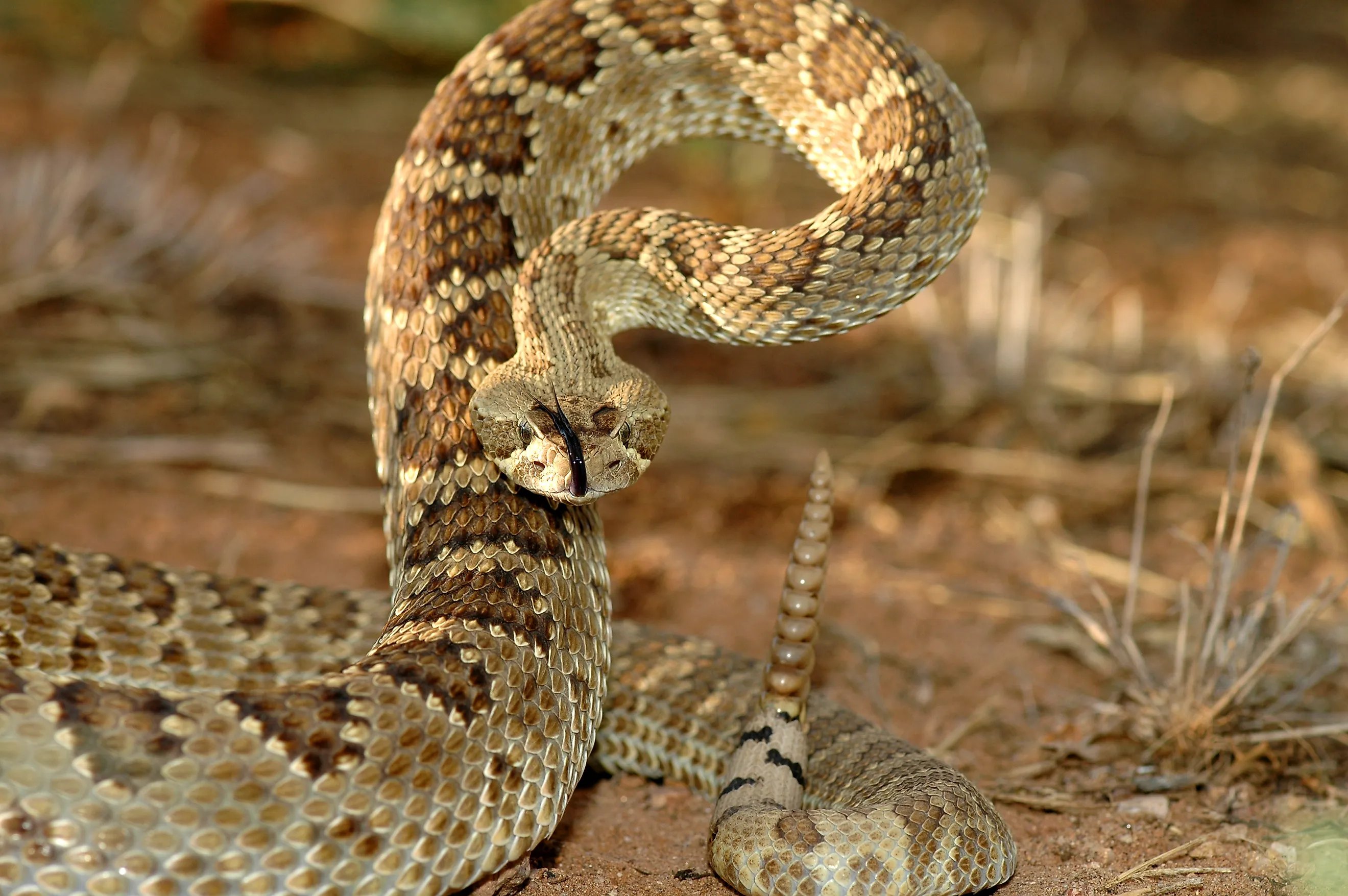
A dry, electric buzz on a rocky trail usually signals the only venomous reptile in Great Basin National Park: the Great Basin rattlesnake. Adult snakes average 30 to 36 inches, are thick-bodied with a blunt, rattle-tipped tail and tan to yellow coloring marked by darker oval blotches. In this eastern Nevada park near the Utah border, they are most common below about 8,000 feet, slithering through sagebrush flats, greasewood and shadscale, pinyon-juniper woodlands, and rocky lower montane slopes.

Male Great Basin rattlesnakes and non-reproductive females disperse, sometimes traveling up to 2.5 miles from the den to hunt. Pregnant females stay close to den sites, basking to regulate embryo development before giving birth in late September.
Because long-term monitoring has documented stable populations here, encounters are regular in lower elevations, especially along rocky slopes and streamside corridors. Their bite is rarely fatal, yet the warning rattle carries authority in one of Nevada’s most studied rattlesnake landscapes.
Humboldt-Toiyabe National Forest

Both the Panamint rattlesnake and the Western rattlesnake have been amateurly and professionally documented in the Humboldt‑Toiyabe National Forest. The area spreads across roughly 6.3 million acres of Nevada, includes 2000 miles of non-motorized trails, is the largest national forest in the lower 48, and is the most expansive wildland in Nevada.

According to iNaturalist, hikers have frequently come across the Western rattlesnake, which possesses both hemotoxic and neurotoxic venom. If bitten, this deadly combination of venom can lead to cardiovascular issues, internal bleeding, and headaches. The snake itself takes on different appearances based on its habitat. However, the typical color pattern includes dark brown, dark gray, or olive brown. They can also have a lateral series of blotches on their skin. The tan or gray-ground-colored Panamint rattlesnake is far less common in the area but can best be seen during the months of April and May.
Lake Mohave

Roughly an hour and a half south of Las Vegas and forty-five minutes north of Laughlin, Lake Mohave cuts through steep desert canyons and open washes as part of the Colorado River, creating a variety of cliffs, sandy beaches, and isolated coves. This is a premier watersports destination in Nevada and is also home to some extremely venomous rattlesnakes.
Boats and kayakers launch into Lake Mohave in Nevada’s Cottonwood Cove. Along the banks and up into the trails around the ancient Indian petroglyphs are plenty of Mohave rattlesnakes, distinguished by their diamond pattern, which blends into the desert’s muted palette. The larger Western Diamondback, which has a similar pattern but with more speckling, inhabits the more exposed rocky washes, its distinctive rattle cutting through the desert heat to warn of human approach. In contrast, the smaller Sidewinder and the Southwestern speckled rattlesnake prefer to melt into sand and talus, rarely revealing themselves unless disturbed.
Nevada’s rattlesnakes take full advantage of heat, cover, and the density of prey. At Lake Tahoe, Northern Pacific and Great Basin rattlesnakes slither beneath rocks and forest litter. The massive Humboldt-Toiyabe National Forest is home to Western and Panamint rattlesnakes among talus and brush, and southern lakes like Mohave and Mead are host to Mojaves and Western Diamondbacks near water that's popular with tourists. Knowledge of where snakes concentrate is crucial for safe exploration, whether you're actively looking for them or trying to avoid them.