10 Old-Timey General Stores In Georgia
Long before big-chain supermarkets and megamalls, general stores supplied farming settlements, mill villages, mountain crossroads, and early transportation routes across Georgia. Many surviving examples now balance heritage preservation with modern commerce, but their original roles remain visible in their architecture, locations, and inventory. These ten stores continue to anchor local identity in communities that still depend on them for groceries, conversation, and a sense of place.
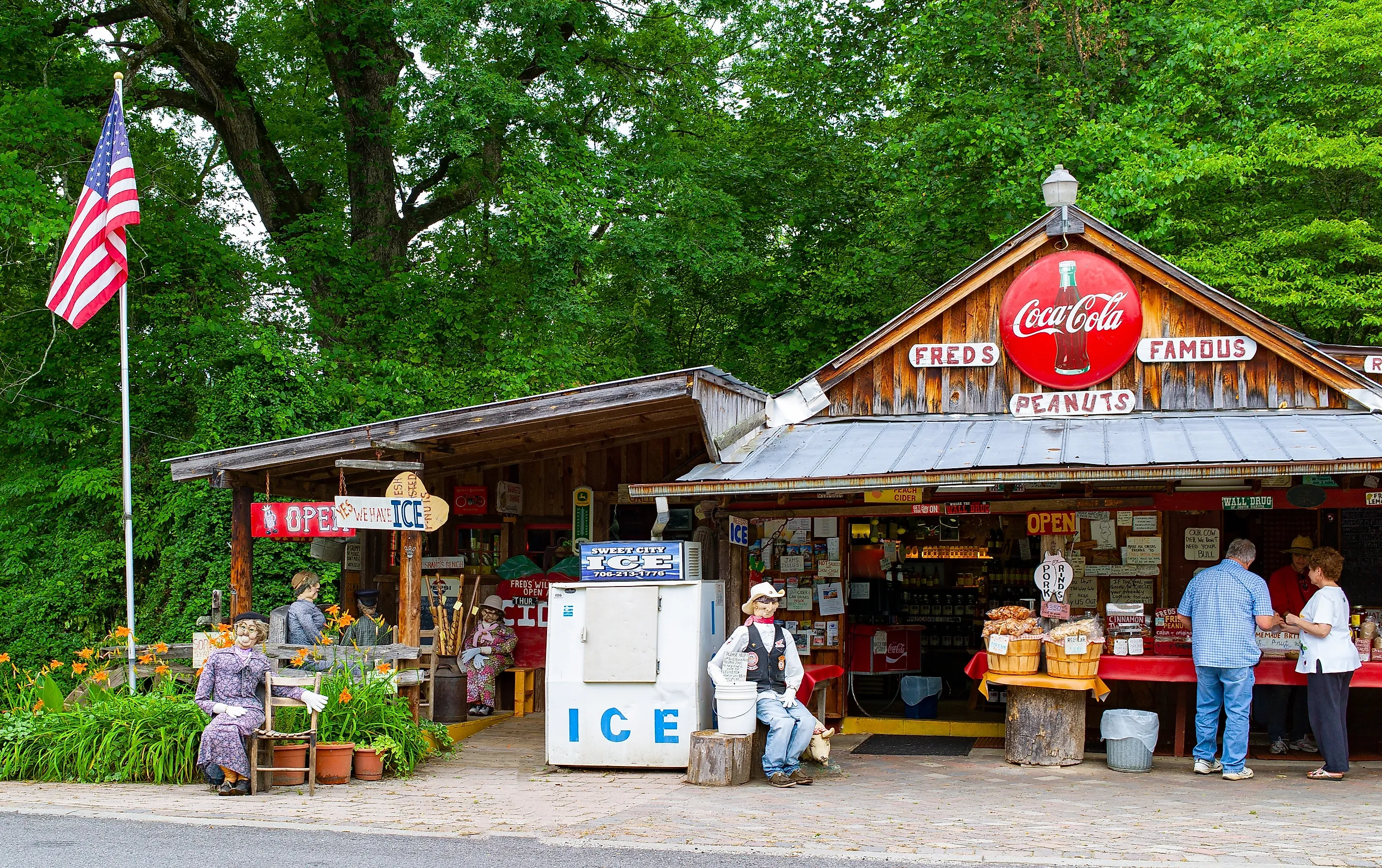
Fred’s Famous Peanuts (Helen)

Just outside Helen, Fred’s Famous Peanuts represents Georgia’s classic roadside country-store tradition. Opened in 1982, it became known for boiled, roasted, and deep-fried peanuts, along with jams, honey, and regional pantry staples. Its mountain-highway setting makes it a pivotal roadside stop that has served travelers moving through North Georgia’s tourism and recreation spaces.
The Old Sautee Store Complex (Sautee Nacoochee)

Established in 1872, the Old Sautee Store remains one of Georgia’s most historically legitimate surviving general stores. Located along the historic Unicoi Trail corridor, it later incorporated a post office that operated until 1962. The preserved front room now functions as a museum-quality mercantile space with original counters, shelving, and vintage fixtures, while the connected market continues active retail service with regional preserves, breads, and imported farmer cheese.
The market and deli next to the 1872 Old Sautee Store functions as the active commercial continuation of the historic property, shifting from the preserved museum-like front room into a working deli, bakery, and lunch stop. Shelves are densely stocked with preserves, stone-ground grits, breads, and Scandinavian specialties, while the food counter emphasizes sandwiches, baked goods, and the store’s well-known farmer’s cheese. Instead of the typical hardware inventory of the 19th-century store, the market now serves travelers and locals navigating their way through the valley.
Dahlonega General Store (Dahlonega)

Although a modern business rather than a preserved 19th-century store, the Dahlonega General Store belongs on this list because it maintains the mixed-inventory model associated with the Georgia Gold Rush region. Positioned in the historic downtown district, it upholds the supply-store style that once served miners and deep mountain communities. Stop by for regional foods, nostalgic candy, books, and household gifts.
The Carter Store (Archery)

Located within the Jimmy Carter National Historical Park, the Carter Store — aka the Jimmy Carter Boyhood Farm Commissary — is one of the strongest historically documented stores around. During the 1930s, it served local farmers, sharecroppers, and rural families as a true community supply hub, often extending credit. Today, the preserved store interior recreates the shelving, merchandise, and layout typical of an early 20th century Georgia country mercantile, making it as historically accurate as possible.
C.F. Hays & Son General Store (Musella)

Established in 1900 in the peach-packing community of Musella, C.F. Hays & Son General Store is one of central Georgia’s best surviving rural mercantiles. The store remains closely tied to the agricultural economy of the region and continues to preserve the compact layout and service style of a traditional crossroads country store. Its multi-generational continuity makes it especially representative of how general stores historically supported Georgia’s farming districts.
Nora Mill Granary (Helen)

The general store at Nora Mill Granary is directly connected to one of the state’s best-preserved operational grist mills, established in 1876 along the Chattahoochee River. Rather than functioning as a decorative gift shop, the store remains closely tied to the mill’s active production of cornmeal, grits, flour, and baking mixes. That direct relationship between manufacturing and retail preserves the same practical supply function that historically defined village stores near mills and waterways.
R. M. Jones General Store (Jones Crossroads)

Built in 1903, the R. M. Jones General Store is one of the most architecturally distinctive surviving general stores in Georgia. Constructed entirely from fieldstone at a former stagecoach crossroads, it reflects the importance of transportation routes in shaping rural trade networks. Its listing on the National Register of Historic Places is a testament to its resilience and rarity as a preserved fieldstone mercantile structure.
Betty’s Country Store (Helen)

Founded in 1973, Betty’s Country Store represents the later evolution of the general store into the small-town full-service country market. While newer than the historic mercantiles elsewhere on this list, it preserves the defining characteristic of the form: a broad, community oriented inventory that combines staples, bakery goods, deli items, and regional specialties under one roof. In Helen’s compact mountain setting, it continues the stalwart role once filled by independent town stores.
Sunrise Grocery (Blairsville)

The Sunrise Grocery (operating since the early 1920s) remains the oldest continuously operating business in Union County. While it now functions as a grocery and roadside stop, it still reflects the mixed-use tradition of the mountain country store through its combination of pantry staples, local produce, handmade goods, and boiled peanuts. Its proximity to Vogel State Park and North Georgia mountain travel routes reinforces the longstanding role of country stores as supply hubs in remote terrain.
Cass Grocery (Cassville)

Located near the old Cassville crossroads, this wood-sided store has outlasted both the destruction of the town during the Civil War and the later bypassing of the historic highway corridor. As one of the few enduring commercial landmarks in a community that never fully recovered its prewar footprint, it preserves the utilitarian role of the rural crossroads general store. Inside, the compressed layout caters to those needing groceries, feed, hardware items, and deli foods. A small deli counter at the rear continues to make it a regular gathering point for local conversation, allowing the store to function less as a preserved relic than as a living piece of Bartow County infrastructure.
That Old-Timey Feel
These general stores remain most compelling where their continued use still reflects the geography that created them. Mountain passes, mill sites, agricultural crossroads, farm country, and historic downtowns all shaped where these stores emerged, and those same patterns still explain why the best of them survive to this day. Whether preserved as museum-quality mercantiles, or full-service country markets, each location on this list retains the defining principle of its time, broad utility rooted in local needs. Taken together, they offer one of the clearest ways to trace how Georgia’s rural communities developed through trade, transportation, and long-term continuity.