10 Famous American Buildings
Plenty of buildings just hold up a roof and get on with their day. A small number do something more: they end up on postcards, in the establishing shot of a movie, and in the back of everyone's mind when they picture an American city. Here are ten that earned that kind of fame, whether by being the tallest thing for miles, the most politically loaded address in the country, or simply the strangest shape on the skyline. The order below is not a ranking, because pitting a Depression-era skyscraper against a Frank Lloyd Wright house and a public library is a fight nobody can win.
Empire State Building

The Empire State Building went up in just over a year and opened on May 1, 1931, roughly the time it now takes to get a permit approved. It rises 1,250 feet to the roof and 1,454 feet to the tip of its antenna, stacks up 102 stories, and used about ten million bricks to hold the whole thing together. The pointed top was originally pitched as a mooring mast for airships, an idea quietly dropped once everyone pictured docking a zeppelin hundreds of feet up in Manhattan wind. It reigned as the world's tallest building for about forty years, and sat so empty during the Depression that locals took to calling it the Empty State Building. These days roughly four million visitors a year ride up for the view instead.
The White House
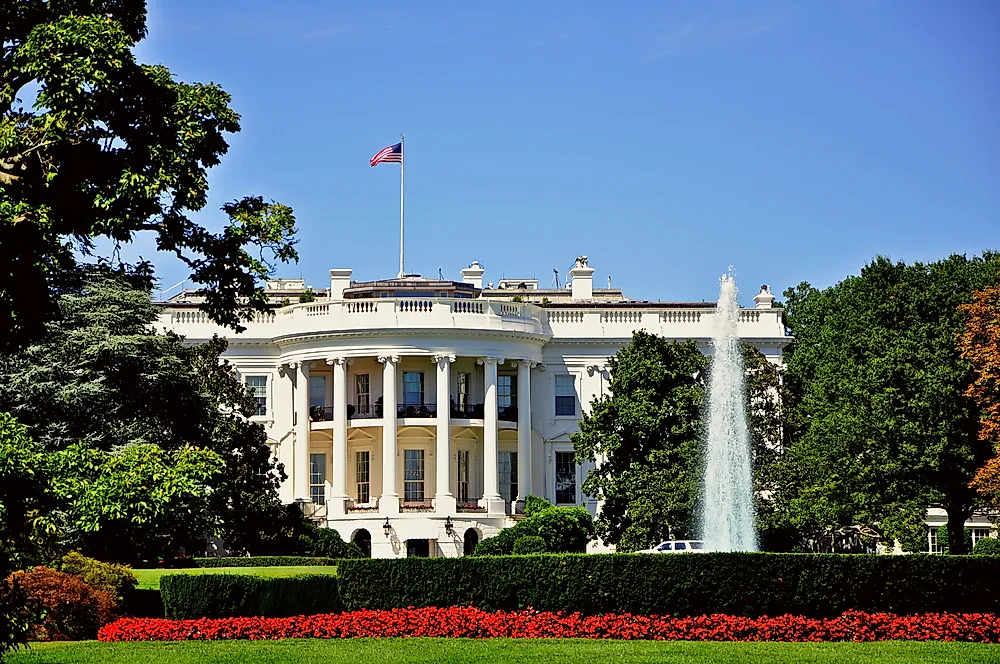
The most famous house in the country was designed by Irish-born architect James Hoban and built between 1792 and 1800, which means presidents have been complaining about the plumbing for over two centuries. It holds about 132 rooms across the executive residence and the wings, including the Oval Office and the press briefing room you have seen on the news a thousand times. Less advertised are the amenities downstairs: a bowling alley and a chocolate shop, because apparently running the country requires both. It is the rare landmark that doubles as an office, a museum, and somebody's actual home.
United States Capitol

The Capitol has been an on-and-off construction project since 1793, which tracks for a building owned by Congress. The first section was finished around 1800, and the giant dome everyone pictures came much later, raised in cast iron between 1855 and 1866 and built straight through the Civil War on Lincoln's insistence that the work continue as proof the country would too. Here is the part most people miss: that dome is not stone at all, but cast iron painted to impersonate it, topped by the bronze Statue of Freedom. Inside its roughly 540 rooms Congress does its deliberating, while a few million visitors a year wander the building's art and history collection.
Chrysler Building

The Chrysler Building won the race to be the world's tallest through what can only be called a sneak attack. While its rival 40 Wall Street was busy declaring itself the winner, the Chrysler's architect had a 185-foot spire secretly assembled inside the building, then hoisted it up through the roof to grab the title at the last second. At 1,046 feet it became the first man-made structure to clear a thousand feet, and it held the world's-tallest crown for a grand total of eleven months before the Empire State Building turned up. The lobby is lined in red Moroccan marble, and steel eagles modeled on 1929 Chrysler hood ornaments jut from the corners near the top. It is still the tallest brick building on Earth, which is a strangely specific thing to be best at.
Fallingwater

Frank Lloyd Wright built Fallingwater between 1936 and 1939 as a weekend house for the Kaufmann family, then did the one thing no sensible architect does: he set it directly on top of a waterfall instead of across from it. The concrete terraces cantilever straight out over the falls on Bear Run, so the water runs underneath the living room rather than past a tidy picture window. The Kaufmanns reportedly expected a house with a view of the waterfall and instead got to live inside the sound of it. It is a museum now, and still one of the most quietly show-offy houses ever built in America.
Willis Tower

Chicago's Willis Tower spent its first few decades as the Sears Tower, and plenty of locals still refuse to call it anything else. At 1,451 feet and 110 floors, it was the tallest building in the world for about twenty-five years after opening in 1973. Architect Bruce Graham and structural engineer Fazlur Rahman Khan built it as nine square tubes bundled together, a system Khan devised to keep a building this tall from swaying itself apart, reportedly settling on the shape by stacking nine cigarettes on a desk. The black aluminum and bronze-tinted glass make it look severe from a distance, right up until you reach the glass-floored Ledge boxes that let you stand on apparently nothing, more than 1,300 feet over the street.
Transamerica Pyramid

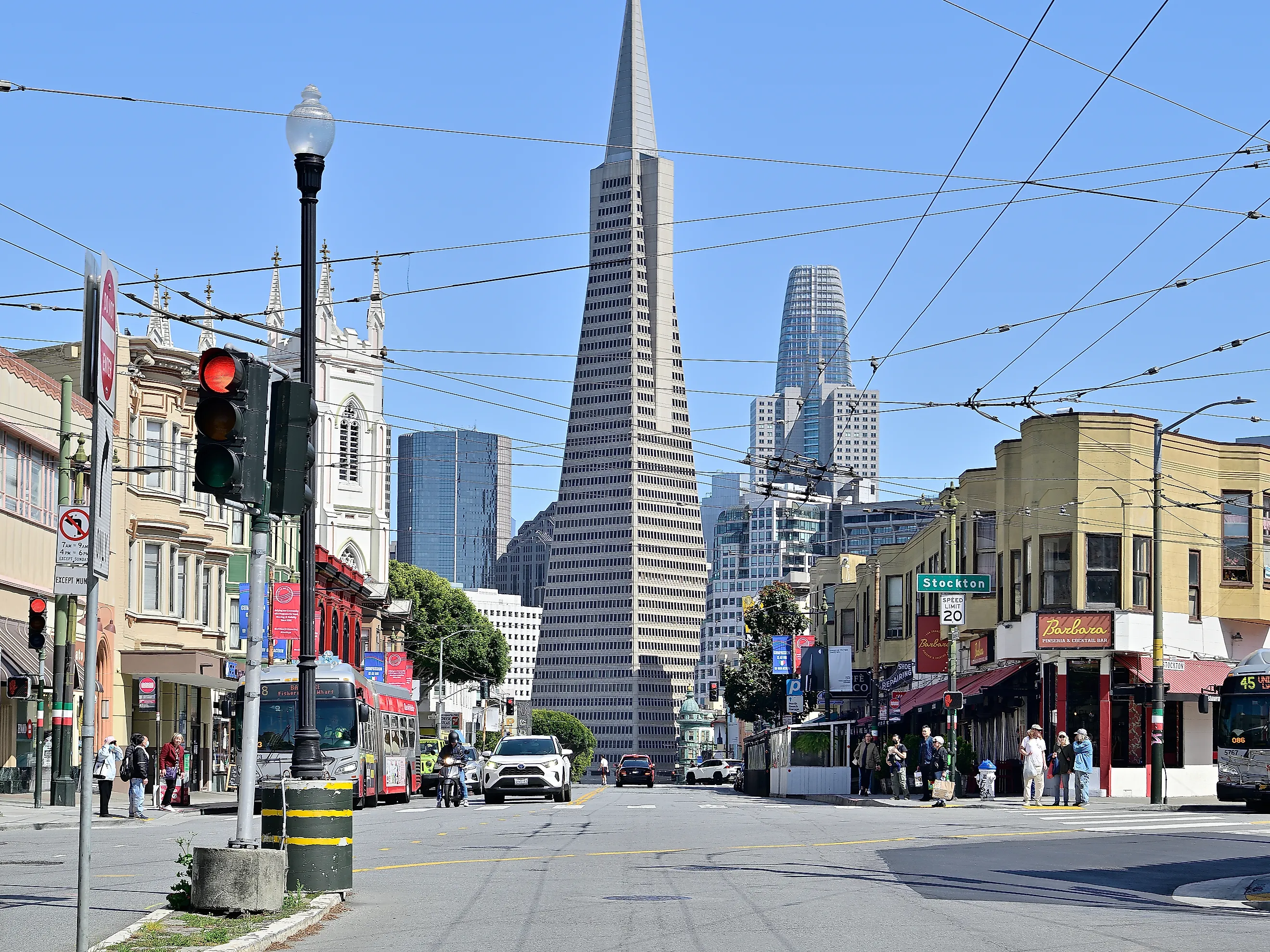
San Francisco's Transamerica Pyramid looks less like an office tower and more like something an advanced civilization left behind, which is roughly the reaction it got in 1972. Architect William Pereira gave it the pyramid shape on purpose, partly so it would cast less shadow on the streets below and partly because he could. It stands 853 feet over 48 floors, was the tallest building in the city until Salesforce Tower edged past it in 2018, and carries two wings near the top holding an elevator shaft on one side and a stairwell on the other. During the holidays a beacon called the Crown Jewel lights up at the peak, in case anyone forgot which pointy building was theirs.
Faneuil Hall

Faneuil Hall has stood in Boston since 1742, when wealthy merchant Peter Faneuil paid to give the town a combined market and meeting hall and hired the painter John Smibert to design it. The arrangement was simple: shops downstairs, arguments upstairs. Those upstairs arguments turned out to matter, because Samuel Adams and James Otis used the Great Hall to rail against British rule, earning the brick building its nickname, the Cradle of Liberty. One clarification worth making: Faneuil Hall is the single brick hall with the gilded grasshopper weathervane on top, not the three long granite buildings beside it, which are the Quincy, North, and South Markets and only arrived in the 1820s. According to legend, knowing what sat on that roof was once used as a quick test to catch out spies.
Hollywood Bowl

The Hollywood Bowl is the one entry here that bends the definition of building, since it is really an outdoor amphitheater carved into a canyon in the Hollywood Hills, with the Hollywood Sign visible off to the northeast. Its signature is the band shell, the stack of concentric arches behind the stage that flings sound out over the audience. It opened in 1922 and is the largest natural amphitheater in the United States, seating somewhere around seventeen thousand people on benches that follow the slope of the hillside. The Beatles played here, and so has nearly everyone else. It earns its place less as architecture than as the way a summer night in Los Angeles is supposed to sound.
Seattle Central Library

The newest building on the list, the Seattle Central Library opened in 2004 and looks like a stack of glass boxes that shifted in transit and never got straightened. That was the point. Rem Koolhaas and Joshua Prince-Ramus of the firm OMA wrapped eleven floors in a diagonal steel-and-glass grid, 185 feet tall, and ran the entire nonfiction collection up a continuous spiral ramp so the books never break across floors in the middle of a Dewey Decimal number. Critics have called it a crystal frog and a lumpy gift package, usually as a compliment. It holds around 1.45 million books and, unlike a lot of buildings that win architecture awards, people genuinely seem to enjoy using it.