The National Parks With Hoodoos
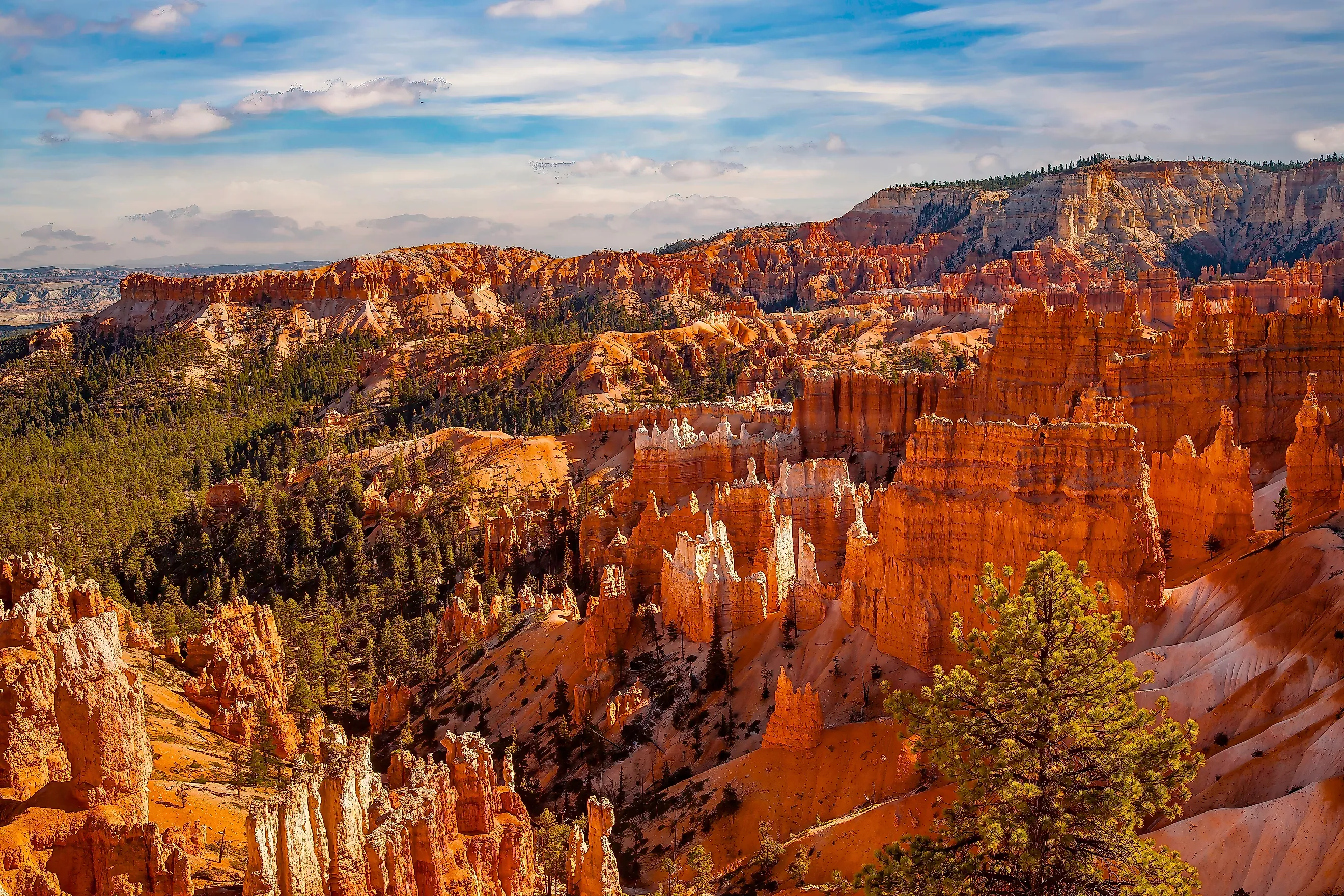
Bryce Canyon National Park holds the world's largest concentration of hoodoos. Located in Utah, the park is most well known for its vast array of uniquely shaped rock formations, which are known as hoodoos. These rocks are made almost entirely out of sedimentary rocks, which are more easily eroded, slowly crafting the rocks into spires. These formations are very rare, as they require a complex set of geological conditions to occur.
What is a hoodoo?

The term hoodoo itself refers to rock formations that arise out of arid landscapes, including badlands. They go by several different names such as fairy chimneys or tent rocks due to their shapes. Hoodoos have no defined shape or size, ranging in size from just a few feet to hundreds of feet. What sets them apart is not their size but rather how they are formed.
These formations have a varying thickness that can be seen by the naked eye. This variation comes through erosive forces. Initially, a hoodoo is part of a land formation, which is slowly eroded through several natural forces such as rain, snow forming then melting, and wind, creating a spire. A hard, resistant caprock on top protects the softer rock column beneath it. Rain tends to flow down the spire.
Hoodoos are often compared to pinnacles, but hoodoos are thicker than pinnacles, and a pinnacle does not have the spire or roof on top. Much like the badlands, hoodoos are often a variety of colors, which reflect the different sediments and states of erosion in their layers of rock. Hoodoos form mostly in arid and semi-arid regions that have large amounts of clay and soft sediment that can be eroded.
Another facet that makes these structures so rare is that the natural forces that formed them will eventually wear them down and destroy them.
How were the hoodoos formed in Bryce Canyon National Park?

The hoodoos in Bryce Canyon National Park were formed through several stages that first began 50 million years ago. Initially, flat rocks were laid down via an ancient body of water called Lake Claron. These rocks were in part formed by particles slipping down from higher elevations together to form limestone, mudstone, siltstone, and sandstone.
These rocks would rise up to much higher elevations through plate tectonics. The North American and Farallon plates collided 50 million years ago, and the Farallon Plate was slowly moved under the North American plate.
Over time, the Farallon plate began to snap apart, and heat flowed up through it, making the land rise to create the Colorado Plateau. This plateau was the building block for the hoodoos.
The hoodoos of Bryce Canyon National Park were created through a long process of erosion from the elements present at the high elevations in the park, which rise to a maximum of 9,115 feet, and lead to cold temperatures. For more than 170 nights of the year, the park is impacted by freezing temperatures, which freeze moisture inside the rocks into ice. This expansion puts pressure on the rock, breaking it down through a process known as ice wedging. Another factor is acidic rain, which dissolves the calcium carbonate in the rocks that binds them together.
The process of a hoodoo's formation happens in stages. First, the plateau is broken down into individual walls, then "windows" are formed into the rock, and eventually only the individual hoodoo is left.
Things to do

Out of all the activities in Bryce Canyon National Park, the most popular is going out to view the hoodoos via the Bryce Amphitheater. This region has the largest concentration of hoodoos not just in the park, or the state of Utah, but rather the entire world.
It is named as an amphitheater due to its bowl shape, which is formed by rain and melting snow. From the amphitheater, one can access several overlooks such as Bryce Point and Sunrise Point that offer dazzling views of the hoodoos slowly circling down.
One of the most iconic hoodoos one can see in this region is Thor's Hammer. Named after the weapon and tool used by the Norse god, the top of it resembles a large hammer held up by a smaller section, which looks like the handle.
Many of these overlooks are also accessible via hiking trails such as Rim Trail, which begins south of Bryce Point at 5.5 miles and goes around the edge of the Amphitheatre. Those who prefer driving to walking can take the 18-mile Southern Scenic Drive, which passes through 9 overlooks along with high points in the park such as the more than 9,000-foot Yovimpa Point, and views down below in Agua Canyon. The landscape also changed this high up, as the ponderosa forests became mixed with white fir, limber pine, aspen, and bristlecone pine.
Visitors during the day can find more information about the geology and history of Bryce Canyon at the Visitor Center Museum, while those at night can go stargazing, as the park is designated as a Gold Tier International Dark Sky Park and is open 24 hours a day. There's a night sky ranger program for those who want a guided experience.
Wildlife

Across the 35,835 acres of Bryce Canyon National Park, there are many types of wildlife one can see, ranging from 59 species of mammals, 175 species of birds, and 11 species of reptiles.
The largest mammals one might run into are the Rocky Mountain elk, mountain lion, and black bear. Rocky Mountain elk can grow up to 8 feet tall and weigh 700 pounds. As elk, they are the second-largest members of the deer family, right behind moose.
Black bears tend to frequent the higher elevations of the park and enter dens in the winter. Unlike other bears, they do not enter a complete period of hibernation but instead are in a torpor, a deep rest state. Mountain lions are active at night as their large eyes with large numbers of rods are adapted to see prey in dim light.
Birding is quite a popular activity in Bryce Canyon due to the variety of birds one can spot, ranging from great horned owls to the peregrine falcon, wood warblers, and the red crossbill. Peregrine falcons in particular form nests in large cliffs, and are among the largest falcons in North America at close to 20 inches in length.
For reptiles, there are a number of lizards found here, including the side-blotched lizard. The only venomous snake found in the park is the Great Basin rattlesnake. It can grow up to 64 inches long and features a light brown or gray body with blotches down its back. These snakes are most commonly spotted at dawn or dusk, and they tend to keep out of higher elevations.
Park authorities note that snake bites are exceedingly rare and mostly occur when someone is trying to harm or harass a rattlesnake. It is illegal to harm these snakes.
When will the hoodoos disappear?
Hoodoos erode at an average of 2 to 4 feet every 100 years, meaning eventually they will erode away. Eventually, the canyon will gain access to the watershed of the Sevier River, which will impact the pattern of erosion and in turn reshape the hoodoos in a V-shaped canyon. This entire process could take around 3 million years.
Another factor is the impact of global climate change. Park authorities note that there hasn't been enough research done into how climate change could impact hoodoos, especially if freeze-thaw cycles are interrupted by rising temperatures.
On the individual side, hoodoos should not be walked on, as foot tracks can weaken the clay slopes that keep the hoodoo upright. This is why the park's hiking trails go around the hoodoos to view them and not right up to the structures.