The National Parks Along the Gulf Coast
National Parks along the Gulf Coast reveal remarkable scenery, diverse wildlife, and some of North America's most distinctive and remote coastal ecosystems. Together, these two parks cover approximately 2,457 square miles of tropical and subtropical ecosystems that make up the Everglades and Dry Tortugas Biosphere Reserve, designated in 1976 under UNESCO's Man and the Biosphere Programme. One park is located 68 miles west of Key West, near the meeting point of the Gulf of Mexico and the Atlantic Ocean, accessible only by boat or seaplane. In contrast, the other is situated on South Florida's mainland and protects approximately 1.5 million acres of marshes, mangroves, and sawgrass prairies.
Everglades National Park

One of the world's most distinctive wetland ecosystems, Everglades National Park is home to iconic native wildlife, outdoor recreational opportunities, and threatened and endangered plants, including the pineland sandmat and the Everglades bully. Congress authorized the Everglades as a National Park in 1934, and President Harry S. Truman officially dedicated it in 1947. The first National Park established primarily to protect its biodiversity, rather than scenery, it has been designated as an International Biosphere Reserve, a Wetland of International Importance, and a World Heritage Site.
The park preserves approximately 1.5 million acres of wetlands, mangrove forests, pinelands, and marine habitats. It has the largest continuous tract of sawgrass prairies in North America, along with the largest mangrove ecosystem in the western hemisphere. The extensive park spans Miami-Dade, Collier, and Monroe counties near the southern tip of Florida's mainland. The third largest National Park in the lower 48 states, it is also the largest subtropical wilderness in the country. It is one of the only places that has both alligators and crocodiles, due to the existence of saltwater, freshwater, and brackish estuaries.

The Everglades is sustained by a slow-moving freshwater river, roughly 60 miles wide, that flows south from Lake Okeechobee toward Florida Bay. Nicknamed "river of grass," because of its extensive system of sawgrass and other wetland vegetation, the Everglades functions as a natural filtration system that supplies drinking water to more than eight million residents of South Florida.
Park entry points include the Gulf Coast Visitor Center south of Everglades City, the Shark Valley Area along the Tamiami Trail, and the Ernest F. Coe Visitor Center at the main headquarters. Visitors can explore on foot or by private boat, while airboat tours operate just outside the park along the Tamiami Trail. Ranger-guided tours and kayak rentals are available. The Wilderness Waterway is a 99-mile path along the western portion of the park, and Long Pine Key Trail is a 22-mile system of interconnected hiking and biking trails. Tram Road has a 45-foot observation tower for wildlife viewing.
Swimming and snorkeling are discouraged in canals, freshwater lakes, and marked channels because of safety concerns and wildlife, such as crocodiles and alligators. Other wildlife found within the park includes the Florida panther and the West Indian manatee, as well as species like the non-native Burmese python.
Dry Tortugas National Park

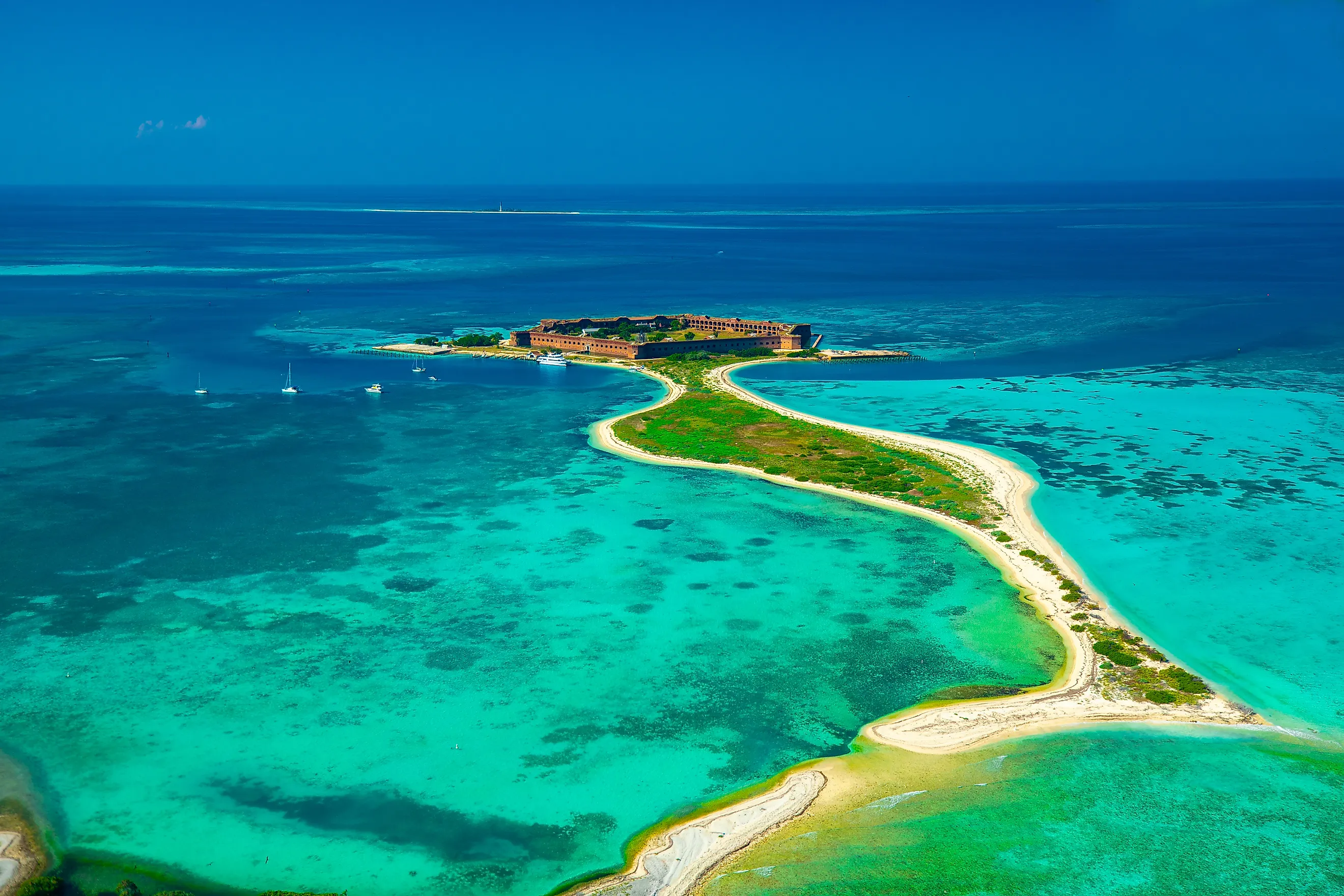
While Everglades National Park offers above-the-water and terrain-based exploration, Dry Tortugas National Park invites visitors to jump into the scenic waters of the Gulf of Mexico. Located about 68 miles west of Key West, Dry Tortugas lies at the western end of the Florida Keys near where the Atlantic Ocean connects with the Gulf. Snorkeling and swimming among colorful tropical fish and other marine animals are focal points of recreation at this remote destination, accessible via seaplane, private boat, or the Yankee Freedom high-speed ferry.
The park spans 100 square miles of open water and seven small islands, providing vital habitats for migrating birds, marine animals, and coral reefs. Its reef system supports sponges, lobsters, anemones, and about 30 coral species, including staghorn, elkhorn, and rough cactus coral. Notable reef sites include Little Africa, a beginner-friendly area near Loggerhead Key known for coral heads and tropical fish, and Texas Rock, a deeper site near Garden Key featuring large coral mounds and marine life. The Windjammer Wreck, an artificial reef created when a vessel ran aground in 1907, has become a thriving habitat where divers may discover rare black coral and schools of colorful fish.

The 14-acre Garden Key, the second largest and most well-known island, is home to the Garden Key Lighthouse and the hexagon-shaped 19th-century Fort Jefferson. Constructed beginning in 1846, Fort Jefferson was intended to protect one of North America's busiest shipping routes and serve as a military outpost, though it was never fully completed. The fort was used as a prison during the Civil War. Garden Key is the site of the park's headquarters as well as a visitor center and off-the-grid campsites. To visit other islands, you will need a private boat, as the ferry service only docks at Garden Key.
Loggerhead Key, the largest island, is about three miles from Garden Key. It is only open for day use and is accessible only via private boats or by kayaking from Garden Key. The Loggerhead Key Lighthouse was constructed around 1858. The park's outlying location provides refuge and habitat to a variety of marine animals. Five sea turtle species are found there, including Kemp's Ridley, the hawksbill, and the loggerhead. The islands provide nesting habitats for colonies of sooty terns and frigatebirds.
In 1513, Ponce de Leon named the area Las Tortugas because of the many sea turtles. The word "Dry" was later added to warn people about the lack of fresh water. Congress established the region as a National Park in 1992 to protect the marine ecosystem and its surrounding waters. It had previously been designated Fort Jefferson National Monument by President Franklin D. Roosevelt in 1935.
Gulf Coast National Parks
These two Gulf Coast parks are distinguished by their native wildlife, diverse ecosystems, and varied terrestrial and marine landscapes. The Dry Tortugas encompasses miles of open water and small islands, inviting visitors to snorkel and swim among coral reefs and tropical fish. Meanwhile, the Everglades shifts the focus to solid ground, emphasizing land-based recreation, airboat tours, and charter fishing excursions. Together, they both protect internationally recognized ecosystems that support biodiversity and illustrate the ecological importance of the Gulf Coast.