The 10 Highest National Parks Of The United States
Here is a fact that should bother you more than it does: the highest national park in America is one you can stand in at sea level. The United States protects 63 national parks, and ranking them by height sounds simple until you realize "height" can mean wildly different things. This particular list measures the single tallest peak inside each park's boundary, which is why an Alaskan park whose floor touches the ocean can still claim the crown on the strength of one enormous mountain. It is a ranking of bragging rights, basically, decided by whichever summit pokes highest into the clouds. The full top ten sits in the table below, in feet, the way Americans actually measure their mountains. Fair warning: the metric makes less sense the longer you think about it.
Denali National Park and Preserve

Denali takes the top spot because it contains Denali itself, the tallest mountain in North America at 20,310 feet. That is the entire case, and it is more than enough. The peak is so dominant that on a clear day you can see it from Anchorage, 130 miles away, which is a bit like spotting a building from the next state. The park around it, established in 1917 and expanded to six million acres in 1980, runs from spruce forest up through tundra to bare ice, and it shelters grizzlies, wolves, caribou, and moose. You can stand near the park entrance at a modest few hundred feet and technically be inside the highest national park in the country, which tells you everything about how this ranking works.
Wrangell-St. Elias National Park and Preserve

Wrangell-St. Elias is the largest national park in America by a comical margin, spreading across 13.2 million acres, which makes it bigger than Switzerland and roughly the size of six Yellowstones stacked together. Almost nobody has heard of it. Its high point, Mount Saint Elias, stands 18,008 feet tall and rises nearly straight up from the Gulf of Alaska, giving it some of the greatest vertical relief on the planet. It runs from sea level to three and a half miles up, with very little in between. The park is a tangle of volcanoes, glaciers, and peaks, and most of it has never felt a human footprint, mostly because getting there requires either a bush plane or a serious commitment to suffering.
Glacier Bay National Park and Preserve

Glacier Bay claims third place thanks to Mount Fairweather, which tops out at 15,325 feet and wears one of the most sarcastic names in American geography. Captain Cook spotted it on a rare clear day in 1778 and named it accordingly, apparently unaware that the surrounding coast is one of the stormiest, cloudiest, foulest-weather places on the continent. The park is best seen from the water, where tidewater glaciers calve directly into the sea and the mountains climb straight out of the waves. It is the clearest illustration of this list's central absurdity: a park you experience at sea level, ranked among the highest in the nation.
Sequoia National Park

Sequoia is the overachiever of the group. It holds Mount Whitney at 14,505 feet, the highest point in the contiguous United States, and it also protects the largest living thing on Earth, the General Sherman tree, which weighs an estimated 2.7 million pounds and has been growing for over two thousand years. Established in 1890 as the country's second national park, Sequoia manages to be both the tallest place in the Lower 48 and the home of the planet's biggest organism. Some parks have a signature feature. This one collects them.
Mount Rainier National Park

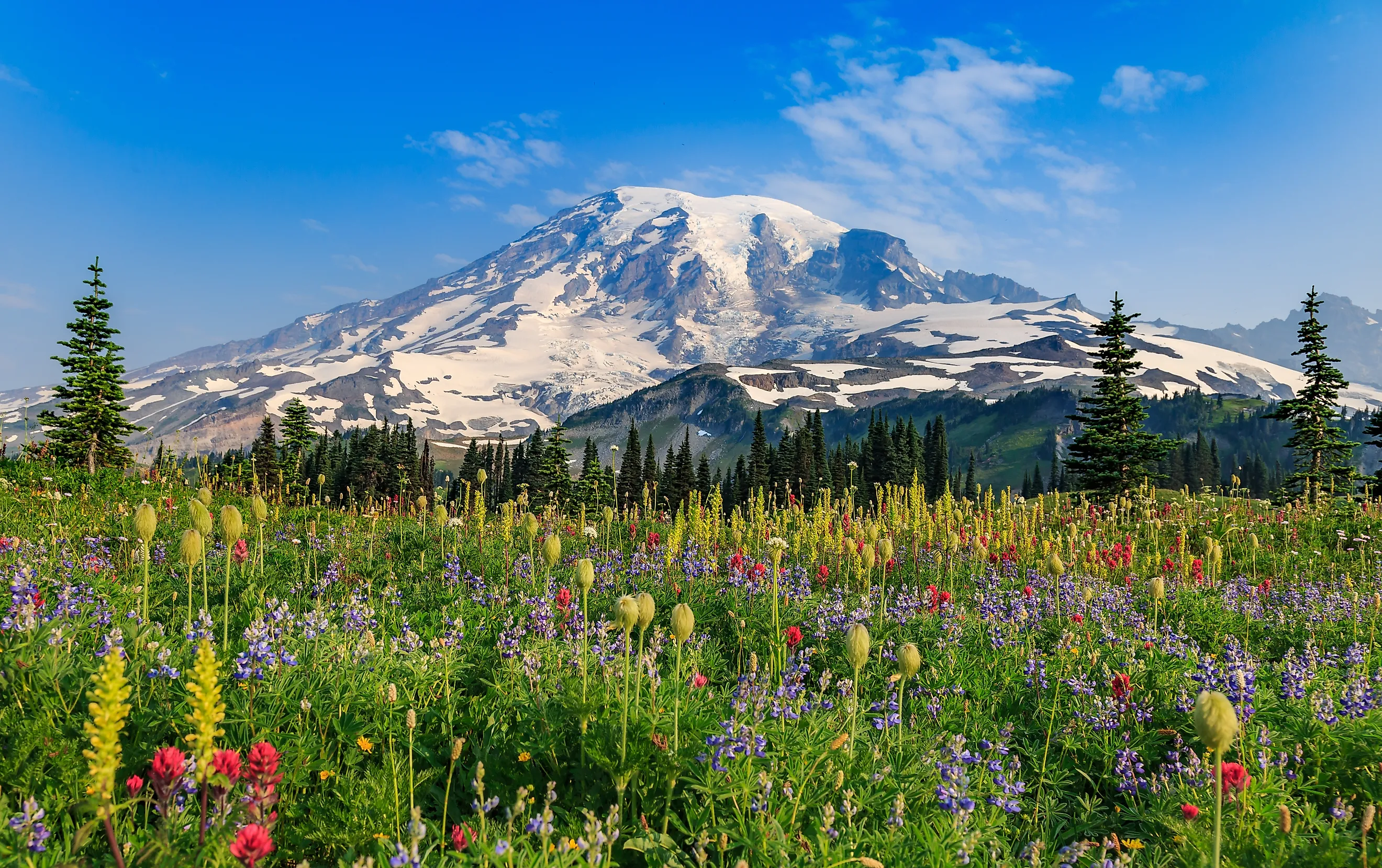
Mount Rainier National Park is essentially one enormous volcano wearing a park as a costume. The peak rises to 14,411 feet and carries 26 named glaciers, more ice than any other mountain in the contiguous United States, all of it sitting on top of an active volcano that geologists watch nervously. Established in 1899, the park frames the mountain with wildflower meadows and old-growth forest that make the whole thing look serene right up until you remember what it is. Rainier is visible from Seattle on clear days, looming over the skyline like a polite reminder that the Pacific Northwest is geologically alive.
Grand Teton National Park

Grand Teton ranks eighth at 13,775 feet, and it earns extra credit for sheer drama. The Teton Range skips the small talk entirely, rising abruptly from the flat valley floor with no foothills to ease you in, which is why the mountains look photoshopped onto the landscape even in person. The range is geologically young, still growing along its fault line, and the jagged profile reflects that youth. It is the rare mountain wall that manages to upstage every barn, lake, and bison placed in front of it, though plenty of photographers keep trying.
So What Does "Highest" Even Mean?
This is the part worth sitting with. Every park on this list ranks by its loftiest summit, not by its average elevation or by where your boots actually land. Measured that way, three of the top three parks reach down to the ocean, which makes "highest" a slightly ridiculous label. Flip the metric and the picture inverts completely. Rank parks by the ground under your feet, where even the parking lots in Colorado's Rocky Mountain National Park sit above 7,500 feet, and the Alaskan giants tumble while the Rockies dominate, because their lowest valleys start higher than most peaks elsewhere. Height, it turns out, depends entirely on whether you are measuring the mountain or the visitor.
The Highest National Parks In The United States
The ranking below measures each park by the elevation of its tallest peak. Figures are listed in feet with meters alongside, drawn from standard survey data.
| Rank | Park | Highest Peak | Mountain Range | Summit Elevation |
|---|---|---|---|---|
| 1 | Denali | Denali | Alaska Range | 20,310 ft (6,190 m) |
| 2 | Wrangell-St. Elias | Mount Saint Elias | Saint Elias Mountains | 18,008 ft (5,489 m) |
| 3 | Glacier Bay | Mount Fairweather | Fairweather Range | 15,325 ft (4,671 m) |
| 4 | Sequoia | Mount Whitney | Sierra Nevada | 14,505 ft (4,421 m) |
| 5 | Mount Rainier | Mount Rainier | Cascade Range | 14,411 ft (4,392 m) |
| 6 | Rocky Mountain | Longs Peak | Front Range | 14,259 ft (4,346 m) |
| 7 | Kings Canyon | North Palisade | Sierra Nevada | 14,248 ft (4,343 m) |
| 8 | Grand Teton | Grand Teton | Teton Range | 13,775 ft (4,199 m) |
| 9 | Hawaii Volcanoes | Mauna Loa | Hawaiian Islands | 13,681 ft (4,170 m) |
| 10 | Great Sand Dunes | Tijeras Peak | Sangre de Cristo Range | 13,604 ft (4,148 m) |
High Bar, Strange Yardstick
The top ten is a parade of genuine giants, from the roof of the continent in Alaska to a volcano in Hawaii that technically counts because one of its peaks scrapes 13,000 feet. What the list really proves is that superlatives need fine print. These parks are "highest" only by the narrow measure of their single tallest point, and that one rule produces a leaderboard where ocean-side parks outrank places you cannot reach without an oxygen-thin drive through the Rockies. It is a reminder worth carrying into every ranking you read: the answer always depends on exactly what someone decided to measure. In this case, they measured the mountain, and the mountains delivered.