5 Most Beautiful Gothic Churches In Tennessee
The Gothic churches found throughout Tennessee represent how European architectural styles were adapted to an area characterized by rivers and ridges. Permanent masonry and stone churches were developed as symbols of stability within developing cities, and throughout the late 19th and early 20th centuries, Episcopal, Catholic, and Lutheran churches adopted a range of Gothic designs. These churches featured pointed arches, load-bearing masonry, and stained glass in cities and academies across the South. Read on to discover how the Gothic architectural style has defined several of the state’s most beloved and enduring sacred spaces.
Calvary Episcopal Church, Memphis

This Episcopal Church is a rare survivor of Memphis’s architectural past and is one of only a few buildings that represent the city’s earliest religious history and limited Gothic-style architecture from that era. The congregation of Calvary Episcopal Church was founded in 1832, and its sanctuary is the oldest public building in continuous use in the city, one of only two pre-Civil War churches in Memphis (alongside St. Peter’s Catholic Church), and one of only three Gothic-style churches in the city. Calvary’s minister at the time of its construction, Rev. Phillip Alston, was the amateur architect who designed the church and modeled it on the designs of English Gothic parish churches. The tower was added in 1848, and the chancel was completed in 1881, both retaining the same stylistic elements as the original church.
The exterior of Calvary features pointed arches, steeply pitched rooflines, and buttressed walls, which are common elements of Gothic architecture. The interior of the church has a long, narrow nave and features stained glass windows, which are consistent with earlier Gothic-inspired Episcopal church designs. Calvary is still an active parish, providing visitors with the opportunity to observe the church in use during regularly scheduled services, rather than as a static monument. Due to its proximity to the historic core of downtown Memphis, Calvary Episcopal Church serves as a place of worship and one of Memphis’ most important surviving examples of 19th-century Gothic architecture.
St. Mary’s Episcopal Cathedral, Memphis

St. Mary's is one of Memphis’ finest examples of the Gothic Revival style of architecture, representing the shift toward a more formalized church tradition for Memphis in the 19th and 20th centuries. St. Mary’s Episcopal Cathedral was designated as a cathedral in 1871, making it the first Episcopal cathedral in the American South. The present Gothic Revival structure was designed by architects William Halsey Wood, L. M. Weathers, and Bayard Snowden Cairns. The exterior of the cathedral has buttressed walls, lancet windows reaching high into the air, and a square bell tower, and each element was carefully proportioned to illustrate medieval precedent adapted to a modern American urban environment.
Upon entering the cathedral, visitors will find the second major feature of the cathedral, Constance and Her Companions, an altar dedicated to the memory of Anglican nuns and clergy who lost their lives while caring for victims of the yellow fever epidemic that devastated Memphis in 1878. In addition, when the cathedral is open and no worship service is being conducted, the public can tour the cathedral to see the stained glass, carved stone details, and memorials, which tell the story of the city’s religious and social history. Due to its proximity to other historic downtown locations in Memphis, St. Mary’s Episcopal Cathedral is frequently explored along with other architectural landmarks in the city.
Christ Church Cathedral, Nashville

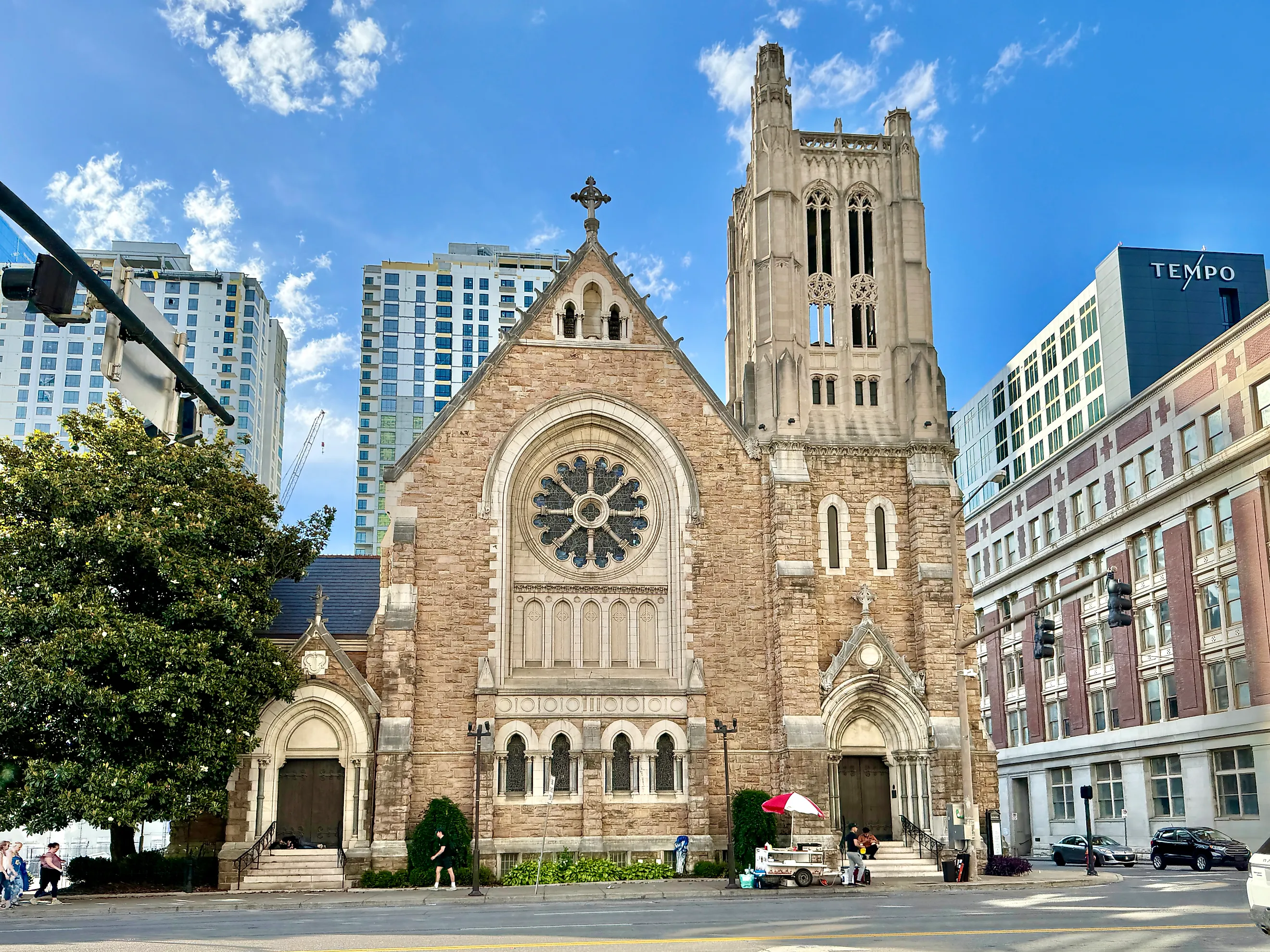
This cathedral is the first example of the introduction of Gothic Revival into Nashville’s early public architecture. Christ Church parish was founded in 1829, making it the oldest Episcopal parish in Nashville, and the cathedral was designed by architect Francis Hatch Kimball, who was well known for his use of English Gothic design principles along with American materials. His design for the cathedral included a limestone building in the form of a cross, with an emphasis on verticality achieved through the use of pointed arches, buttresses, and high lancet windows. Because the exterior detailing is relatively simple, the cathedral fits well into Nashville’s historic urban area as an example of English parish church designs instead of the elaborate forms found in many continental buildings. The first Eucharist at Christ Church was celebrated on Christmas Day, 1894, and in 1997, the church was officially designated as the cathedral of the Diocese of Tennessee, recognizing its role as an important place of worship in Tennessee.
The interior of the cathedral has maintained many of its original features, including ribbed vaults, carvings in the wood furnishings, and stained glass windows that depict both biblical stories and the history of religion in Tennessee. Although services are held throughout the week, when the cathedral is open to the public during non-service hours, visitors can walk through the nave and chapels, where there are numerous memorial displays that reflect the life and times of Nashville from the late nineteenth and early twentieth centuries. Due to its proximity to the Tennessee State Capitol and the historic districts of downtown Nashville, Christ Church Cathedral is often included in architectural tours that detail the development of the institutions of early Nashville.
All Saints’ Chapel, University of the South, Sewanee

One of the most iconic examples of late Gothic Revival in Tennessee, the chapel is considered the symbolic heart of the University of the South, long before it was constructed. In the 1850s, planning for the chapel began, and the university received a grant of 10,000 acres of land, located between Nashville and Chattanooga, from the Sewanee Mining Company. Construction of All Saints’ Chapel was undertaken in two major phases between 1904 and 1959, under the direction of Ralph Adams Cram, one of the nation’s leading architects of the Gothic Revival style. Cram designed the entire structure using local sandstone and utilized load-bearing masonry rather than concrete or steel. The Gothic characteristics of the exterior include a crenellated parapet, flanking entrance towers, pointed arches, and a large rose window inspired by Notre Dame in Paris.
The interior of the chapel was also planned to be a large and monumental worship space rather than a small collegiate chapel. The wide nave is vaulted by stone ribs and features Gothic Revival pews and choir stalls, with seating for approximately 1,400 people. Most of the stained glass was created during the 1950s, when the clerestory and side aisles were completed with windows that employed both medieval visual language and contemporary subject matter. Biblical subjects are featured alongside depictions of artists, scientists, and notable individuals from the history of the University, and contemporary images including students dressed in mid-century fashion, civil rights-era themes, and even a Volkswagen Beetle. The chapel continues to serve as a place of worship and as an integral part of university life. It is available for viewing by the public outside of religious services and is situated at the center of the walkable, wooded campus, where architecture, landscape, and history are intertwined.
St. John’s Lutheran Church, Knoxville

Built in 1913, St. John’s Lutheran Church stands as one of Knoxville’s clearest examples of late Gothic Revival architecture adapted for a Lutheran congregation. In 1913, St. John’s was built according to the plans created by local architect R.F. Graf. The church is made from random-coursed Indiana sandstone with a stone base. The dimensions are approximately 90 feet by 100 feet, giving the church a solid presence within the city. The pointed arches, steeply pitched roofs, and careful balance of masses reflect the elements of the Gothic Revival style, and they were also practical for a parish church in urban Tennessee during the early part of the 20th century.
The interior of the church provides the same sense of clarity and focus as the interior of other Lutheran worship spaces. Tall lancet stained glass windows provide light to the interior, which helps soften the heavy stone walls and draws the eye to the altar area. St. John’s is still an active congregation today and hosts weekly services and community functions that allow people to see the church as a functioning place of worship, not only a historic site. As such, the church is commonly included on architectural walking tours of downtown Knoxville and is an excellent example of how the Gothic Revival style was locally interpreted with durable materials and local craftsmen.
Tennessee’s Finest Gothic Churches
The development of Gothic architecture in Tennessee came from a combination of church buildings centered in developing cities and college campuses, as well as the river towns that supported those developments. One of the first examples of Gothic architecture in Memphis is found at Calvary Episcopal Church, which was originally constructed by the congregation before the Civil War. The nearby St. Mary’s Episcopal Cathedral has elements of Gothic Revival and serves as a reminder of the clergy members who died in the yellow fever epidemic that affected the city in 1878. Christ Church Cathedral in Nashville is an example of an urban Gothic-style building designed by nationally recognized architects, and All Saints’ Chapel in Sewanee is distinct because of its large size, its use of local sandstone, and its academic location. While St. John’s Lutheran Church in Knoxville shows how late Gothic Revival styles can be incorporated into Midwestern materials and craftsmanship, all five of these churches have helped to document and show the evolution of both Tennessee’s architectural history and its religious heritage through their stone, glass, and enduring form.