7 Best Downtowns In Arizona
The charming desert towns of Arizona have a unique way of mixing Western history, Victorian architecture, creative culinary scenes, and whimsical art. The walkability of the downtown areas in these smaller towns makes them a desirable destination for visitors seeking to take in multiple sites in a compact area. The historic Tlaquepaque Arts & Shopping Village in downtown Sedona, the Museum of Indigenous People in Prescott, and Dead Horse Ranch State Park in Cottonwood are just a few examples that showcase the art, history, culture, diversity, and liveliness of these seven best downtowns in Arizona.
Cottonwood

Founded in the Heart of the Verde Valley Wine Country, Old Town Cottonwood is one of the main attractions in Cottonwood, drawing visitors to its Main Street, which features over 60 businesses. Founded in 1879, the Wild West town started as a vital farming, supply, and transportation hub for nearby miners in Jerome and soldiers at Camp Verde before it had a brief stint as a rowdy town with gambling halls and a rough atmosphere, to eventually become the vintage 1920s era charming town it is today. Sprinkled with historic buildings to host wineries, galleries, and restaurants, Old Town Cottonwood has retained its charm while filtering out its rough exterior. For more local history, the Clemenceau Heritage Museum has been providing guests with the history of the Verde Valley since 1991. Located in the former classrooms of the Clemenceau School, the museum is focused on preserving the town's heritage and culture and on displaying it through exhibits featuring Sinagua and Yavapai Tools, early 20th-century home interiors, a mid-century Clemenceau Public School classroom, and more.
History does not need to be limited to museums and exhibits. Dead Horse Ranch State Park holds Cottonwood history that can be explored through nature and exploration. Acquired by Arizona State Parks in 1973, the park offers a trail system of over 20 miles, some of which lead up to the high desert of Coconino National Forest. Named by the original owners in honor of the dead horse they saw in the field while scouting farms, the park is centrally located near the larger towns of Flagstaff, Phoenix, and Prescott for easy access.
Sedona

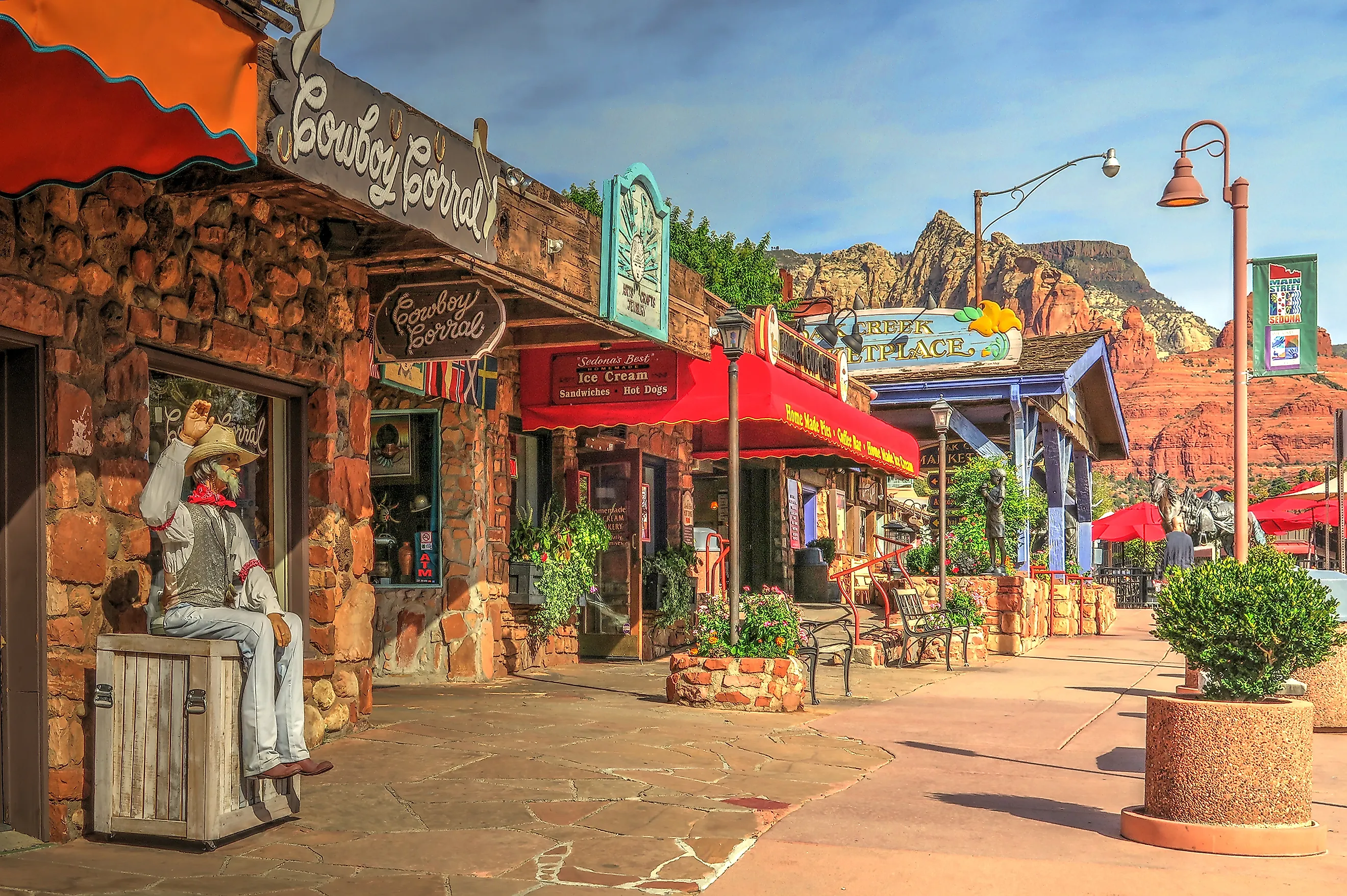
Step into Sedona and experience its culture, heritage, history, and entertainment all in one place. The Tlaquepaque Arts & Crafts Village Shops were designed with an Old Mexico aesthetic and crafted with an emphasis on how individuals, gardens, fountains, and trees shaped social interaction in a public setting. The iron grillwork, enormous carved doors, handmade lanterns, clay pots, and benches in the village all originated from Mexico and have adorned the specialty shops, art galleries, and restaurants since their arrival. Embrace even more of this desert town’s heritage at Amitabha Stupa and Peace Park. The park is a destination designed for prayer, meditation, and the experience of peace in a sacred location. The 36-foot-tall Amitabha Stupa is open to all who wish to visit and can be found at the foot of Thunder Mountain. Various findings and offerings can be located inside the stupa and relate to spreading compassion in the world, ending suffering in the world, and personal spiritual growth.
Mix culture and adventure with a hike to Seven Sacred Pools, a series of trickling blue pools that flow into each other as they cascade over layers of tawny rock. The pools are framed by a series of deep green juniper trees and situated between the Oak Creek Mountains and Sedona’s desert landscape. Recognized for its religious significance for Sedona’s indigenous people, the pools symbolize a relationship between water, life, and harmony in the desert landscape.
Bisbee

Founded in 1880, Bisbee was once a thriving mining town. The Bisbee Queen Mine Tour offers visitors a chance to tour the mines that once made this a bustling town. The mines were closed in 1975 and officially reopened in 1976, but for different purposes this time. To keep this history of mining alive, they were reopened for history enthusiasts and all guests to enjoy a ride into the mountain on the underground mine tour train. The Bisbee Mining & Historical Museum also offers insight into Bisbee's mining era. The interactive museum tells the story of this western copper mining town’s role in the industrialization of the U.S. The Museum shares the stories of the people who lived through the family and social issues over the last 125 years and how their reactions to those issues helped shape the city, the state, and the U.S.
Stay a while, and spend the night at the Copper Queen Hotel, nestled in the historic heart of Bisbee. The hotel's Victorian charm transports guests to the rich history and culture of the small mining town. The antique luxuries and modern amenities offer a unique and memorable stay. For paranormal junkies, the hotel is also rumored to be haunted, with the spirits of Julia Lowell and the ghostly child Billy roaming the halls!
Prescott

If there is a town to get extensive history about Arizona, desert landscape, and Indigenous people, downtown Prescott is it. The Sharlott Hall Museum displays Arizona’s heritage and history through a series of historic buildings, exhibits, and a rose garden. There are 11 buildings on the 4 acres that include Fort Misery, the oldest surviving log cabin in Arizona, Fremont House, built with local milled lumber, Governor’s Mansion, and others, some of which are included on the National Register of Historic Places. Tour the buildings on the ground and take a detour to the Territorial Women’s Memorial Rose Garden, which honors over 500 women, representing almost every occupation and ethnic background.
The stone buildings on the site of the Museum of Indigenous People, completed in 1935, exhibit displays of prehistoric, historic, and modern examples of Indian cultural and artistic material from the southwestern U.S. and Mexico. Be a guest of the visiting speakers, artist talks, demonstrations, and local programs, or just take in the rotating exhibits on site. The Phippen Museum is another institute dedicated to the preservation and exhibition of Western art and public education regarding its diverse heritage, history, legends, and influence on American West art. The exhibits showcase the Arizona Rancher & Cowboy Hall of Fame, Bill & Marion Gary Western Heritage Gallery, History of the Cowgirl, and others. Rotating exhibits present rare surviving objects created by “painters of saints” that are preserved for their beauty and enduring faith to the people of the Spanish Frontier who created and cherished them.
Wickenburg

Enjoy a relaxing afternoon in Wickenburg at the Hassayampa River Preserve. The 100-mile river flows mostly underground, but it emerges within the preserve and displays its crystal-clear waters for visitors to enjoy. Some of the state’s most unusual wildlife can be found along the riverbed. Enjoy searching for creatures, or take the trails along abundant river bottoms, across the river’s floodplain, or through the dense cottonwood-willow forests. For more tree-related attractions, although not as majestic, an old mesquite tree located behind a gas station is quite a draw in this small town. The Wickenburg Jail Tree is over 200 years old, but it's not its age that draws curious folks; it’s the tree's folklore. It is believed the ancient tree once served as a makeshift jail in the Old West. Allegedly, from 1863 to 1890, drunks and criminals who were apprehended in Wickenburg were shackled to this tree in the middle of town, as Wickenburg had no jail of its own. A small plaque near the site provides a slight bit of interesting history as well, no criminal had ever escaped from the jail tree!
For a more relaxing evening, stop in and catch a new release or cinematic classic at The Saguaro Theater. Established in 1948, it has been the only movie theater in Wickenburg since then. The neon-colored marque is a showstopper itself, but the films range from first runs to classics, as the theater aims to always have a film playing. Upcoming and new releases, older quality films, and some well-known films that never quite got the notoriety they deserved can all be watched at the Saguaro Theater.
Ajo

Downtown Ajo offers a journey back in time through its historic streets lined with Spanish Colonial Revival architecture. The Ajo Plaza is a great place for leisurely strolls, followed by coffee and delicious bakery treats at Oasis Coffee. Ajo offers a great outdoors experience, including the Cabeza Prieta National Wildlife Refuge. Established in 1939, the refuge was created to conserve and develop wildlife. Explore the Sonoran Desert, the world's most biodiverse desert, and scan the horizon for a glimpse of the wildlife that thrives there. With almost 60 species of mammals, 350 species of birds, 20 amphibians, 100 reptiles, and 30 species of native fish, there is no shortage of animals to be spotted. If the animals aren’t as easy to find as expected, the desert also houses over 2,000 species of plants.
Another developed landmass that draws in visitors to Ajo is the New Cornelia mine, which can be viewed from the New Cornelia Open Pit Mining Lookout. Offering a panoramic view of almost two miles of open pit, the height vantage allows for noticeable differences in soil color. The circular pit measures one and a half miles across at its widest segment and drops 1,100 feet deep at its center. Although not technically a dam, it is hailed as the largest dam structure in the U.S.
For more naturally forming landmarks, the Organ Pipe Cactus National Monument offers a mix of thriving metropolis of plants and wildlife throughout the Sonoran Desert. Miles of trails lace through the monument grounds, and allow hikes for beginners or advanced adventurers. Take the mountain trails or the canyon trails for over 28 miles combined to take in all the desert scenes.
Window Rock

As the capital of the Navajo Nation, Window Rock has multiple establishments dedicated to learning about and exploring its culture and history. Begin your exploration at the Navajo Nation Museum. The museum has collections of art, ethnographic, archaeological, and archival materials, including over 40,000 photographs! Other media, such as documents, recordings, and videos, are also archived at the center. Active and professional exhibition programs are available at the museum and highlight Navajo artists from varied media, including traditional weavings.
Don’t just take time to learn about the Navajo people; honor them at the Window Rock Navajo Tribal Park & Veterans Memorial. One of the most alluring sites in the park is the red sandstone arch for which the capital Tségháhoodzání is named. The park is home to a sacred water pond located under the arch that a Navajo medicine man would use during the Waterway Ceremony; it is one of four sacred ponds at this location. In 1995, an addition was built in the park, Veterans’ Memorial, to honor the many Navajos who served in the U.S. military. The memorial park is home to multiple symbolic creations, a statue of a Navajo Code Talker with his 32-pound radio on his back, a circular path outlining the four basic directions, 16 steel pillars holding a sign with names of war veterans, and a healing sandstone sanctuary used for reflection and solitude.
Experience a range of traditional and modern Navajo effects at the Navajo Nation Zoo and Botanical Park, a sanctuary for nature and the spirit. Visitors of the zoo are encouraged to practice the Navajo ways of reflection while connecting with over 50 different species of animals. Learn not just about the importance of the animals, but also their significance in the Navajo nation. One of the Navajo’s biggest relationships is with the natural world, plants and animals, and the zoo is a way to help them maintain this relationship. The only Native American-owned and- operated zoo in the U.S, Navajo Nation Zoo and Botanical Garden, is a sanctuary for animals that have been injured or orphaned in the wild.
The Navajo people have a looming presence in Arizona, and that presence is acknowledged and acknowledged in the landscapes, museums, and memorials. Immerse yourself in their culture while also appreciating all else this vast desert has to offer. The towns may be more old-timey and wild west than that of modern areas, but they offer plenty of entertainment, excitement, views, and more. Don’t miss out on any of the offerings from these seven best downtowns in Arizona.