5 Most Beautiful Gothic Churches In Alabama
Alabama’s Gothic churches reflect how European architectural traditions were adapted to Southern materials and local congregations during the 19th and early 20th centuries. As Episcopal and Catholic communities expanded across the state, they commissioned churches marked by pointed arches and vertical forms that expressed stability and devotion. Many of these structures became early anchors within their towns and remain defining landmarks today. The churches included in this article remain strong examples of Gothic design in Alabama and show how religious architecture helped shape local identity. They also continue to influence the present-day built environment through active use, preservation, and public visibility.
Cathedral of Saint Paul, Birmingham

This cathedral was completed in 1890 and remains one of the clearest markers of Birmingham’s early architectural and religious development. Its brick construction replaced a small 30-by-60-foot wood-framed church built in 1872, a scale that matched the rapid growth of new congregations in the late 19th century. Architects Adolphus Druiding and Lawrence Scully designed the present building, which is widely regarded as a strong American interpretation of the Neo-Gothic style and was completed at an estimated cost of $90,000. The design emphasizes height through pointed arches, narrow windows, and a clear vertical axis. In 2013, a major rehabilitation of the exterior helped preserve the long-term condition of the brick and masonry. Above the main entrance, a large statue of Christ crowns the doors, reinforcing the cathedral’s role as a spiritual landmark in downtown Birmingham.

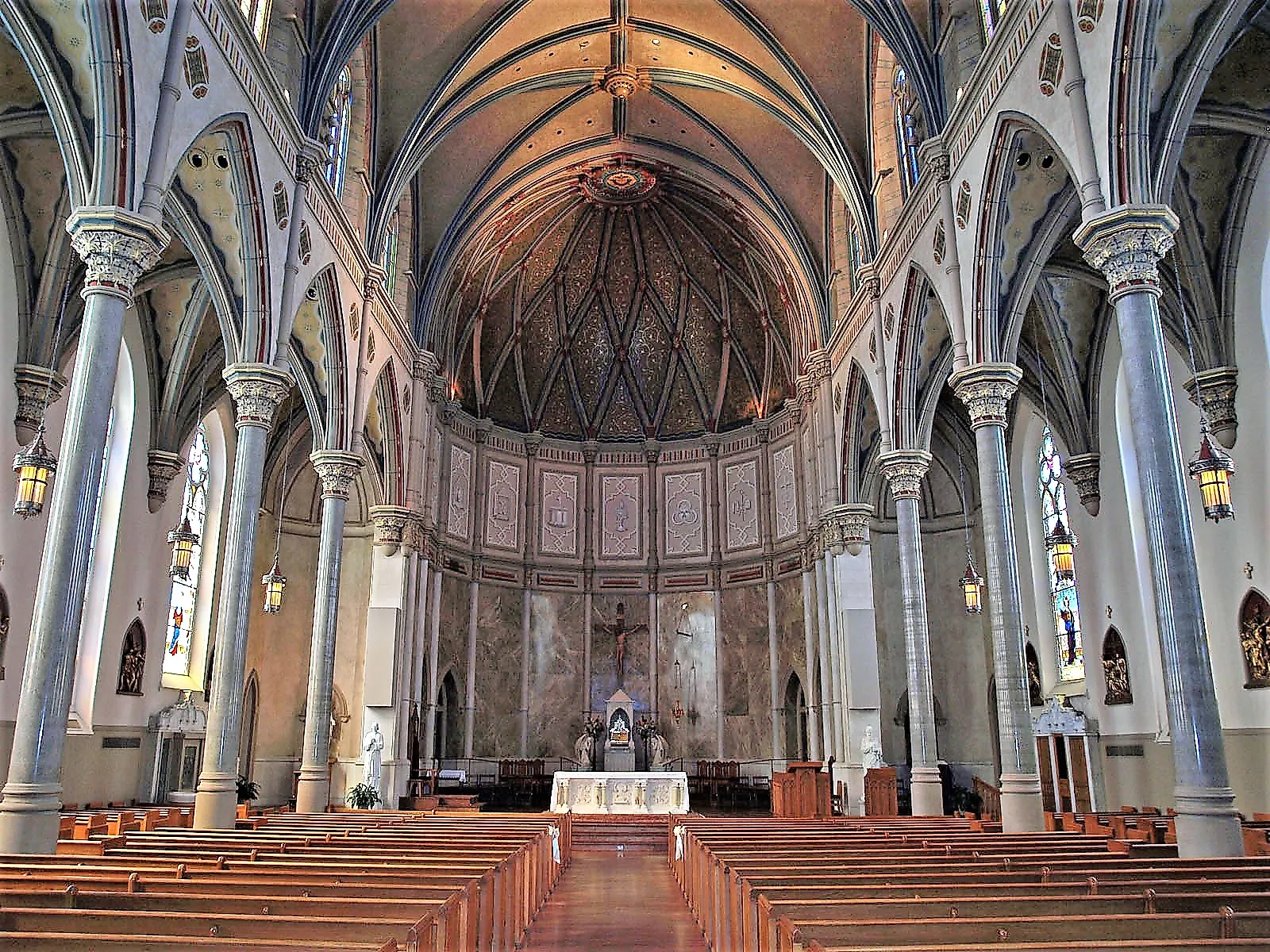
Inside, the cathedral follows a basilica plan, with a long central nave flanked by two side aisles and ending in a semicircular domed apse. 10 solid granite columns support the vaults and arches, creating a steady visual rhythm as visitors move toward the altar. Near the entrance, the baptismal font is placed as a deliberate reminder that baptism marks entry into Christian life, a meaning reinforced when parishioners use holy water and make the sign of the cross when entering. The nave provides the primary space for worship, and the confessionals positioned near the aisles reflect long-standing Catholic interior planning.
Trinity Episcopal Church, Mobile

Rising above the historic streets of downtown Mobile, this Gothic Revival church reflects the city’s early engagement with European ecclesiastical design. Founded in 1845, the congregation first worshiped in rented spaces around downtown Mobile in the neighborhood now known as DeTonti Square. As the congregation grew, a permanent church building was erected in the mid-19th century in an English Gothic tradition, expressed through pointed arches and a deliberate emphasis on vertical form. In 1945, the church building was dismantled brick by brick and moved to Dauphin Street, where it was rebuilt in order to preserve its original architectural character and detailing.
Inside, the Gothic theme continues through the long nave, stained glass windows, and plain wood furnishings that place emphasis on proportion and craftsmanship rather than heavy decoration. In 1932, a Parish House was constructed and was known as Trinity Junior Parish House to distinguish it from the Robinson Memorial Parish House, supporting the growth of parish programming and community functions. On the west side of the church, the Memory Garden honors “all women who served the church since its founding in 1845,” adding a quiet commemorative space to the site.
Church of the Nativity, Huntsville

Named for the approaching Christmas season during which its congregation was formed, the Church of the Nativity stands among Alabama’s most significant Gothic Revival churches. Built in 1859 at a cost of $37,500 and consecrated on Easter Eve, April 13, 1859, the building reflects the principles of the Ecclesiological Movement, which strongly shaped Anglican church design in the mid-19th century. It is widely regarded as one of the most pristine examples of Ecclesiological Gothic architecture in the American South and remains among the country’s least-altered works by the noted architect Frank Wills, a major proponent of that movement. The structure follows a nave-and-chancel plan and features a monumental entrance tower at the northwest corner, a massing choice that reinforces formal symmetry and upward emphasis.

Constructed of brick with pointed-arch openings, the church balances restraint with clear Gothic identity. Inside, the long nave leads the eye toward the chancel, where lancet windows and traditional wood detailing maintain the atmosphere associated with early Episcopal worship spaces. Because of its architectural integrity and historical significance, the Church of the Nativity is listed on the National Register of Historic Places. It remains an active parish church today and continues to be recognized as one of the best-preserved 19th-century Gothic Revival churches in the region.
St. Paul’s Episcopal Church, Lowndesboro

St. Paul’s Episcopal Church, built in 1857, stands among Alabama’s strongest rural examples of Gothic Revival architecture. Its design reflects mid-19th-century Episcopal preferences through pointed-arch windows, a steeply pitched roof, and vertically-laid boards that create a controlled sense of height. The church sits in the village of Lowndesboro within the Lowndesboro Historic District, which is listed on the National Register of Historic Places. That setting reinforces the building’s relationship to a preserved community layout that still reflects early town development patterns.
The church expresses the ecclesiastical ideals of its era through simplicity, balance, and permanence rather than heavy ornament. Inside, original wooden pews remain, and the interior relies on light from the lancet windows to shape the mood of the space. The restrained Gothic detailing supports a quiet atmosphere that aligns with Episcopal design values of the period.
Cathedral Church of the Advent, Birmingham

Rising prominently in downtown Birmingham, this Gothic Revival landmark reflects the confidence of a growing city and the ambitions of an expanding Episcopal community. Built for a rapidly developing industrial center, the cathedral uses limestone and a traditional cruciform plan to establish its Gothic identity. Pointed arches, a high nave ceiling, and carefully executed stonework draw the eye upward in a classic Gothic manner. The exterior is shaped by strong vertical lines, narrow lancet windows, and a tower that acts as a focal point within the street grid, giving the cathedral a commanding civic presence as well as a religious one.

The interior is defined by ribbed vaulting, carved stone details, and stained glass that filters light into the nave and chancel. The space was designed to support congregational worship and choral music, and its acoustics continue to serve those purposes through services and programmed events. As a functioning parish and a well-known architectural landmark, the cathedral also hosts concerts and public gatherings. Continued use and careful preservation have kept the Cathedral Church of the Advent central to Birmingham’s architectural identity and to Alabama’s broader Gothic Revival legacy.
Stone and Faith
Gothic churches in Alabama show how local congregations used European design traditions to build permanent landmarks that still shape city and townscapes today. The Cathedral of Saint Paul in Birmingham reflects the ambitions of an expanding industrial city through a confident Neo-Gothic design and a carefully ordered interior plan. Nearby, the Cathedral Church of the Advent demonstrates how an urban Episcopal community relied on refined proportions, limestone construction, and stained glass to create a lasting Gothic presence downtown. In Huntsville, the Church of the Nativity stands out for its Ecclesiological Gothic pedigree and its rare level of preservation in the American South. St. Paul’s Episcopal Church in Lowndesboro shows how rural congregations adopted Gothic Revival forms with restraint and strong craftsmanship. In Mobile, Trinity Episcopal Church illustrates continuity across generations through its preserved structure, relocated history, and still-active parish life.