5 Most Beautiful Gothic Churches In Maryland
In terms of Maryland's architectural terrain, it is surprisingly rich in Gothic-style churches, ranging from urban stone wonders to rural limestone chapels. While Gothic architecture is often associated with cathedrals found in Europe, Maryland offers an American interpretation that blends local resources, utility, and history. These Gothic cathedrals serve as timeless reminders of Maryland's religious legacy and its distinctive adaptation of a historically European design, from the busy streets of Baltimore to the peaceful lanes of Harford County.
St. Alphonsus Church

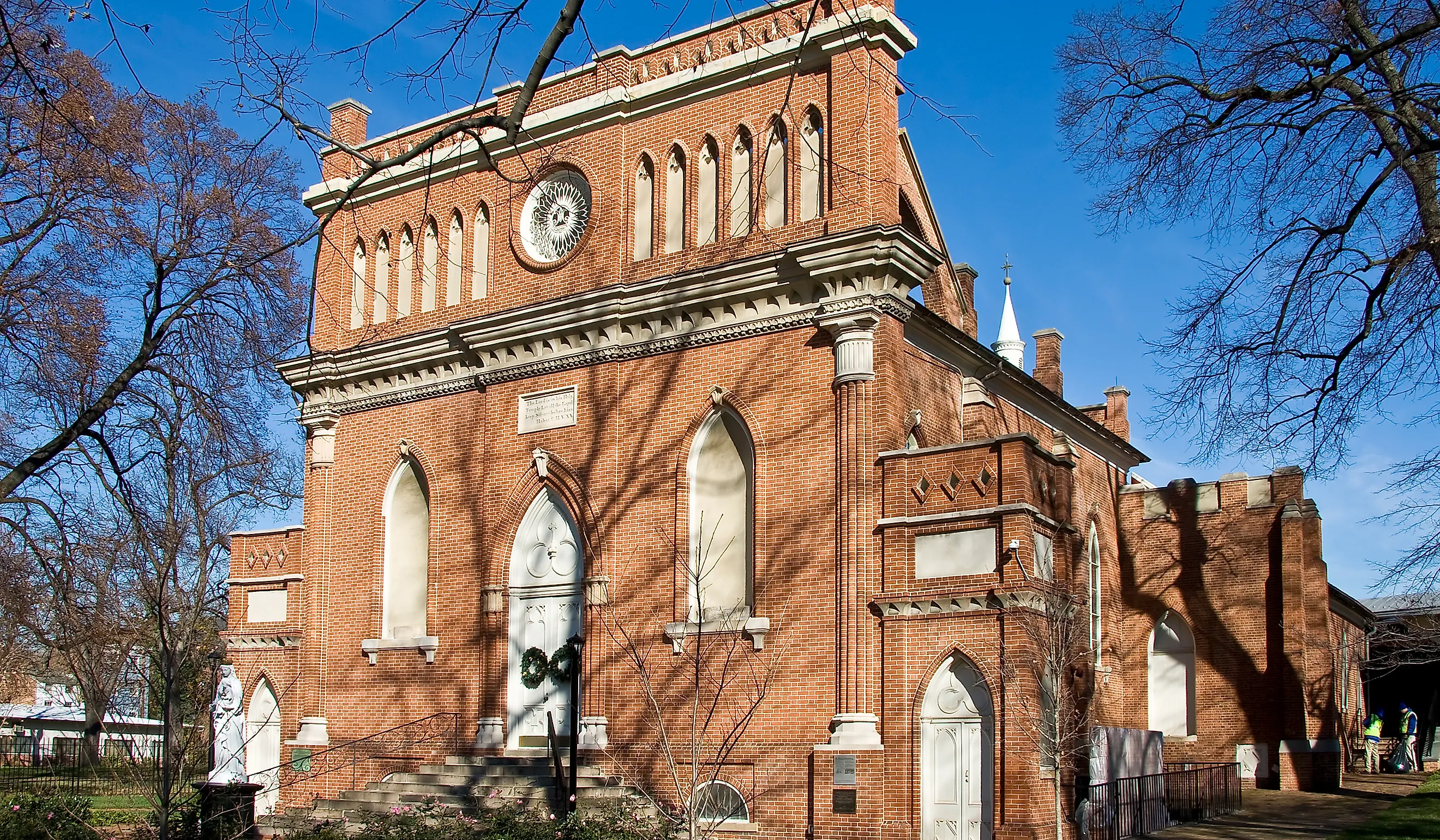
St. Alphonsus Church in downtown Baltimore, built between 1842 and 1845 by architect Robert Cary Long Jr., was first established for a German Catholic community. Constructed in red brick, it features typical Gothic Revival elements, including a central tower with pinnacles and parapets, steep gables and buttresses, lancet windows with tracery, and a symmetrical English Perpendicular façade.
The interior boasts painted vault-like ceilings, carved altars, and tall stained-glass windows. One of Baltimore’s most photographed Gothic Revival churches, St. Alphonsus, remains in active use as a shrine.
All Saints Episcopal Church

All Saints Episcopal Church in Frederick, designed by prominent Gothic Revival architect Richard Upjohn and built in 1855-1856, is one of the city’s most elegant mid-19th-century churches. The brick church, trimmed with brownstone, features a steeply pitched roof with buttresses, lancet windows, an entrance tower with spire, and clustered interior columns supporting the nave.

Reflecting Upjohn’s philosophy of adapting Gothic design for American parish churches, All Saints remains a well-preserved example of the style in a smaller-city context and is frequently documented in photographs.
St. Luke's Church

Locals can attest that St. Luke's Church, built about 1851, is one of the largest Gothic Revival Episcopal churches in the state from the mid-19th century. It strongly resembles the English medieval architecture contained in the Ecclesiological Society's principles, with features such as its high nave, side aisles beneath a clerestory, crenellated tower, lancet and rose windows, and steeply pitched roof.
This church, which exhibits both grandeur and attention to liturgical and communal needs, is a perfect example of how the Gothic Revival was modified for the United States.
St. Mary’s Seminary Chapel
St. Mary’s Seminary Chapel, designed by French-born architect Maximilien Godefroy and built between 1806 and 1808, is widely recognized as the first Gothic Revival church in the United States. The chapel has a semicircular apse, a nave with side aisles, shallow transepts, plaster ceilings that resemble rib vaulting, and tall, narrow pointed-arch windows.

It reflects the early American interpretation of the Gothic style and exhibits restraint and classical proportion, in contrast to subsequent Victorian Gothic churches. A National Historic Landmark, the chapel’s historic and aesthetic significance is well documented.
St. Mark's Episcopal Church

Maryland's rural stone Gothic Revival architecture is best represented by the 1849 construction of St. Mark's Episcopal Church. It was made from limestone that was mined locally, and its stone walls are reminiscent of medieval craftsmanship, with simple pointed windows and a steep Gothic Revival roof and steeple.
The church, a rural parish, serves as an example of how Gothic Revival concepts were simplified and kept their historical flavor while being adapted for small-town contexts. Its architectural and cultural significance is well established, as it is listed on the National Register of Historic Places.
From the oldest Gothic Revival chapel in America to functional Episcopal churches in tiny towns from the middle of the 19th century, Maryland's Gothic-style churches exhibit a remarkable range. These include both urban red-brick wonders and stone rural parish churches. The five churches listed above are not only visually striking but also historically significant and well-documented, making them ideal examples for architectural enthusiasts, historians, and travelers.