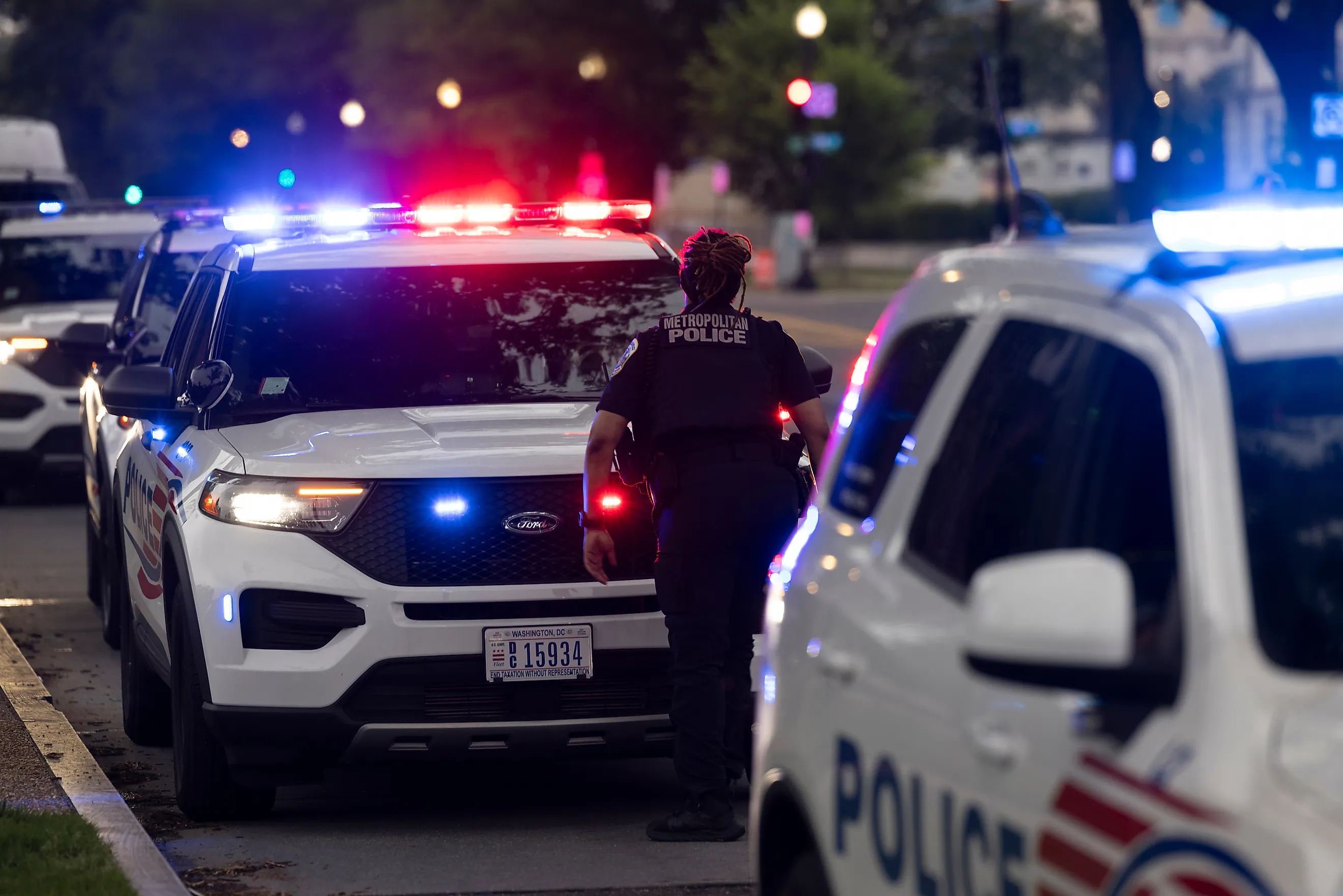
The Worst Decades For Crime
1980 and 1991. Those two years bookend the worst stretch of crime in modern American history. The US homicide rate peaked at 10.2 per 100,000 in 1980, and the overall violent crime rate peaked at 758.2 per 100,000 in 1991, the highest figures recorded since the FBI began publishing national crime statistics in 1930. Three and a half decades later, both numbers have fallen by roughly half. The 2024 murder rate was 5.0 per 100,000 and the violent crime rate stood at 370.8 per 100,000, both at or near the lowest levels recorded since the late 1960s. This article walks through the decades that produced the highest US crime rates of the postwar era, the long decline that followed, and the COVID-era spike and subsequent recovery of the 2020s.
How US Crime Data Is Measured

Two federal data sources track US crime. The first is the FBI's Uniform Crime Reporting Program (UCR), which compiles offense data submitted by roughly 16,000 state, county, city, college, and tribal law enforcement agencies. The second is the National Crime Victimization Survey (NCVS), administered by the Bureau of Justice Statistics, which surveys about 240,000 Americans each year about crimes they have experienced, whether or not those crimes were reported to police.
The UCR Program has gone through a major transition in the last few years. For decades, the FBI collected crime data through a Summary Reporting System (SRS) that counted only the most serious offense in each incident. On January 1, 2021, the FBI attempted to retire SRS entirely and shift to the National Incident-Based Reporting System (NIBRS), which captures details on every offense in an incident along with information on victims, offenders, weapons, and circumstances. The transition was rocky: only about 66 percent of agencies were able to report in NIBRS format in 2020, and data from thousands of agencies dropped out of the national totals that year. In 2022 the FBI resumed accepting both SRS and NIBRS submissions, and by the 2024 reporting year 95.6 percent of the US population was covered by reporting agencies.
The standard UCR violent crime categories are murder and non-negligent manslaughter, forcible rape, robbery, and aggravated assault. The property crime categories are burglary, larceny-theft, motor vehicle theft, and arson. The "Part I" or "index" offenses are the eight crimes whose long-term trends are most reliably tracked at the national level.
The Postwar Crime Wave: 1960 to 1980

Crime in the United States rose steeply through the 1960s and 1970s, then peaked for the first time around 1980. The homicide rate roughly doubled between the mid-1960s and 1980, reaching 10.2 per 100,000 people. Several factors converged. The postwar baby-boom generation moved through its teen and young-adult years, the demographic group historically responsible for most violent crime. Heroin use spread through major cities in the late 1960s and early 1970s. Urban industrial bases hollowed out, especially in the Midwest and Northeast, leaving behind concentrated poverty and joblessness in cities like Detroit, Cleveland, and St Louis. Police forces in many cities were under-resourced relative to the workload, and forensic and investigative capabilities were limited by the standards of later decades.
By the end of the 1970s, US violent crime rates had decisively diverged from those of Western Europe. The most cited comparison from this era: London, with a population three times that of Chicago, recorded around 45 homicides in 1980, while Chicago recorded just under 900. The gap had not existed at the turn of the 20th century and remains a defining feature of US crime statistics into the present.
The 1980s and the First Homicide Peak

The homicide rate eased slightly in the early to mid-1980s, falling to 7.9 per 100,000 by 1985, before climbing again into the late 1980s with the arrival of crack cocaine in major US cities. The crack epidemic, which intensified between 1984 and 1990, drove a sharp increase in drug-market violence involving young men. Homicides among Black teenage males roughly doubled between 1984 and 1991. The 1980s ended with US violent crime rates approaching record highs, even though the overall homicide peak from 1980 was not yet exceeded.
The 1990s: Violent Crime Hits Its Recorded Peak

In 1991 the US violent crime rate reached 758.2 offenses per 100,000 people, the highest annual rate in the modern FBI series. The homicide rate that year was 9.8 per 100,000, slightly below the 1980 peak but the second highest on record. The early 1990s recorded the largest absolute numbers of property crimes and violent crimes in US history, partly because the US population was much larger than during the 1980 peak. Across the full decade, the 1990s registered roughly 136.4 million reported index crimes, more than any decade before or since.
Crime then began to fall. The decline was sharp and sustained, and it surprised most criminologists who had projected continued increases into the 2000s. Between 1991 and 1999, the homicide rate fell from 9.8 to 5.7 per 100,000, a 42 percent drop in nine years.
The Great American Crime Decline: 1991 to 2014
For more than two decades after the 1991 peak, US crime rates fell almost continuously. By 2014, the homicide rate had reached 4.4 per 100,000, the lowest figure since the early 1960s, and the violent crime rate had fallen below 362 per 100,000, less than half its 1991 peak. Property crime fell even further. Burglary rates dropped by about two-thirds, and motor vehicle theft fell sharply in cities that had been particularly hard hit in the 1980s and 1990s.
Researchers continue to debate the causes of the decline. The most cited contributors include the end of the crack cocaine epidemic in the mid-1990s; the expansion of state and federal prison populations through the 1980s and 1990s, which incapacitated a portion of the population most likely to offend; substantial increases in police numbers, funded partly by the 1994 federal Violent Crime Control and Law Enforcement Act; the adoption of CompStat-style data-driven policing in major departments starting with the New York City Police Department in 1994; the phaseout of leaded gasoline beginning in the 1970s, which lowered childhood lead exposure for the cohort that came of age in the 1990s; the increasing availability of legal abortion following Roe v Wade in 1973, which one prominent hypothesis links to lower crime rates roughly two decades later; and improvements in private and commercial security technology, especially vehicle immobilizers and electronic anti-theft systems. No single factor explains the full size of the decline, and the relative weight of each remains contested in the academic literature.
The 2020 Pandemic Spike

The long decline reversed in 2020. The homicide rate rose from 5.0 per 100,000 in 2019 to 6.5 in 2020, an increase of nearly 30 percent in a single year. The Council on Criminal Justice has called it the largest single-year homicide increase recorded since 1960. The Center for American Progress reports that firearm-related homicides specifically rose 44 percent between March 2020 and October 2021. Aggravated assault and motor vehicle theft also rose sharply. Property crime fell, however, as commercial businesses closed and people stayed home.
The causes are still being studied. The most cited contributors include the social and economic disruption of the COVID-19 pandemic itself, including school closures, business closures, and changes in policing patterns; a surge in firearm sales in 2020 (about 22 million guns were sold in the US that year, a record); the unrest following the May 2020 killing of George Floyd in Minneapolis, which strained police-community relations in many cities and was followed by significant declines in proactive police stops; and disruptions to courts, social services, mental health care, and addiction treatment during the first year of the pandemic. As with the 1990s decline, no single factor explains the full size of the spike.
The Post-Pandemic Decline: 2022 to 2025
The 2020 spike proved short-lived. Violent crime began to ease in 2022, returned to near pre-pandemic levels in 2023, and continued to fall through 2024 and 2025. The FBI's 2024 annual report, released in August 2025, shows violent crime down 4.5 percent and property crime down 8.1 percent year over year. Murder fell 14.9 percent in 2024 alone, reaching a rate of 5.0 per 100,000, the lowest figure in nine years.
The Bureau of Justice Statistics' parallel reports show the violent crime rate falling from 393.9 per 100,000 in 2023 to 370.8 in 2024, with property crime falling from 2,019.7 to 1,835.1 per 100,000 over the same period. Both the 2024 violent crime rate and the 2024 property crime rate were the lowest recorded since at least 1969, according to the Center for American Progress analysis of the FBI data.
Early 2025 data suggests the trend is accelerating. The Council on Criminal Justice's mid-year analysis of 30 large US cities found that homicides declined 21 percent in 2025 compared with 2024, putting US homicides 44 percent below their 2021 pandemic peak. If the national figures confirm that pattern, the 2025 US homicide rate would be the lowest in more than a century.
The Worst Decades by the Numbers
The table below summarises the peak years and the post-decline lows in the FBI's violent crime and homicide rates. Rates are per 100,000 people.
| Year | Violent crime rate | Murder and non-negligent manslaughter rate | Context |
|---|---|---|---|
| 1980 | 596.6 | 10.2 | First modern homicide peak |
| 1991 | 758.2 | 9.8 | Violent crime peak; second homicide peak |
| 1999 | 523.0 | 5.7 | End of the 1990s decline |
| 2014 | 361.6 | 4.4 | Pre-pandemic recent low |
| 2020 | 398.5 | 6.5 | Pandemic-era spike begins |
| 2021 | 395.7 | 6.8 | Recent homicide peak |
| 2023 | 393.9 | 5.7 | Return to near pre-pandemic levels |
| 2024 | 370.8 | 5.0 | Lowest violent and property crime rate since 1969 |
Sources: FBI Uniform Crime Reporting Program; Bureau of Justice Statistics; Council on Criminal Justice; Congressional Research Service.
Why US Crime Rates Move

No comprehensive theory explains why US crime rates rose so steeply in the 1960s and 1970s, peaked in 1991, fell for two decades, spiked in 2020, and fell again. The variables that matter most appear to be a mix of demographic, economic, policy, and technological factors.
Demographic age structure matters. Young men aged roughly 15 to 24 commit a disproportionate share of violent crime, and the rise of the baby-boom generation through that age band contributed to the 1960s-1980 rise, while its passage out contributed to the 1990s decline. Drug-market dynamics matter: the heroin trade of the 1970s, the crack market of the late 1980s, and the opioid and stimulant markets of the 2010s and 2020s have all influenced violence patterns. Policing capacity and strategy matter, including raw officer numbers, deployment models, and the relationship between police and the communities they serve. The legal environment matters, including sentencing law, parole policy, and the size of the prison population. Economic conditions matter, especially the level of joblessness in cities where violence is concentrated. Technological change matters: vehicle immobilisers transformed auto theft, mobile-phone tracking and surveillance cameras altered street-crime detection rates, and ubiquitous documentation has changed how police interactions are recorded.
None of these factors works in isolation, and the academic literature shows substantial disagreement on relative weights. What is clear is that US crime rates can change quickly: the 30 percent homicide jump in 2020 and the 35 percent cumulative homicide drop from 2021 through 2024 both occurred faster than most professional forecasters anticipated.
Crime in the United States Today
By the most recent national data, the United States is safer in 2025 than it has been at any point since the late 1960s. The 2024 violent crime rate of 370.8 per 100,000 is about half the 1991 peak. The 2024 murder rate of 5.0 per 100,000 is roughly half the 1980 peak. Early 2025 numbers point to further declines, with homicides on track for the lowest annual rate in more than a century. Violent crime remains heavily concentrated in a relatively small number of cities and neighbourhoods, and the gap between US and Western European homicide rates that opened in the postwar era persists. But the long arc since 1991, interrupted by the COVID-era spike, has been one of substantial decline.