10 Best Places To Live In Illinois
Median home values across the 10 cities below run between $115,000 and $320,000. None requires a tech salary to afford, all keep an active downtown with a full-service hospital, and most are anchored by either a state university, a Fortune 500 employer, or a regional medical system. Among them are Springfield, the state capital built around Lincoln history; Champaign-Urbana, home of the Big Ten flagship campus; Galena, where 85 percent of the buildings predate 1900; and Rockford, whose 12-acre Anderson Japanese Gardens ranks among the best public examples outside Japan.
Springfield

Springfield is the state capital and runs on government, healthcare, and tourism centered on Abraham Lincoln. The Lincoln Home National Historic Site preserves four blocks of the neighborhood where Lincoln lived for 17 years before the presidency. The Old State Capitol, where Lincoln gave his House Divided speech in 1858, still stands downtown. Frank Lloyd Wright's Dana-Thomas House from 1902 sits on Lawrence Avenue as one of the most intact Prairie-style homes in existence, with the original Wright-designed furniture in place.
Population is around 115,000. The state government employs thousands of residents and HSHS St. John's Hospital plus Memorial Medical Center anchor regional healthcare. Median home values run around $160,000, which is unusually affordable for a state capital. Downtown holds the bulk of Lincoln-era history with several museums plus the Illinois State Capitol building. Springfield is roughly 200 miles from Chicago by car or about three hours via Amtrak.
Champaign

Champaign and its sister city Urbana share the campus of the University of Illinois Urbana-Champaign, which has shaped the entire metro area for over 150 years. The university brings everything that comes with a Big Ten flagship: football at Memorial Stadium, basketball at State Farm Center, the Krannert Center for the Performing Arts, and a research economy that has produced major tech alumni including Mosaic and Netscape co-founder Marc Andreessen, YouTube co-founder Steve Chen, and PayPal co-founder Max Levchin.
Champaign's population is around 89,000 with Urbana adding another 38,000. Carle Foundation Hospital is the regional medical anchor and one of the largest hospitals in central Illinois. Downtown along Neil and Walnut Streets holds an unusually strong restaurant and music scene for a city this size. Median home values run around $220,000, which makes this one of the more affordable Big Ten college towns in the country relative to amenities. Amtrak's Illini and Saluki services connect to Chicago in about two hours forty minutes.
Bloomington

Bloomington is the financial center of central Illinois thanks to State Farm Insurance keeping its corporate headquarters here. The company employs thousands of residents and has anchored the local economy through good times and bad. Illinois State University sits in the adjacent town of Normal, which functions as a single metro area with Bloomington.
Population is around 78,000. The McLean County Museum of History occupies the 1903 courthouse in downtown Bloomington and runs comprehensive exhibits on the central Illinois region. The Constitution Trail covers more than 25 miles of converted rail-trail through both Bloomington and Normal for walkers and cyclists. OSF St. Joseph Medical Center serves the community as the regional hospital. Median home values run around $215,000, which makes Bloomington one of the more affordable mid-sized cities in the state.
Peoria

Peoria sits on the bluffs above the Illinois River and runs on Caterpillar manufacturing, healthcare, and Bradley University. Caterpillar Inc. moved its global headquarters out of Peoria to Deerfield in 2017 and on to Irving, Texas in 2022, but the company still has more than 12,000 employees in the Peoria area, the largest concentration of Caterpillar workers anywhere in the world. Bradley University covers about 85 acres on the West Bluff and enrolls around 5,400 students across five colleges. The Peoria Riverfront Museum holds the Caterpillar Visitors Center plus a planetarium and Smithsonian-affiliated exhibits. Grand View Drive, the bluff road north of downtown that Theodore Roosevelt called "the world's most beautiful drive," is one of the most scenic urban streets in the state.
Population is around 113,000. OSF Saint Francis Medical Center is the fifth-largest hospital in Illinois and the only Level I Trauma Center for a 26-county region. UnityPoint Health Methodist adds a second full-service hospital, and the Children's Hospital of Illinois shares the OSF campus. Median home values run around $150,000, which is among the lowest in any Illinois mid-sized city. The Peoria Symphony Orchestra is one of the oldest in the country, and the Peoria Civic Center hosts touring Broadway shows. General Wayne A. Downing Peoria International Airport runs daily connections to Chicago and several hub cities.
Rockford

Rockford is the third-largest city in Illinois after Chicago and Aurora, and sits on the Rock River about 90 miles northwest of Chicago. The 12-acre Anderson Japanese Gardens, designed by master craftsman Hoichi Kurisu, is consistently rated among the highest-quality public Japanese gardens outside Japan. The Coronado Theatre downtown is an Art Deco and Spanish Baroque Revival venue from 1927 and hosts the Rockford Symphony Orchestra. Frank Lloyd Wright's Laurent House, the only Wright building designed for a person with a disability, is open as a museum on the south side of town. The Burpee Museum of Natural History holds Jane, the world's most complete juvenile Tyrannosaurus rex.
Population is around 145,000. MercyHealth and UW Health (formerly SwedishAmerican) together run the major hospitals; MercyHealth's Javon Bea Hospital, opened in 2019 on Riverside Boulevard, was the largest construction project in city history at the time. Rockford University is a private liberal arts college on the east side; Rock Valley College handles community-college coursework. Median home values run around $145,000, among the lowest of any city this size in the upper Midwest. The aerospace cluster around Collins Aerospace and the Chicago Rockford International Airport gives the local economy a steadier industrial base than the city's Rust Belt reputation suggests.
Galena

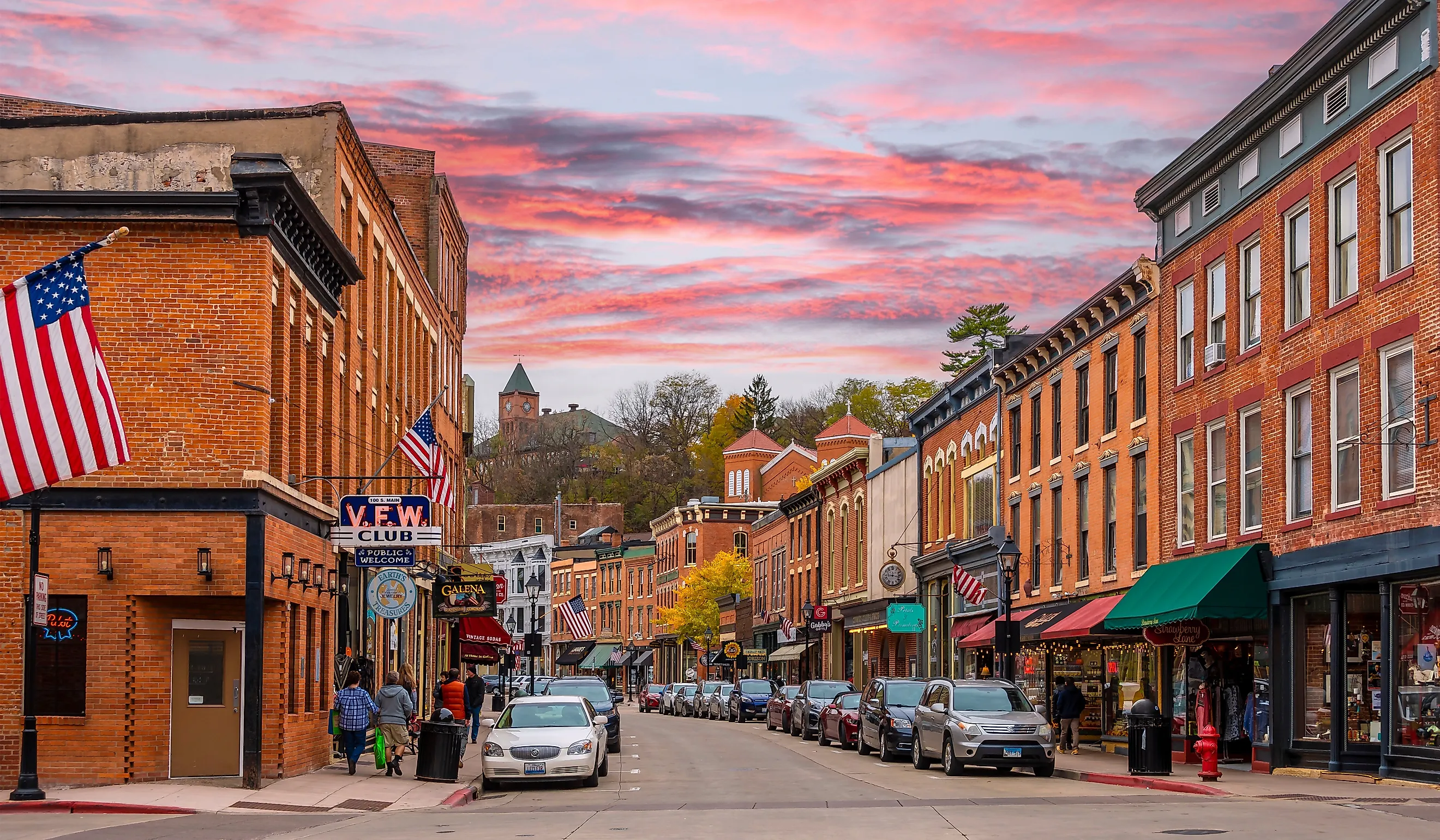
Galena keeps an unusual amount of pre-1900 architecture for a town of just 3,000 people. The Galena Historic District covers about 85 percent of the town and includes more than 800 properties. The Ulysses S. Grant Home from 1859 is a National Historic Landmark and operates as a state historic site with original 1860s furnishings still in place. The DeSoto House Hotel on Main Street has been continuously operating since 1855 and is one of the oldest hotels in Illinois.
Population is just over 3,000, which makes this the smallest town on the list. The Galena River bends through the bluffs at the heart of town. Galena Cellars Winery and a string of antique stores fill the Main Street storefronts. Median home values run around $320,000, with a strong second-home market that drives prices up. The closest major hospital is across the river in Dubuque, Iowa. Galena rewards retirees and second-home buyers more than commuters, since the closest big city is two and a half hours away.
Quincy

Quincy sits on the limestone bluffs above the Mississippi River at the western edge of Illinois and goes by the nickname "the Gem City." The South Side German Historic District and the Downtown Quincy Historic District together preserve one of the largest concentrations of Victorian-era architecture in the Midwest. Villa Kathrine, a Moorish-style 1900 villa overlooking the river, is one of the most unusual surviving residences from the period. The Quincy Museum, housed in the Newcomb-Stillwell Mansion, holds local and natural history exhibits in an 1891 Romanesque Revival home.
Population is around 39,500. Blessing Hospital is a 340-bed regional referral center serving West Central Illinois, Northeast Missouri, and Southeast Iowa, and is the largest medical employer in town. Quincy University is a private four-year Franciscan school, and John Wood Community College handles two-year programs. Median home values run around $130,000, among the most affordable in any Illinois city of this size. Amtrak's Illinois Zephyr and Carl Sandburg routes connect Quincy to Chicago in about five hours.
Decatur

Decatur is the seat of Macon County and runs on agribusiness. Archer Daniels Midland (ADM) maintains its North American headquarters and roughly 4,400 jobs in town, even after moving its global headquarters to Chicago in 2014. Tate & Lyle Americas, the food and beverage ingredients company, is also headquartered in Decatur. Lake Decatur, a 2,800-acre reservoir on the Sangamon River, runs through the south side of the city and is the local center for boating, sailing, and waterfront events including the Devon Lakeshore Amphitheater concert series. Millikin University, founded in 1901 with President Theodore Roosevelt presiding at its dedication, sits on a 75-acre campus near downtown.
Population is around 70,000. Decatur Memorial Hospital, founded in 1916 and now part of Memorial Health, is a Level II Trauma Center; HSHS St. Mary's Hospital adds a second full-service option in town. Median home values run around $115,000, which makes Decatur one of the most affordable mid-sized cities in the state. Scovill Zoo and the Children's Museum of Illinois keep the family-trip lineup deeper than the population would suggest. Decatur is about 38 miles east of Springfield and 130 miles from St. Louis.
Edwardsville

Edwardsville is the seat of Madison County and the closest of the 10 to St. Louis, with downtown St. Louis only about 20 miles southwest across the river. Southern Illinois University Edwardsville covers a 2,660-acre campus on the south edge of town and enrolls around 12,000 students. The Madison County Transit trail network covers more than 130 miles of paved bike paths through the metro east region, with several trailheads in town. The Watershed Nature Center and the Leclaire Historic District are the local everyday-use draws.
Population is around 26,800. Anderson Hospital and the larger HSHS St. Elizabeth's in nearby O'Fallon handle most regional healthcare; the BJC HealthCare and SSM Health systems in St. Louis are within easy reach for specialized care. Edwardsville School District 7 is consistently ranked among the strongest public school systems in southern Illinois. Median home values run around $300,000, which is higher than most downstate cities but reflects the St. Louis-metro pull. Edwardsville works well as a downstate landing spot for anyone who wants St. Louis access without St. Louis prices.
Carbondale

Carbondale is the gateway to the Shawnee National Forest and the home of Southern Illinois University Carbondale, a Carnegie R1 research institution chartered in 1869. The forest covers around 280,000 acres just south of town and includes the Garden of the Gods Wilderness, Little Grand Canyon, and Bell Smith Springs. Crab Orchard National Wildlife Refuge, on the east side of town, covers another 44,000 acres of lakes and woodlands. The Shawnee Hills Wine Trail, the first wine trail in Illinois, links 12 vineyards in the surrounding hills.
Population is around 22,000. Memorial Hospital of Carbondale is the flagship hospital for Southern Illinois Healthcare and the regional referral center for a 16-county area. SIU's medical school operates out of Springfield, which means Carbondale-based students rotate through clinical sites across central and southern Illinois. Median home values run around $115,000, which makes this the most affordable college town on this list. Amtrak's Illini and Saluki routes connect Carbondale directly to Chicago in about five and a half hours.
Picking Your Illinois
What ties these 10 places together is what they all keep working: a real downtown, a serious hospital, a college or major employer in town, and home prices that beat the Chicago lakefront by a wide margin. Beyond that they go in 10 different directions. The right one depends on whether you want to live next to a Big Ten football stadium, a state capitol building, the Mississippi River bluffs, an Art Deco theater, the Shawnee National Forest, or a 12-acre Japanese garden. Each of these is a real choice in Illinois.