Where People Are Moving To In Texas In 2026
Texas added more new residents than any other state in the country between July 2024 and July 2025. The state grew by 391,243 people to reach 31.7 million, per the US Census Bureau's Vintage 2025 estimates released May 14, 2026. National growth slowed sharply over that period to just 0.5%. Texas continued to outpace the country at 1.2%. The clearest pattern in the data is exurban expansion radiating outward from Dallas-Fort Worth plus Houston plus Austin. Outlying cities at the edge of those metros are absorbing the bulk of in-state movement while core counties like Dallas and Travis are losing domestic migrants even as international arrivals prop up their totals.
Celina

Celina is now the fastest-growing city in the United States. The Collin County exurb north of Dallas grew 24.6% between July 2024 and July 2025 to a population of 64,427, per Census Vintage 2025, adding more than 12,000 residents in one year. Since the 2020 Census count of 16,739, Celina has nearly quadrupled in size, a 285% gain over five years. The Census Bureau noted that "rapid growth is nothing new for Celina," which also led the nation in 2023 before Princeton briefly took the title.
The core driver is a combination of housing affordability and school district quality. Celina ISD and Prosper ISD, both of which serve the city, rank among the most sought-after in North Texas. Median household income reached $170,894 by 2024, suggesting in-migration skews toward higher-earning professional households. From 2010 through June 2024, the city issued 15,062 single-family permits, with master-planned communities from Taylor Morrison, Toll Brothers, and Highland Homes driving the pace. Celina ISD is planning for three additional elementary schools over the next decade as enrollment continues to grow.
Fulshear

Fulshear was the nation's second-fastest-growing city in the Vintage 2025 release, expanding 21% between July 2024 and July 2025. The Fort Bend County city west of Houston counted 16,856 residents in the 2020 Census and has grown roughly 300% since. Fort Bend County drew its migrants primarily from Harris County and surrounding suburban counties according to IRS Statistics of Income county-to-county migration data.
Fort Bend County remains more affordable than Harris County on a per-square-foot basis for new construction, and the Texas Heritage Parkway expansion connecting the Westpark Tollway to I-10 meaningfully reduced travel time to central Houston. Homeownership in Fulshear runs at 90%, and 31% of residents were born outside the United States, reflecting Fort Bend County's well-documented international migration patterns. The city's growth accelerated so quickly that in 2023, its city council considered a moratorium on new development before deciding to proceed. Cross Creek Ranch, a master-planned community, is one of the largest active developments in the Houston metro.
Princeton

Princeton, which led the entire country in growth in Vintage 2024 at 30.6%, dropped to third nationally in Vintage 2025 with an 18.1% one-year increase. The city has more than doubled in size since the 2020 Census, when roughly 17,000 people lived there. Most of Princeton's new residents are arriving from elsewhere in Collin County and the broader DFW metro per IRS migration data, which show neighboring Collin County ZIP codes generating the largest inflows.
The driver is straightforward. The typical Princeton home is valued at approximately $325,000 compared to more than $500,000 in nearby McKinney and $685,000 in Frisco according to Zillow's 2024 estimates, a price gap large enough to shift household decisions at scale. The city's school enrollment has expanded alongside its population and new residential master-planned communities continue to break ground. The 2020s buildout has converted what was largely farm and open land into a network of subdivisions feeding the Collin County labor corridor.
Fort Worth

Fort Worth officially entered the nation's top 10 most populous cities in the Vintage 2025 release. The city added 19,512 residents between July 2024 and July 2025, the second-largest numeric gain of any US city, helping it pass Jacksonville for the #10 spot at 1,028,117 residents. Since the 2020 Census, Fort Worth has grown by 11.9%, more than any other large Texas city in percentage terms per the Texas Demographic Center. IRS SOI data shows Tarrant County draws movers from Dallas County and from out of state, with California and Illinois among the leading source states in recent filing years.
The Fort Worth-Arlington metro added jobs at a pace that supported the population gain, anchored by Lockheed Martin, American Airlines, and Cook Children's. Home prices in Fort Worth remain meaningfully below Dallas proper, and the city's Near Southside and Cultural District neighborhoods have seen commercial investment that is accelerating residential interest from within the metro. DFW is now the only urban area in the country with two cities exceeding one million residents.
Austin

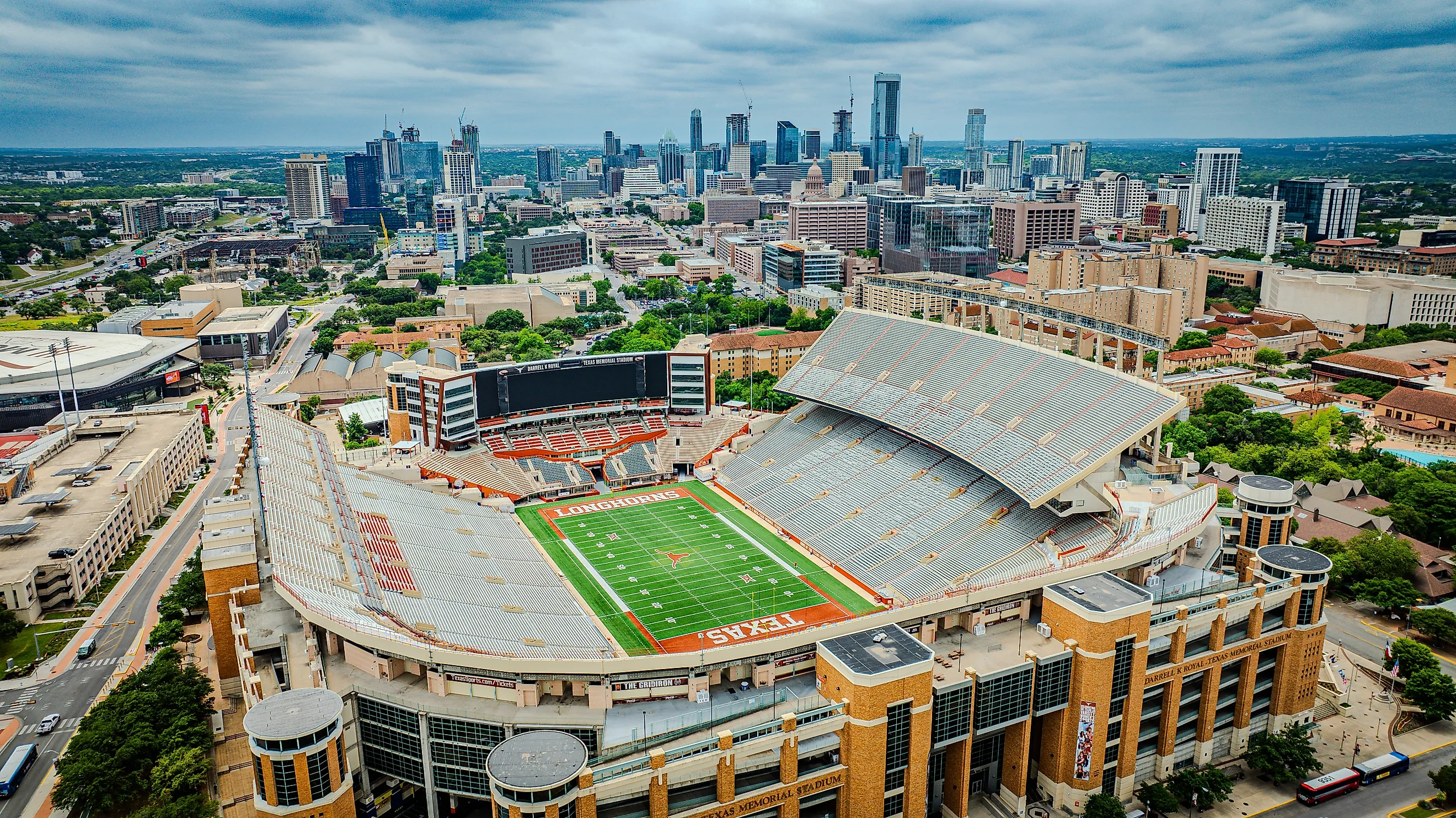
Austin crossed the one-million-resident threshold for the first time in its 187-year history in Vintage 2025, reaching 1,002,632 residents and the #12 spot nationally per Census estimates. The 4,025-person gain over July 2024 represented just 0.4% year-over-year growth, the slowest among the state's largest cities. Even so, city demographer Lila Valencia credited job growth that has outperformed expectations plus housing costs that have fallen from their pandemic-era peaks for the milestone.
Travis County added 16,197 housing units between July 2024 and July 2025, the seventh-largest housing gain of any county nationwide. The Austin metro area continues to add residents at 1.4% annually, with most of the growth happening at the edges rather than inside city limits. Leander, immediately north, jumped to roughly 91,000 residents in Vintage 2025, up from about 87,000 the year before. The city's proximity to the Dell Technologies and Samsung Austin Semiconductor campuses anchors much of the employment geography for the Williamson County corridor.
San Antonio

San Antonio added more than 14,000 residents between July 2024 and July 2025, the third-largest numeric gain of any US city per Census Vintage 2025. Between April 2020 and July 2025, the San Antonio-New Braunfels metro added roughly 230,000 people, with the majority coming from domestic migration per Census components-of-change data. Unlike the DFW and Houston corridors, where international migration has surpassed domestic inflows in recent years, Bexar County's growth has continued to be led by Americans relocating from within the country.
The metro's population reached approximately 2.8 million by mid-2025. The city's lower cost of living relative to Austin, 80 miles north, is the most commonly cited driver among newcomers, with median home prices running roughly 40% lower than in Travis County. Comal County, on San Antonio's north edge, has grown faster in percentage terms than Bexar County itself, indicating active expansion into the New Braunfels corridor, a pattern consistent with IRS SOI data showing Bexar County-to-Comal County movement as a significant in-state flow.
Jarrell

Jarrell remained the fastest-growing city in the Austin metro area in Vintage 2025, expanding 18.2% between July 2024 and July 2025. Its 2020 Census count was 1,753 residents and the city has more than tripled in size since then. Located in Williamson County along I-35, 17 miles north of Georgetown and 44 miles from downtown Austin, Jarrell sits at the outermost edge of the Capital Area Metropolitan Planning Organization's coverage zone.
IRS SOI data for Williamson County shows Travis County as the dominant migration origin. The median property value in Jarrell is approximately $346,300, roughly 32% below the Leander median, and the median household income of $111,333 tracks the region's professional demographic. New subdivisions have been approved along Ronald Reagan Boulevard, and Jarrell Independent School District has seen a 96% enrollment increase since the 2018-2019 academic year, with the district projecting it will double in size over the next five years.
Moving to Texas in 2026
The state's growth corridor has clearly consolidated around the outer ring of three of its major metros, and the direction of travel is consistently outward from Travis County into north Williamson County, from Harris County into Fort Bend, and from inner Collin County into Celina, Princeton, and Anna. That pattern is likely to continue as long as affordability gaps between core and fringe hold. Vintage 2025 confirms the structural shift: domestic migration to Texas has slowed to its lowest level since 2005, and the growth that remains is increasingly within-state reshuffling rather than large-scale out-of-state inflows.
Even with the deceleration, Texas placed five cities in the top 15 most populous in the country, with Fort Worth and Austin both joining the million-resident club in the same year. Five of the country's six fastest-growing cities over 20,000 residents (Celina, Fulshear, Princeton, Melissa, Anna) sit in Texas. School districts in Celina, Jarrell, Leander, and Princeton are adding capacity faster than any comparable period in their histories, and road infrastructure in all four corridors is under documented strain. Housing inventory in fringe markets continues to move quickly because supply, though substantial, is constantly being absorbed.