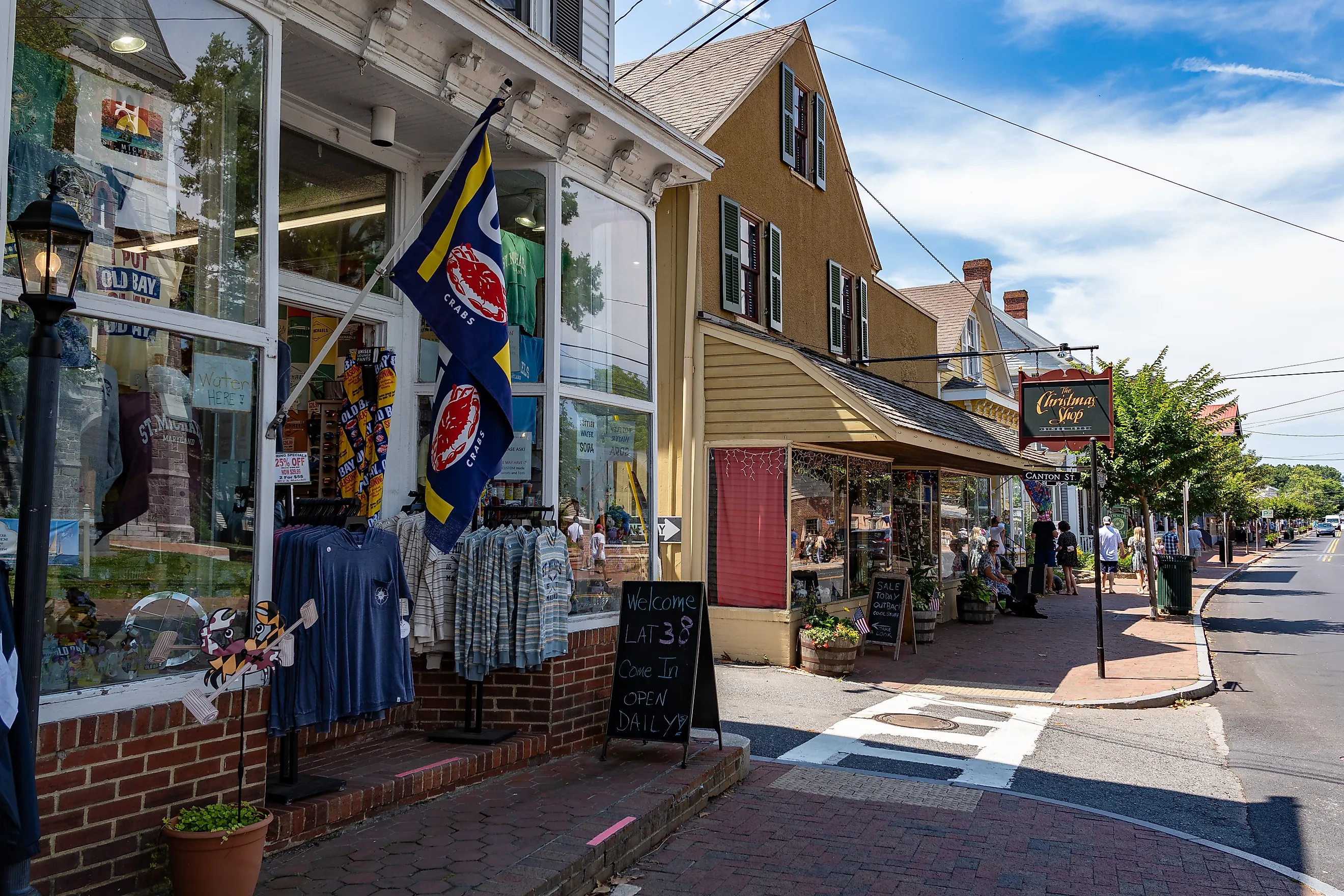
This Maryland Downtown Is Made For Strolling
You'll need a car to get to St. Michaels, but once you arrive, you can park and toss those keys in your bag. The town sits on Maryland's Eastern Shore, along the Miles River, a narrow tributary of the Chesapeake Bay that wraps around the harbor, keeping everything close to the water. Downtown St. Michaels is relatively small and centered on Talbot Street, which is known for its array of historic inns. Talbot Street is also conveniently located near multiple museums, restaurants, and a variety of boutique shops. This means you can shop between visiting some of the town's most historical buildings, then follow it up with a bar hop. Because of its design and maritime community vibe, St. Michaels functions as a place you can explore on foot, block by block, rather than jumping between destinations.
A Brief History Of St. Michaels

St. Michaels began in the mid-1600s as a working waterfront community on Maryland's Eastern Shore, where tobacco farmers and trappers gathered to trade goods along nearby waterways. What would become downtown St. Michaels took clearer shape in the 1670s with the establishment of Christ Episcopal Church of St. Michael Archangel. The church not only gave the town its name but also marked the center of early community life, a role it still plays today near the heart of downtown.
The walkable downtown visitors explore now was formally laid out in the 1770s. British land agent James Braddock purchased the land and divided it into 58 lots, organizing the town around St. Mary's Square. That square remains downtown's historic core. Braddock also donated land for a Methodist church, and as Methodist preachers gained influence, the town's religious composition shifted as well. Sardis Chapel (St. Luke's United Methodist Church), completed in 1839, still stands on that original site and remains one of downtown's most recognizable buildings.
By the early 1800s, downtown's shoreline had become a center of shipbuilding. During the War of 1812, as many as six shipyards operated here, producing fast schooners known as Baltimore Clippers. The town gained lasting recognition after the Battle of St. Michaels on August 10, 1813, when British forces bombarded the area but failed to destroy the shipyards. That event later earned St. Michaels the nickname "The Town That Fooled the British." Tourism became the town's economic focus in the 1970s, helping to preserve downtown landmarks that are now listed on the National Register of Historic Places.
Touring The Historic Sites Of St. Michaels

Many of the buildings in downtown St. Michaels are listed on the National Register of Historic Places, including the Cannonball House, the Old Brick Inn, and the St. Michaels Historic District, all of which you can visit on foot.
Everything revolves around Talbot Street, the town's only major through-road and the spine of downtown. It runs straight toward the Miles River and is lined with some of the Eastern Shore's best-preserved colonial and 19th-century buildings.
Start near the water at the Chesapeake Bay Maritime Museum, set directly along the harbor just off Talbot Street. This is not a one-building museum but a walkable waterfront campus, complete with a working shipyard, historic lighthouse, and a floating fleet of traditional Chesapeake vessels. It's also where Wedding Crashers filmed its most memorable boat-to-wedding scene, using the museum grounds and the Inn at Perry Cabin nearby as its backdrop. Seasonal boat cruises depart right from the museum docks, letting you step from sidewalk to water in minutes.
From there, head inland, south toward Mulberry Street. The Cannonball House sits quietly at the corner, still bearing the cannonball embedded in its wall from an 1813 British bombardment. A few doors away is the Thomas-Kirby House, once home to a local shipbuilder whose mule-powered marine railway operated just behind the property.
Finish at St. Mary's Square, the town's historic center since the 1700s. Today, it's home to the St. Michaels Museum complex, where three relocated historic buildings tell the story of watermen, merchants, and families who helped shape this Maryland town.
Restaurants And Bars In Downtown St. Michaels

Bar hopping or simply sampling some of the best restaurants that St. Michaels has to offer is best done on foot. Start your stroll at St. Mary's Square, just a block from the water and Talbot Street. Head southwest along Mulberry Street to Talbot, where The Fool's Tavern sets the tone for a relaxed afternoon with its self-serve drink wall. Walking south, you'll find Bistro St. Michaels and Ava's Pizzeria & Wine Bar, followed by Theo's Steaks, Sides & Spirits.
Just beyond the downtown core, Eastern Shore Brewing, St. Michaels Winery, and Filter Feast provide additional casual dining and craft drinks. Heading north from Mulberry, the Treetop Lounge, Talbot Street Tavern, and Limoncello Restaurant & Wine Bar offer cocktails, wine, and elevated dining. At the northern edge of Talbot, near the Chesapeake Bay Maritime Museum wharf, Ruse provides a refined option with chef-curated menus right in The Wildset Hotel. For a quick sweet stop, Justine's Ice Cream has been a local favorite since 1987. Finish with a tasting at Lyon Rum/Windon Distilling Company, just off Talbot, where complimentary samples make for a perfect cap to your walkable culinary tour.
Shopping In Downtown St. Michaels

Heading north along Talbot Street from Mulberry Street, you'll discover a charming mix of boutiques and gift shops that make St. Michaels perfect for souvenir hunting. Take Me Home offers a collection of coastal-inspired decor, while Sea Bags carries upcycled sailcloth totes that feel straight from the Chesapeake. A block down, The Preppy Redneck draws visitors in with jewelry, home goods, and even pet accessories.
For a touch of local flavor, stop at The Bench Goods. This cozy shop is full of St. Michaels' charm, from vintage-style sweaters and oversized rugby shirts to quirky patches and keepsakes. Five minutes north of The Bench Goods is Guilford and Company, which offers estate jewelry from the 19th and 20th centuries, including pieces from the Victorian, Art Deco, and Art Nouveau eras.
Exploring The Parks Of Downtown

Downtown St. Michaels is full of small green spaces that reward a leisurely stroll. Muskrat Park, tucked off of Willow Green Street from South Talbot Street, charms with its flower beds, historic cannons, and harbor views. The town's main path, like the St. Michaels Nature Trail, can be accessed from Waterfront Park, which is found a couple of blocks southwest of the downtown core. The trail takes you out from the downtown area through woods, neighborhoods, and over a covered creek bridge.
Within the downtown limits, near the grounds of the Chesapeake Bay Maritime Museum, is Hollis Park, which features a charming little bridge over a pond right by the marina.
Maryland's Other Walkable Downtowns

Maryland is full of small-town downtowns worth wandering, and Berlin and Havre de Grace offer distinctly walkable experiences like St. Michaels. Berlin's Main Street is compact, tree-lined, and rich in culture, earning its designation as a Maryland Arts and Entertainment District. Visitors can explore more than 60 shops, from Victorian Charm's coastal-inspired jewelry to The Merry Haven's local artisan works. Food is easily compelling, with Drummer's Cafe at the Atlantic Hotel.
Havre de Grace, perched at the junction of the Chesapeake Bay and Susquehanna River, blends waterfront scenery with electric downtown charm similar to that of St. Michaels. The Concord Point Lighthouse and Havre de Grace Decoy Museum highlight the town's maritime and waterfowling history, while the Maritime Museum collects local crabbing and fishing artifacts. Along Union Avenue, galleries, bakeries, and breweries line the streets, and Millard Tydings Memorial Park offers a breezy waterfront break from it all.
A Strollable Harborside Town
St. Michaels stands out as one of Maryland's most walkable downtowns, where Talbot Street leads you past boutiques like The Preppy Redneck and The Bench Goods, historic sites such as the Cannonball House, and the Chesapeake Bay Maritime Museum. Cafes, restaurants, and distilleries make strolling through town an easy mix of history, shopping, and dining. With green spaces like Muskrat Park and the nearby nature trail, exploring town on foot offers a full view of its maritime heritage and small-town charm.