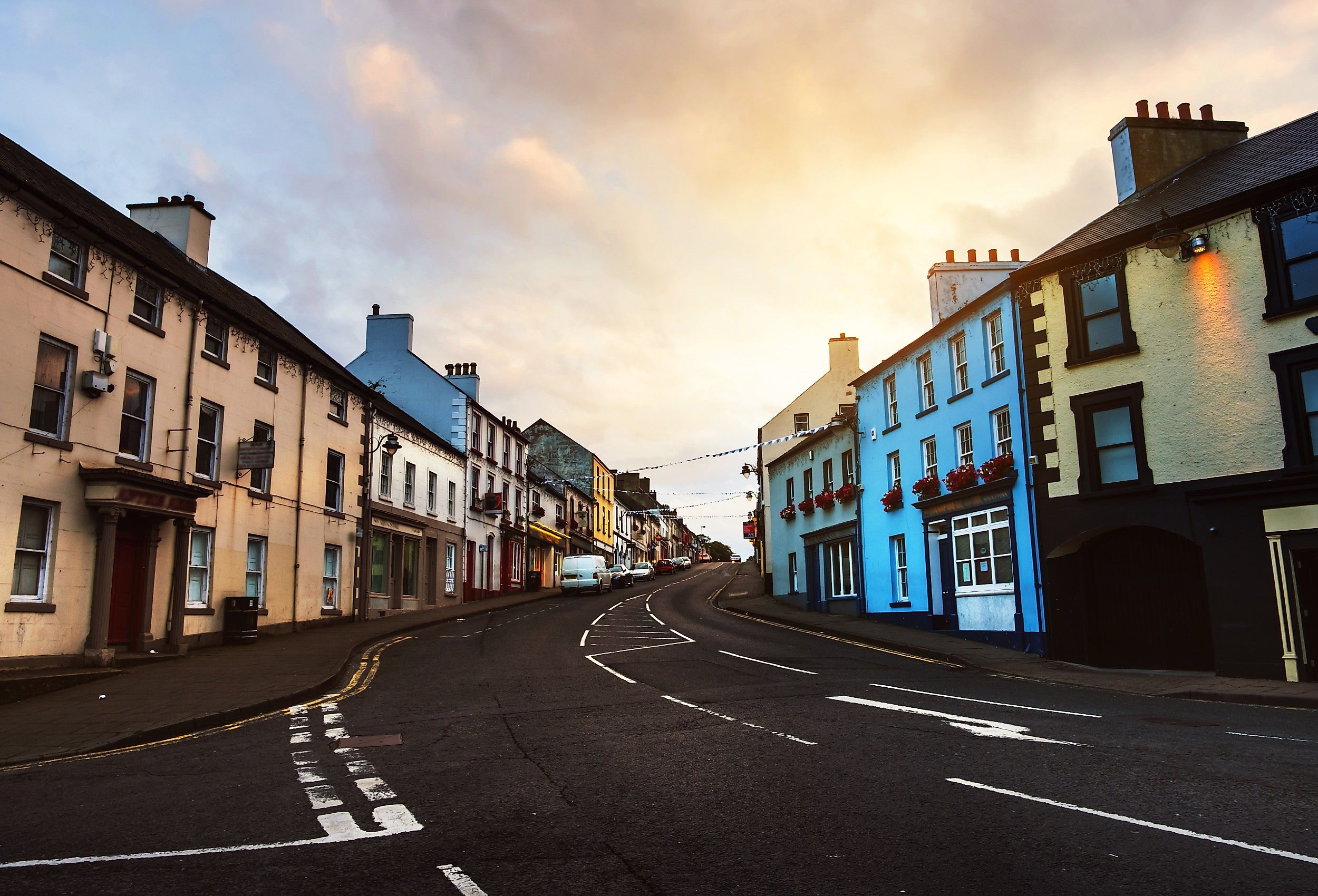
Northern Ireland's 11 Most Laid-Back Towns
Northern Ireland offers peaceful towns filled with coastal scenery, woodland trails, and centuries of history. Portrush opens onto Atlantic beaches and the fairways of Royal Portrush Golf Club. Farther inland, Belleek Pottery preserves a craft tradition dating to 1857. Woodland paths surround Rostrevor, where Kilbroney Park overlooks Carlingford Lough. Whitehead offers coastal walks and a railway museum filled with restored locomotives. These laid-back towns provide historic landmarks and open countryside without the crowds.
Portrush, County Antrim

This small seaside town may be well-known for its sandy beaches and an elite golf club, but its history foretells a village whose lore precedes its current leisurely offerings. The site of Portrush was founded in the late 19th century during the Larnian (or the late Irish Mesolithic) era, which is estimated to have been around 4000 B.C. Its impressive natural defences is what most likely led to it becoming a permanent settlement around the 1300s or 1400s. According to records emerging from that time period the local Portrush church, and by extension the locality, appears to have been considerably wealthy. After the Wars of the Three Kingdoms in the mid-17th century, Portrush became a small fishing town that eventually grew into a tourist destination during the 1800s following the opening of a railway system. The Coleraine-Portrush section of this original route still remains open and is operated by Northern Ireland Railways (NIR).
Positioned on a mile-long peninsula surrounded by rugged cliffs and a breathtaking natural backdrop, Portrush has always been a tranquil setting. Add to that its modest population of just over 6,000 residents, and the vibe in this town is centered in community rather than crowds and commercialization. The aforementioned renowned beaches include Whiterocks, East Strand, and West Strand, all of which are a short walk or drive from the town's main centre. On the edge of town, The Royal Portrush Golf Club, founded in 1888, has two championship courses and remains a source of local pride, especially since its refurbishment under the Royal and Ancient Golf Club of St Andrews in preparation for the 2019 Open.
Belleek, County Fermanagh

This town's relaxing ambiance is contributed to by its serene riverside views and gentle rolling fields almost as much as its sparse population of less than 1,000 residents. Although local amenities are limited, locals see this as encouraging simple, slow-living routines over fast-paced consumerism, often synonymous with bigger metropolitan areas. Its heritage only adds to its prestige, with one of the city's more renowned attributes being Belleek Pottery. Founded in 1857, this company is currently known to be Ireland's oldest fine china pottery and is seen as a symbol of Irish resilience, creativity, and enterprise. Belleek Pottery remains the village's principal heritage attraction, while the similarly named Belleek Castle hotel is in Ballina, County Mayo, and should not be listed as a Belleek establishment. The local churches of Belleek, encompassing both the Church of Ireland and St. Patrick's Catholic Church, have been integral parts of the community since the late 18th century and still hold reflections of local heritage and value systems.
Hillsborough, County Down

Hillsborough, also commonly referred to as Royal Hillsborough, is a historic village celebrated for its Georgian architecture, green streets, and close ties with the British Royal Family through Hillsborough Castle, the official Royal Residence in Northern Ireland. Sometimes described as a polished postcard version of County Down, the village is characterized by cobblestoned squares, mature trees, quiet lanes, and a welcoming atmosphere. Independent cafes, bakeries, pubs, and artisan shops only add to its charm, while the relatively light traffic creates an idyllic pace that invites exploration.
Although Hillsborough Castle may be the town's most notable attraction, there are plenty of other engaging destinations to discover. Hillsborough Fort dates to the 17th century and later hosted social gatherings, but the fort itself is currently inaccessible while the surrounding green remains open. Nearby, Hillsborough Forest Park spans almost 200 acres, with woodland paths, a lake, and pleasant walking trails bordering the village.
Whitehead, County Antrim

There is something so valuable about a town small enough to have an "everyone knows everyone" feel without feeling suffocating or overly isolated. This locality of approximately 3500 people manages to balance this impeccably. Described by locals as a quiet, sleepy town with a strong sense of community, there is little in the way of constant nightlife or crowds other than a few pubs, a cafe, local shops, golf clubs, and a yacht club. The average local is typically of an older generation; the atmosphere that is cultivated here is calm and unhurried.
The crown jewel of Whitehead's attractions is undoubtedly the Whitehead Railway Museum, which offers visitors a fascinating glimpse into the golden age of steam railways in Ireland through its impressive collection of restored locomotives, interactive exhibits, and insightful guided tours. Beyond its museum, the Blackhead Path provides a scenic coastal walk that leads to the Blackhead Lighthouse, and the Whitehead Golf Club has been offering challenging courses alongside spectacular sea views since 1904.
Draperstown, County Londonderry

Tucked into the Sperrin Mountains of County Londonderry, Draperstown is a small rural municipality of about 1,800 people encapsulated by lush green hills, winding rivers, and serene lakes. The Moyola River flows through the village, passing old mills and charming stone bridges that add to the town's vivid and calming character. Well-preserved buildings and heritage sites give Draperstown a sense of timelessness, while its surrounding countryside invites visitors to slow down and enjoy the landscape. For those looking to connect with nature, the trails of nearby Davagh Forest offer quiet walks and sweeping scenery away from the bustle of some of the more crowded tourist destinations. In the town's main centre, the Draperstown Library serves as a cultural hotspot, providing a glimpse into the town's literary and historical resources, regularly hosting exhibitions and events. Visitors can learn about local history at Draperstown Library or follow the nearby Derrynoyd River Trail through woodland beside the Moyola River.
Kilrea, County Londonderry

The name Kilrea is derived from the Irish word Cill Ria, meaning 'church on the hill', and the town received this name from the ancient church that used to overlook it. Its quiet rural setting and population of fewer than 2,000 residents provide a slower pace of living in contrast to some of the busier tourist hubs in the region, ideal for leisurely activities like gentle walks, cycling, and fishing. The town's narrow, sloping Main Street is crowned by the tall spire of St Patrick's Church of Ireland, which stands near the site of Kilrea's ancient church. Neighboring woodlands such as Portglenone Forest provide space for nature-based relaxation, while landmarks like the ruins of Kilrea Old Church and the War Memorial deepen its historical atmosphere. Blended into the old is the new, with modern builds such as the Kilrea Library being placed in close proximity to some of the town's most antiquated structures.
Ballycastle, County Antrim

Located on the north-easternmost coastal tip of Ireland and encompassed by some of the region's most striking landscapes, lies a city whose name roughly translates to 'town of the castle', Ballycastle. This town has been recognized on multiple occasions by The Sunday Times, a well-renowned British newspaper, on their "Best Places to Live List" and was even previously crowned the overall regional winner for Northern Ireland in 2022. Its history can be traced back to the founding of a settlement around Port Brittas in the late 14th century, which eventually grew into a coastal market and port in the 18th and 19th centuries. The town initially experienced significant industrial activity, but this eventually declined due to changes in trade and transport, inevitably leading to the locality embracing tourism and its cultural heritage as a key part of its modern identity.
Comprising approximately 5,600 residents, Ballycastle offers a range of landscapes and relaxing ways to experience the outdoors. Ballycastle Strand is a family-friendly beach where visitors can stroll along the shore, swim, or simply watch the waves roll in. Nearby, Ballycastle Forest provides tranquil woodland trails for hiking and birdwatching, while walks along the Tow River provide a slower, more scenic escape from the commotion of the city. Beyond its natural surroundings, Ballycastle's heritage adds another layer to its character. The Ballycastle Heritage Trail passes the 18th-century courthouse that houses Ballycastle Museum and continues near the Children of Lir sculpture, but the museum is closed for restoration until 2028.
Ederney, County Fermanagh

This small but historic rural community in the Glendarragh Valley, home to less than 600 inhabitants, preserves its heritage through its landmarks while continuing to serve as a focal point for local trade, culture, and community life. The village's name, extracted from the Irish word 'Eadarnaidhe' meaning 'middle place', is reflective of its position between rivers and landscapes, a location that is also responsible for the sense of calm and seclusion the township provides. Its 1839 Town Hall is still used today as its community center, and the Bronze Age Drumskinny stone circle situated on the outskirts of the village provides evidence of a long-standing, if not ancient, regional history. The area also happens to be one of the highest daily Irish-speaking communities in Fermanagh, which gives it yet another unique edge in terms of its modern cultural identity. Cobbler's Gastropub & Pizzeria at 1 Main Street is a currently verifiable dining option in Ederney.
Gortin, County Tyrone

With a population of approximately 374 residents, Gortin is a base for exploring the surrounding forests rather than a tourist destination in its own right. The village sits at the edge of Gortin Glen Forest Park, a large woodland area that contains trails, scenic drives, and viewpoints over the valley. Visitors can enjoy birdwatching and deer spotting, and observe ancient trees planted along various trails. From Gortin Glen Forest Park, visitors can hike to Darach the Guardian, one of three recycled-wood sculptures created by Thomas Dambo for the Giants of the Sperrins Sculpture Trail. Mossey's Bar at 53 Main Street is a verifiable long-running pub in Gortin.
Rostrevor, County Down

Set between the southern Mourne Mountains and the shores of Carlingford Lough, Rostrevor is a peaceful settlement with an extensive Gaelic and medieval history. This settlement of roughly 2,600 was originally named Caisleán Ruaidhrí (or Rory's Castle) after Rory Magennis, a member of a powerful Gaelic family known as the Lords of Iveagh. The name was only changed in the early 17th century after Welsh soldier and landowner Sir Edward Trevor of Denbighshire settled into the area and named it Rostrevor, seemingly after himself and his wife Rose, although the exact origins are disputed. By the 18th century, it had begun to evolve into the town it is known as today, described as a seaport with well-built houses, wide streets, and a salubrious climate.
The village itself offers a mix of history and natural scenery. It lies adjacent to Kilbroney Park, which contains a massive granite boulder perched on the slopes of Slieve Martin about 1,000 feet above the town, locally referred to as 'the big stone' but formally known as Cloughmore. This park also happens to be the physical space that inspired one of literature's most beloved fantasy realms. Author C.S. Lewis spent childhood holidays exploring the local mountains and eventually brought them to life on paper through the world of 'Narnia', which has since been immortalized in said park with the Narnia Trail. Rostrevor offers kayaking and sailing on Carlingford Lough, while camping and picnicking are available locally at Kilbroney Park.
Newtownstewart, County Tyrone

Newtownstewart, originally named Lislas, was established during the early 1600s during the Plantation of Ulster, when Sir Robert Newcomen built Newtownstewart Castle. About a decade later, his son-in-law, Sir William Stewart, acquired said castle and renamed it, along with the village, after his hometown. The town sits in the Sperrin foothills where the Strule and Owenkillew rivers meet, a tranquil location that offers easy access to walking paths and fishing spots, ideal for leisurely strolls, nature photography, and other similar activities.
At its heart is the ruins of the aforementioned Newtownstewart Castle, burned during the Irish Rebellion in 1641 and then rebuilt only to be destroyed after the retreat from the failed Siege of Derry in 1689. Today, only fragments of the north and west walls survive, and the site currently serves as a State Care Historic Monument that is open to the public by arrangement. A nearby ruin that fared slightly better is Harry Avery's Castle, a rare surviving stone fortress built by a Gaelic Irish chieftain around 1320 and named after Henry Aimhréidh O'Neill. Unlike Newtownstewart Castle, this structure's destruction was the result of its capture in the early 17th century during the English conquest, which was followed by its abandonment and decay rather than any deliberate destruction. The Newtownstewart Conservation Area preserves the historic streetscape, while the active Newtownstewart Centre 2000 hosts community events and activities.
Across the region, the localities that feel most removed from the hustle and bustle of modern-day living tend to share familiar rhythms. Small populations create close-knit communities while quiet streets, independent shops, and local gathering places preserve a sense of everyday connection. Beyond the towns themselves, forests, rivers, beaches, mountains, and open countryside provide the space to wander without an itinerary, or the space to simply stop and take it all in. History also contributes to this serene character. Ancient ruins, old churches, historic buildings, and long-standing customs remain actively woven into daily life rather than just being confined to museums or preserved for outsiders.
Perhaps that is what makes these places so restful; they do not need to be entirely untouched by modernity to feel peaceful, they just move at a gentler pace. These qualities create the kind of towns where the landscape, community, and heritage work together to encourage visitors to slow down, breathe deeply, and fully immerse themselves in the stillness of Northern Ireland's laid-back towns.