Most Populated US State Capitals
- Austin, Texas was the fastest-growing city in the United States in 2019.
- The US is the third-largest country in the world with a population of 331 million in 2020.
- Population in the US has increased over 10% in 20 years.
Here is a bar-trivia trap worth remembering: name the biggest city in Texas. If you said Austin, the state capital, you just walked right into it, because Austin is not even in the top four. That gap between "the capital" and "the biggest city" runs straight through this entire list. The United States is the world's third-most populous country, home to roughly 342 million people, and its largest state capital, Phoenix, holds more than 1.6 million of them. Behind Phoenix come Austin, Columbus, Indianapolis, and Denver to round out the five biggest. But being the seat of government and being the largest city in the state turn out to be two very different jobs, and plenty of capitals only hold one of them.
The Five Largest State Capitals
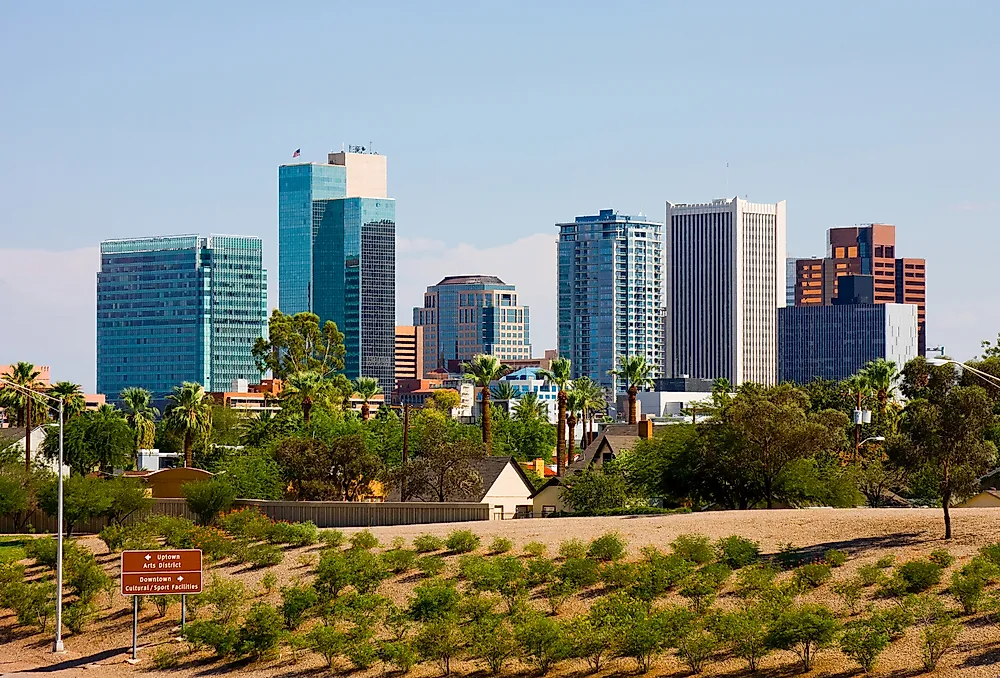
Phoenix, Arizona

Phoenix pulls off something almost no other capital manages: it is both the seat of government and, at about 1,665,000 residents, the fifth-largest city in the entire country. The Valley of the Sun spent the 2010s as one of America's great population magnets, drawing transplants after warm winters, jobs at expanding tech and manufacturing firms, and housing that at the time cost a fraction of California's. That growth has cooled from its blistering peak, and the 2025 estimates even nudged the city slightly below its 2024 count, but Phoenix still towers over this list, outweighing the next-largest capital by more than 600,000 people.
Austin, Texas

Austin finally cracked the seven-figure club, crossing one million residents between 2024 and 2025 to reach about 1,002,600. Here is the twist, though: in its own state, that barely earns a podium finish. Houston, San Antonio, Dallas, and even Fort Worth are all bigger, which leaves the Texas capital as roughly the fifth-largest city in Texas despite being one of the fastest-growing in the nation. The boom came with a hangover attached. Home prices rocketed during the pandemic rush, briefly making Austin one of the hottest and priciest markets in the country before cooling, and lately the fiercest growth has jumped the city limits into the surrounding suburbs.
Columbus, Ohio

Columbus is the quiet giant of the Midwest. It is not only Ohio's capital but its largest city, having outgrown both Cleveland and Cincinnati while they stalled or shrank. At about 938,000 residents and still climbing, Columbus leaned on a diverse economy of universities, insurance, logistics, and a growing tech presence to become one of the few large Midwestern cities adding people at a healthy clip. City officials have openly floated projections of another million residents flowing into the broader region over the next quarter century.
Indianapolis, Indiana

Indianapolis wears a lot of hats: state capital, largest city in Indiana, and home to the world's largest children's museum. Add professional sports teams, a growing web of recreational trails, and a downtown that swells for the Indianapolis 500 every May, and you get a city of about 901,000 that keeps attracting new residents even as the rest of Indiana grows slowly. The formula is not flashy, just jobs, affordability, and quality of life, but it does the trick.
Denver, Colorado

Denver spent the 2010s as one of the country's hottest destinations, with newcomers pouring in for mountain access, a strong job market, and a lifestyle that practically sold itself. That surge carried the Mile High City to about 741,000 residents and, predictably, strained everything from the highways to the housing market. Growth has slowed sharply in the 2020s as costs climbed, but Denver is still Colorado's largest city and the economic anchor of the entire Rocky Mountain region.
When The Capital Isn't The Biggest City
Here is the pattern hiding in the table below: a state capital is frequently not the state's biggest city, and sometimes it is not even close. Eight of the twenty capitals on this list get outmuscled at home. Austin trails four other Texas cities. Sacramento is dwarfed by Los Angeles. Raleigh sits behind Charlotte, Saint Paul behind its twin Minneapolis, Lincoln behind Omaha, Madison behind Milwaukee, Richmond behind Virginia Beach, and Baton Rouge behind New Orleans.
Zoom out and the mismatch gets even starker. Run down the roster of the largest cities in America, New York, Los Angeles, Chicago, Houston, and you will not hit a single state capital until Phoenix arrives at number five. The biggest names on the map, New York, Los Angeles, Chicago, are not capitals at all. That is no accident. When states chose their capitals back in the 1800s, they often picked small, central towns as a compromise between feuding rivals or to keep the government out of the grip of the largest city. Albany got the nod over New York City, Sacramento over Los Angeles and San Francisco, Springfield over Chicago, and Harrisburg over Philadelphia. The capital took the statehouse; the other city kept the skyline.
Most Populated US State Capitals
| Rank | City | State | Population (2025 est.) | State's largest city? |
|---|---|---|---|---|
| 1 | Phoenix | Arizona | 1,665,481 | Yes |
| 2 | Austin | Texas | 1,002,632 | No (Houston) |
| 3 | Columbus | Ohio | 938,396 | Yes |
| 4 | Indianapolis | Indiana | 901,116 | Yes |
| 5 | Denver | Colorado | 740,613 | Yes |
| 6 | Nashville | Tennessee | 721,074 | Yes |
| 7 | Oklahoma City | Oklahoma | 719,849 | Yes |
| 8 | Boston | Massachusetts | 672,973 | Yes |
| 9 | Sacramento | California | 536,449 | No (Los Angeles) |
| 10 | Atlanta | Georgia | 529,110 | Yes |
| 11 | Raleigh | North Carolina | 506,306 | No (Charlotte) |
| 12 | Honolulu | Hawaii | 341,868 | Yes |
| 13 | Saint Paul | Minnesota | 306,684 | No (Minneapolis) |
| 14 | Lincoln | Nebraska | 301,522 | No (Omaha) |
| 15 | Madison | Wisconsin | 286,233 | No (Milwaukee) |
| 16 | Boise | Idaho | 238,429 | Yes |
| 17 | Richmond | Virginia | 237,257 | No (Virginia Beach) |
| 18 | Baton Rouge | Louisiana | 222,795 | No (New Orleans) |
| 19 | Salt Lake City | Utah | 218,428 | Yes |
| 20 | Des Moines | Iowa | 212,086 | Yes |
The Bottom Line
Population rankings are never frozen. Austin only just crossed a million, Nashville and Oklahoma City recently elbowed past Boston, and Sacramento slipped ahead of Atlanta, all since the last census. Big-city growth has cooled across the mid-2020s, with several capitals posting small declines even as their suburbs balloon. The order above is a snapshot, not a settled score, and the next round of estimates will almost certainly reshuffle it all over again.