9 Small Towns In Indiana Were Ranked Among US Favorites
Visitors come to Shipshewana every Tuesday and Wednesday from May through October for an auction and flea market that has been running since 1922. The Roofless Church (Philip Johnson, 1960) and the Atheneum (Richard Meier, 1979) draw architecture-tour traffic to New Harmony from Chicago and Cincinnati. Madison's 133-block National Historic Landmark District is one of the most intact antebellum river towns east of the Mississippi. Brown County draws painters and weekenders to Nashville every fall. The nine Indiana towns below show up on national favorite-small-towns lists for specific reasons, and the histories under each hold up to the visit.
Angola

Angola is the seat of Steuben County in Indiana's northeastern corner, with a population of about 8,600. The Steuben County Soldiers' Monument, built in 1917, sits at the center of the public square and lists the names of more than 1,000 county residents who served in the Civil War, Spanish-American War, and World War I. The Angola Commercial Historic District around the courthouse holds Italianate, Classical Revival, and Late Gothic Revival buildings, most from the late 19th century.
Pokagon State Park borders the town and covers 1,260 acres around Lake James and Snow Lake. The 1.7-mile Hell's Point Challenge crosses several habitat types in the park's northern section. Other in-park draws include a refrigerated toboggan run that operates from late November through February (one of only two in the country), the CCC-era stonework in the Potawatomi Inn, and quiet swimming at Lake James's small public beach.
Nashville

Nashville is a town of about 800 people in Brown County, settled in the late 1800s as a working community and reinvented in the 1920s as an artists' colony. The T.C. Steele State Historic Site, six miles southwest, preserves the home and studio of the impressionist painter Theodore Clement Steele, whose 1907 move to Brown County is widely credited with starting the colony. The Brown County Art Gallery and the Hoosier Artist Gallery in town carry contemporary work by member artists.
Brown County State Park, just east of town, is the largest state park in Indiana at over 15,000 acres. Trail 8 is a 3.9-mile loop through the hilly forested terrain that distinguishes Brown County from most of the rest of the state. The park has campgrounds, mountain bike trails, and the Abe Martin Lodge for stays without tents. The Hobnob Corner Restaurant on Main Street has been operating in a 19th-century brick storefront since 1983; Big Woods at Hard Truth Hills sits up the road for craft beer and food.
New Harmony

New Harmony was founded in 1814 by the Harmony Society, a millenarian German Pietist sect led by Johann Georg Rapp. The Harmonists built about 180 buildings, ran a successful agricultural and manufacturing economy, and then sold the entire town to Robert Owen in 1825 to relocate to Pennsylvania. Owen, a Welsh industrialist, bought the town to attempt a secular utopian community based on common ownership and education. The experiment lasted barely two years before factional disputes ended it in 1827.
The town that survived both utopias is now a National Historic Landmark District. The Atheneum, designed by Richard Meier in 1979, serves as the visitor center. The Roofless Church, an open-air worship space designed by Philip Johnson and completed in 1960, sits a few blocks away. The Labyrinth (a hedge maze recreating an 1815 Harmonist original) and the David Lenz House are part of the standard walking tour. Harmonie State Park, on the Wabash River three miles south, has 3,500 acres of trail-accessible woodland.
Shipshewana

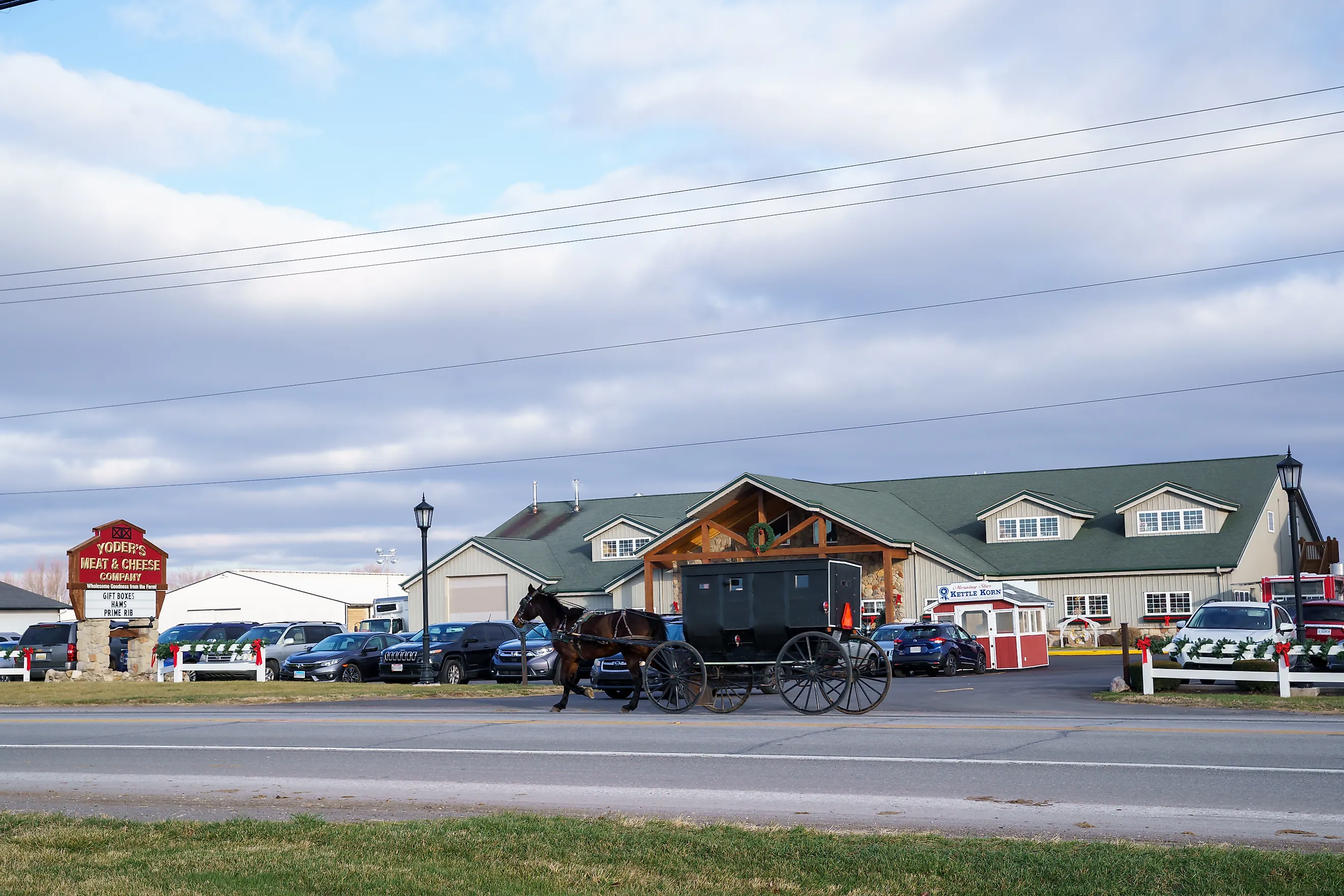
Shipshewana sits in LaGrange County in the heart of Indiana's Amish country, the third-largest Amish settlement in the United States. Buggies are a normal part of daily traffic. Menno-Hof, on the south edge of town, is the standard orientation: a museum that walks visitors through the history of the Amish, Mennonite, and Hutterite communities from their Anabaptist origins in 16th-century Switzerland forward. The Shipshewana Auction and Flea Market, in operation since 1922 on Tuesdays and Wednesdays from May through October, is one of the largest of its kind in the Midwest.
Local food includes Yoder's Meat and Cheese (a traditional Amish butcher and grocery), the Blue Gate Restaurant for buffet-style Amish cooking, and JoJo's Pretzels for hand-twisted soft pretzels. Buggy tours through the surrounding farms are available from Buggy Lane Tours and similar operators. Shipshewana's Lights of Joy, a 1.5-mile drive-through Christmas light display, runs from mid-November through New Year's Eve.
Madison

Madison sits on a narrow shelf of land between the Ohio River and 400-foot bluffs, with a population of about 12,000. Its boom decade was the 1840s, when river commerce made it briefly the largest city in Indiana. That period left a downtown with one of the most extensive concentrations of antebellum architecture in the Midwest, now a 133-block National Historic Landmark District. The Lanier Mansion (1844), in Greek Revival, was built for railroad financier James F.D. Lanier and is open as a state historic site.
Clifty Falls State Park, on the western edge of town, covers more than 1,400 acres of hilly hardwood forest with four major waterfalls. Big Clifty Falls drops about 60 feet. The park has trails ranging from easy creek-bottom walks to demanding rim climbs. Lanthier Winery, on Mill Street downtown, occupies an 18th-century stone fort foundation.
Aurora

Aurora is a small Ohio River town in Dearborn County, platted in 1819 and named for the Roman goddess of dawn. The population sits around 3,750. The town's defining building is Hillforest, an 1855 Italian Renaissance Revival mansion designed for steamboat builder Thomas Gaff. The architect was Isaiah Rogers, better known for the Tremont House in Boston (the first hotel in the United States with private rooms and indoor plumbing).
Aurora's main street has stayed compact and walkable. The town runs a public mural program with around 60 outdoor murals tracing local history, art, and industry; a printed walking-tour guide is available at city hall. Second Time Around, a long-running collectibles shop, occupies one of the older storefronts. The Aurora Farmers Fair (running annually since 1908) takes over downtown for four days each early October.
Corydon

Corydon, in Harrison County, served as Indiana's first state capital from 1813 to 1816, when Indiana entered the Union, and remained the capital until the seat moved to Indianapolis in 1825. The town's population is about 3,100. The 1816 Old Capitol building (a small two-story limestone structure where the state's first constitutional convention met) still stands at the center of the historic district and is open to visitors. The First State Office Building, also from 1817, sits across the green.
The Battle of Corydon, fought July 9, 1863, was the only Civil War battle on Indiana soil. A small Confederate raiding force under General John Hunt Morgan defeated local home guard troops on the south edge of town; the battlefield is now a public park with interpretive signage. O'Bannon Woods State Park, ten miles south, has 2,000 acres of woodland recreation. Turtle Run Winery is the local stop for tastings.
Goshen

Goshen is the seat of Elkhart County in northern Indiana, with a population of around 35,000 and a long-running Mennonite influence (Goshen College, a Mennonite liberal arts school, has been here since 1903). The downtown around the Elkhart County Courthouse runs a First Friday event most months that draws regional crowds. The Old Bag Factory, a converted 1896 industrial building, houses about a dozen artisans and small businesses (pottery, glassblowing, leather, woodworking) with open studios.
The Pumpkinvine Nature Trail follows a former rail corridor for 17 paved miles between Goshen, Middlebury, and Shipshewana, passing through farm country at the level of buggy traffic. Fidler Pond Park, on Goshen's east side, has an 80-acre former gravel-pit pond used for paddling and catch-and-release fishing. The Elkhart County 4-H Fair (one of the largest county fairs in the country) runs the last full week of July at the fairgrounds north of town.
Greenfield

Greenfield, the seat of Hancock County, has a population of about 23,500 and is the birthplace and longtime home of poet James Whitcomb Riley (1849-1916), known in his time as the Hoosier Poet. His childhood home on West Main Street (now the James Whitcomb Riley Old Home and Museum) preserves the family's furnishings and a substantial collection of his papers. The town runs the Riley Festival around his birthday each October.
The Greenfield Residential Historic District has more than 500 contributing buildings, mostly Italianate, Queen Anne, and Colonial Revival from 1870 to 1930. The Charles Barr House on East Main Street is among the more elaborate. Sugar Creek Brickhouse on the courthouse square has been the local gathering bar for decades.
Indiana's small towns sit at unusual intersections: Pietist utopias next to socialist ones, Amish buggies sharing roads with industrial trucking corridors, antebellum river ports backed by hardwood forest. The nine above all show up on national lists for specific reasons, and the histories behind those reasons hold up to the trip.