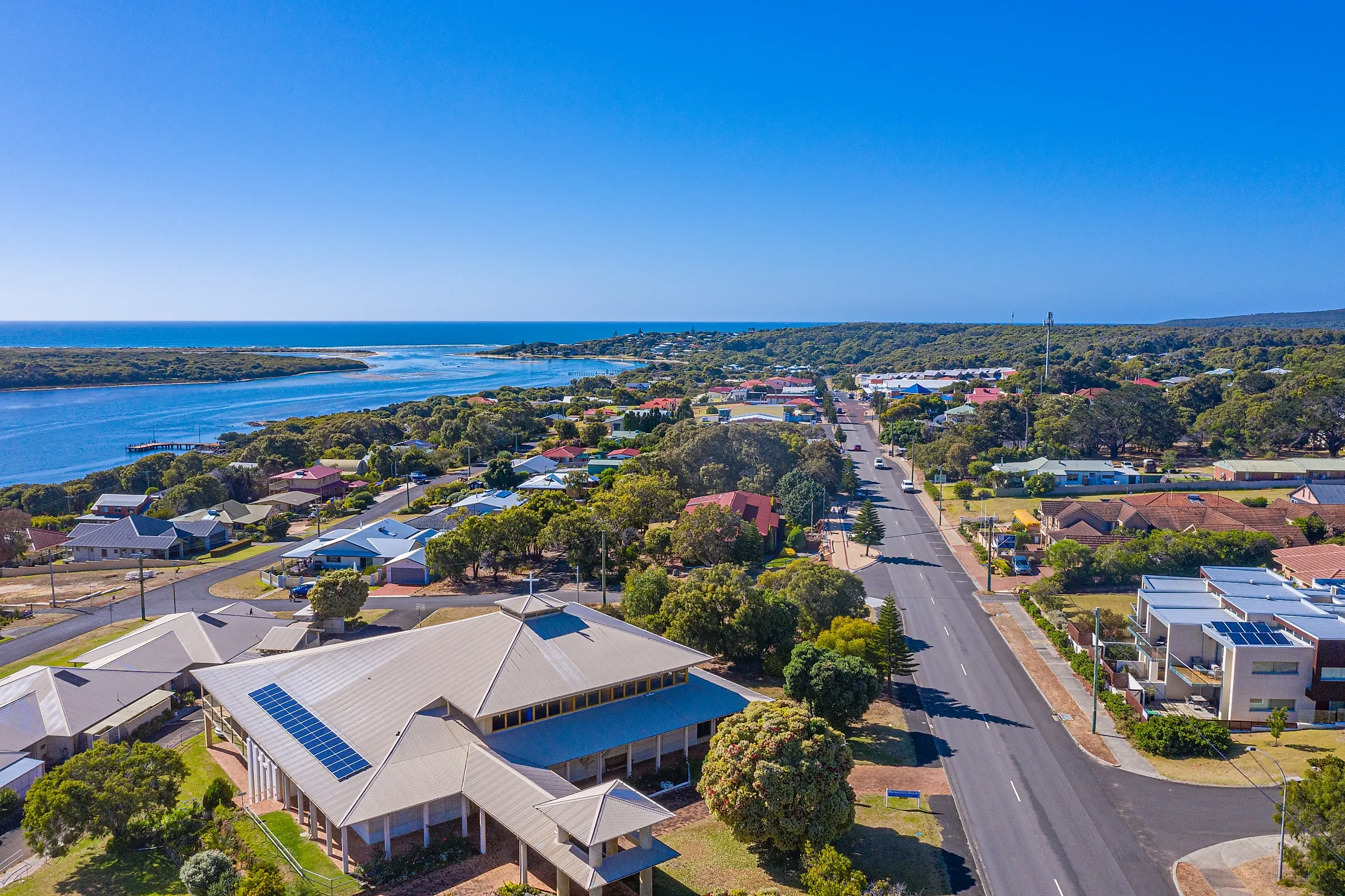
9 Most Peaceful Small Towns In Western Australia
Western Australia covers a third of the continent, and its small towns are scattered across some of its most untouched landscapes. In Denmark, places like the Mokare Heritage Trail show how closely daily life is tied to the river, wetlands, and old timber crossings. Farther north, Jurien Bay revolves around the coast, with the Turquoise Way Trail and sea lion tours making the ocean part of everyday experience. On the south coast, Walpole is shaped by the forests of Walpole-Nornalup National Park, while local stops like Petrichor Gallery bring that quiet setting into town. Together, these places reveal the slower, more grounded side of Western Australia.
Walpole

Walpole is on the edge of the 3,600 square km Walpole Wilderness area on WA's south coast, making it one of the most ecologically intact small towns in the country and one that genuinely earns the title. Walpole-Nornalup National Park wraps around the town itself, sheltering forests of old-growth red tingle trees, the largest-girthed eucalypts in the world, with the Giants Trails Walpole Trailhead giving direct trail access into one of Australia's last untouched Gondwanan forests without leaving the townsite. The WOW Wilderness EcoCruise departs the Town Jetty, running 2.5 hours through the Walpole and Nornalup Inlets Marine Park to a secluded Southern Ocean beach. Guide Gary Muir, whose family was among the first European settlers here, covers local geology, marine ecology, and conservation history throughout.
On Nockolds Street, Petrichor Gallery occupies a building originally purpose-built as a studio for an internationally recognised glassblower and runs rotating exhibitions every two to four weeks, showing ceramics, glass, textiles, woodwork, and painting by WA artists. A short drive from the gallery, the Knoll Scenic Drive is a free 5 km loop through the peninsula between the Walpole and Nornalup Inlets, winding through karri and marri forest with two inlet lookouts and a picnic area at The Channels, where both inlets narrow and meet.
Denmark

Fewer than 3,000 people live in Denmark, yet the town consistently pulls visitors who return year after year, partly for its beaches, partly for its karri forest, and partly for the particular kind of unhurried life it seems to model. The Mokare Heritage Trail runs over 3 km along the Denmark River, from the South Coast Highway traffic bridge down to the Heritage Rail Bridge at the river mouth, where black swans and pelicans regularly gather. The trail passes karri trees, paperbark wetlands, and the old timber rail bridge, all within walking distance of town. The river eventually finds its way to Ocean Beach, the town's main surf beach. It is patrolled by lifeguards in summer and sits where the calm Wilson Inlet meets the open Southern Ocean, creating a rare stretch of coastline where you can swim in sheltered inlet water or paddle out into surf breaks within metres of each other.
On South Coast Highway, Dark Side Chocolates is run by John Wade, a winemaker with 40 years of experience who applies the same logic of terroir to chocolate. Some of the pairings include Swiss couverture with Australian native bush flavours like Kakadu plum, wattleseed, and lemon myrtle. Chocolates are made by hand on-site, and the range rotates with the seasons. Just as considered in its curation, Denmark Riverfront Gallery sits opposite the river in the heart of town and represents over 30 local and Great Southern artists. There are oils, watercolours, ceramics, felted textiles, and timber work, with a gallery artist present daily.
Bremer Bay

Bremer Bay has quietly become one of the most ecologically significant coastal towns in Australia. Between December and April, Naturaliste Charters departs from the town boat ramp daily for the Bremer Canyon, a deep-sea trench about 70 km offshore where nutrient upwelling attracts sperm whales, pilot whales, blue whales, and 150-200 orcas each season. Closer to shore, John Cove is the town's main sheltered beach, calm enough for swimming year-round, and frequented by a resident dolphin pod. It is one of the few places in WA where dolphin encounters happen without a tour or a boat.
The town's history is just as worth exploring as its coastline. A local stone building constructed in 1896 by colonial architect George Temple Poole, the Telegraph Café was originally built after the 1875 telegraph station burnt down and is now the top-rated restaurant in Bremer Bay, with breakfast and lunch centred on seasonal local produce. From food to four generations of collected history, The Wellstead Heritage Museum spans the original Wellstead family farm, one of the first European settlements in this region dating to 1850, with over 6,000 exhibits across multiple sheds. It includes 30 restored vintage vehicles, tractors dating back to 1904, a working shearing shed, and four generations of collected musical instruments.
Augusta

Where the Blackwood River finally empties into Hardy Inlet, which opens into Flinders Bay, Augusta sits proudly as one of the oldest European settlements in Western Australia. Flinders Bay, which now forms the southern end of the townsite, is the main swimming beach. It features calm water protected by rocky reefs running parallel to shore, with a jetty, pontoon, free gas barbecues, picnic tables, and shade from giant pine trees lining the foreshore. During the May to August whale migration season, humpbacks and southern right whales regularly pass close enough to be spotted from the beach itself. A short walk west along the foreshore leads to Granny's Pool, a large natural rock pool carved into the headland that shelters the water from open-ocean swell, shallow enough for snorkelling and popular with families year-round.
On Blackwood Avenue, the Augusta Historical Museum documents the town from 1830 onwards through artefacts from local shipwrecks, personal effects of the original settler families, relics from the MC Davies timber empire, and a dedicated exhibit on the 1986 whale rescue. Perched above the river at the top of Blackwood Avenue, the 1912 Augusta Hotel has been the social centre of town for decades, with a verandah that looks out over the Hardy Inlet and the surrounding forest, the kind of pub view that takes a genuinely long time to get tired of.
Green Head

A town of 250 people perched on a dramatic headland 300 km north of Perth, Green Head is known for its coastline. Dynamite Bay, the town's centrepiece beach, forms an almost perfect circle of calm turquoise water sheltered by a protective rocky cliff. It draws visitors who come purely for the swimming and snorkelling over its rock reef and seagrass beds. Threading between the bays, the Three Bays Walkway is a 2.8km coastal trail built by the local Coastcare Group after two decades of dune rehabilitation work, running from South Bay through Dynamite Bay to Anchorage Bay with stepped beach access, sections with recorded Aboriginal heritage significance, and Indian Ocean lookouts along the way.
For something entirely different, the Green Head Gallery Café on Ocean View Drive is run by seascape painter Deborah Crookes, whose oils, pastels, and painted vintage surfboards line the walls. There is also a café attached serving barista coffee, handmade sausage rolls, and seasonal cakes. The town's most distinctive wildlife encounter, however, is the sea lion tour departing from Green Head's boat ramp to North Fishermans Island, home to the second-largest Australian sea lion colony on the Mid West Coast, with between 40 and 80 animals depending on the season.
Hopetoun

Hopetoun is wedged between the Southern Ocean and the edge of the Fitzgerald River National Park, one of Australia’s most biodiverse national parks, which makes it feel simultaneously remote and remarkably alive. Fitzgerald River National Park sits just outside town and protects over 1,700 plant species, nearly 20 percent of Western Australia’s flora. Walking tracks like East Mount Barren offer coastal views and access to wildflower-rich landscapes in spring within the 330,000-hectare park. Heading back into town leads to Jim McCulloch Park on Veal Street, a well-developed foreshore reserve with a large bouncy cushion, climbing structures, a fenced toddler area, and a heritage railway station structure.
At the edge of the foreshore, the Port Hotel has been part of the town's fabric since the 1900s, with the two-storey timber and iron section added in 1907 still standing. Its restaurant and bar look out over Mary Ann Haven, with East Mount Barren visible in the distance at sunset. The menu leans into local seafood, and the building itself is State Heritage listed. A few doors down on the main street, Shipwrecked Gourmet Bakery is the town's most reliably busy spot for fresh bread baked daily, handmade pies, layered cakes, and barista coffee.
Jurien Bay

Jurien Bay is home to one of the most accessible Australian sea lion colonies on WA’s west coast. Turquoise Safaris and Jurien Bay Oceanic Experience both depart year-round from the Boat Harbour on Breakwater Drive for 2-3 hour tours to Essex Rocks and the offshore islands. Here, an endangered colony of Australian sea lions can be snorkelled with, guided by qualified marine staff at a maximum of 15 swimmers per tour. The town's 162-metre Jurien Bay Jetty, rebuilt by the community in 2007 after a fundraising effort, extends into the Indian Ocean from the redeveloped foreshore precinct. It is a hub for squid fishing at dusk and morning swims off the pontoon.
Stretching south from the marina, the Turquoise Way Trail is a 14.2 km sealed path along the Jurien Bay Marine Park coastline to the Hill River Mouth, passing several beach access points, roofed picnic shelters, and foreshore parkland. It is flat enough for all ages and one of the few coastal trails in WA where the turquoise water is visible for almost the entire length. After time on the water or the trail, Jurien Seafoods on Roberts Street is the town's go-to for western rock lobster served fresh as takeaway alongside fish and chips, squid, and burgers.
Cervantes

Cervantes has grown from a crayfishing camp into one of the most ecologically diverse small towns on the Indian Ocean coast. Lake Thetis, just east of the town centre on Hansen Bay Road, holds one of the few accessible living stromatolite sites in the world. These are rock-like structures formed by cyanobacteria over thousands of years, representing one of Earth’s oldest life forms, accessible via a 1.5 km loop with an observation platform directly above the formations. A short drive north, Hangover Bay inside Nambung National Park is one of the more reliable snorkelling spots along this stretch of coast, with clear, calm water over limestone reef and easy access straight from the beach.
In town, the Lobster Shack on Catalonia Street runs regular factory tours through a working lobster processing facility, alongside a beachfront restaurant serving locally caught lobster. During the season, it also operates sea lion tours out to the nearby Cervantes Islands. Threading between all of this is the Cervantes Art Trail, a self-guided walk through the townsite featuring 23 sculptures and murals that document the town's fishing heritage, Noongar history, and coastal identity.
Gregory

Gregory (formerly Port Gregory) is sandwiched between the Indian Ocean and Hutt Lagoon, a large pink lake that can cover up to around 70 square kilometres, creating a rare geographic pairing along this stretch of the coast. The lagoon’s colour comes from Dunaliella salina. These carotenoid-producing algae thrive in highly saline water, with the hue shifting between soft pink, lilac, and deep red depending on light and conditions. The Pink Lake Lookout along Port Gregory Road is the most reliable place to see these colour changes, with elevated views across the lagoon and access to walking tracks near the shoreline.
Near the centre of town, the Port Gregory Jetty is where mornings and evenings tend to settle. Pelicans gather along the edge, and locals fish for species like snapper as the light drops. To take in the full layout of the place, guided buggy tours departing near the caravan park cross the dunes between the lagoon and the ocean, moving through low swales and vegetation where kangaroos, reptiles, and birdlife are regularly spotted. The town itself is home to around 100 people, showcasing the peaceful side of Western Australia, where tourists can focus on the scenery.
A Quaint Retreat In Western Australia
From the still inlets of Walpole to the reef-sheltered bays of Green Head, the most peaceful small towns in Western Australia show how space and routine shape daily life in this part of the Southern Hemisphere. Each town holds onto its own rhythm, whether it’s early mornings on a jetty in Jurien Bay or quiet coastal walks in Denmark. Taken together, they offer a clear way to experience Western Australia without needing to go far beyond these towns.