8 Undiscovered Small Towns in Wisconsin
In Chippewa Falls, the Leinenkugel family has brewed beer on the same spot since 1867, and the sixth generation is still running the place. That is the kind of specific, checkable thing the eight towns here are built on. Most of them sit a short drive from a larger city, Madison, Green Bay, La Crosse, the Twin Cities, Eau Claire, or Stevens Point, close enough that people tend to pass them on the way somewhere else. What follows is a plain account of what each one is worth stopping for.
Plover

Plover sits just south of Stevens Point, and its best-known landmark is easy to miss from the highway. On a small island in Lake Pacawa, reached by a short causeway, stands the Wisconsin Korean War Veterans Memorial: bronze figures from every branch of service, and plaques marking the 132,000 Wisconsin residents who served in the war and the 801 who did not come home. The lake around it is a man-made park with a swimming beach, a splash pad, and Easlan Weslan Park's ball fields a short walk off.
This is potato country, the sandy flat of central Wisconsin known as the Central Sands, and Plover leans into it. The Food and Farm Exploration Center on the town's southeast edge is part children's museum, part working demonstration farm, and it keeps what it bills as the world's largest potato masher out front. For a meal, Monk's Bar and Grill downtown does a Friday fish fry, and O'so Brewing pours its own beer a few minutes away. The Green Circle Trail, 27 miles of it, loops through the area along the Little Plover River.
Waunakee

Waunakee makes one boast and makes it constantly: it is, by its own road signs, "The Only Waunakee in the World." The village sits about 5 miles north of Madison, close enough to be a bedroom community and far enough to keep its own Main Street, where the old railroad depot, now on the National Register and housing the chamber of commerce, anchors a row of shops, the Lone Girl brewpub, and a weekly farmers market held in the Waun-A-Bowl parking lot.
For open ground, Governor Nelson State Park runs 422 acres along the north shore of Lake Mendota, with about 8 miles of trails through restored prairie and oak woods and a clear view of the State Capitol dome across the water. Drumlin Ridge Winery, out on River Road, pours in a tasting room that looks over the surrounding drumlin country.
Hudson

Hudson sits on the east bank of the St. Croix River, with the Minnesota edge of the Twin Cities filling in the far shore. Downtown ends at the water, where a lighted arch built in 1936 marks the entrance to Lakefront Park, a strip of beach, band shell, and bathhouse that hosts free concerts on summer evenings. The Phipps Center for the Arts overlooks the park and runs plays, concerts, and gallery shows year-round.
Two blocks up, on Third Street, the Octagon House Museum has stood since 1855, an eight-sided home built for Judge John Moffat and now kept by the county historical society. About 6 miles east of downtown, Willow River State Park covers roughly 3,000 acres and holds the town's biggest draw: Willow Falls, where the river drops through a rock gorge above a small dammed lake with a swimming beach. Hudson also claims the first Little Free Library, built here in 2009.
De Pere

De Pere sits on the Fox River about 5 miles upstream from Green Bay, at the spot where a lock and dam still lift boats around the rapids the French called the Rapides des Peres. The De Pere Riverwalk runs out along the east bank and onto a pier over the water; in spring the walleye stack up below the dam to spawn, and white pelicans work the current for fish. St. Norbert College, the only Norbertine college in the country, sits on the west bank a few blocks away. Downtown, the Mulva Cultural Center opened in 2023 with rotating art and history exhibits, a theater, and a cafe, and Seroogy's has been making chocolate in town for generations. It is a walkable stretch, river on one side and shops on the other.
Baraboo

Baraboo is where the circus wintered. The five Ringling brothers launched their show here in 1884 and brought it home every off-season until 1918, and the old winter quarters on the edge of town are now Circus World, a National Historic Landmark that holds the largest collection of circus wagons anywhere and runs Big Top shows through the summer. Downtown, on the square, the Al. Ringling Theatre opened in 1915, modeled on a French opera house, and still shows films and stages concerts under its original Barton organ.
The country around Baraboo is the reason a lot of people come. Devil's Lake State Park, 3 miles south, is the most-visited state park in Wisconsin: a spring-fed lake pinned between 500-foot quartzite bluffs, with beaches at both ends and bluff trails that carry the Ice Age Trail across the top. A few miles toward the Wisconsin Dells, the International Crane Foundation keeps the only collection of all 15 of the world's crane species.
Holmen

Just northwest of Holmen, in the Van Loon Wildlife Area, an old wagon road runs into the Black River bottoms and does not come out the other side. This is the McGilvray Seven Bridges Road: Alexander McGilvray ran a ferry here starting in 1854, and after the county replaced it, five steel bowstring-arch bridges were built across the backwater channels between 1905 and 1908. The road closed to cars in 1948, but the bridges still stand, and a 1.8-mile trail crosses them on foot through floodplain forest, the whole group listed on the National Register. Holmen itself is a fast-growing village on the northern edge of the La Crosse area, with 14 parks; the largest, Deer Wood Park, packs 40 acres of ball fields, tennis courts, and a sledding hill, and Halfway Creek Park downtown runs free concerts at its band shell on summer Sundays.
Chippewa Falls

The Jacob Leinenkugel Brewing Company has run on the same ground above the Chippewa River since 1867, one of the oldest breweries in the country, and the Leinie Lodge still gives free tours and pours samples at the end. The town's other claim is quieter: Chippewa Falls is the birthplace of Seymour Cray, the engineer who built the first supercomputers, and the Chippewa Falls Museum of Industry and Technology keeps a run of his machines alongside exhibits on Mason Shoe and the Darley fire-equipment works, both local firms.
Irvine Park spreads across 318 acres in the middle of town, free to enter, with a free zoo whose residents include bison, elk, black bears, and hyenas, plus the waterfalls at Glen Loch Dam. Up on the bluff, the Heyde Center for the Arts occupies a 1907 school saved from demolition and now runs theater and music. The 1887 Cook-Rutledge Mansion, an Italianate house from the lumber boom, gives tours in the warmer months.
New Glarus

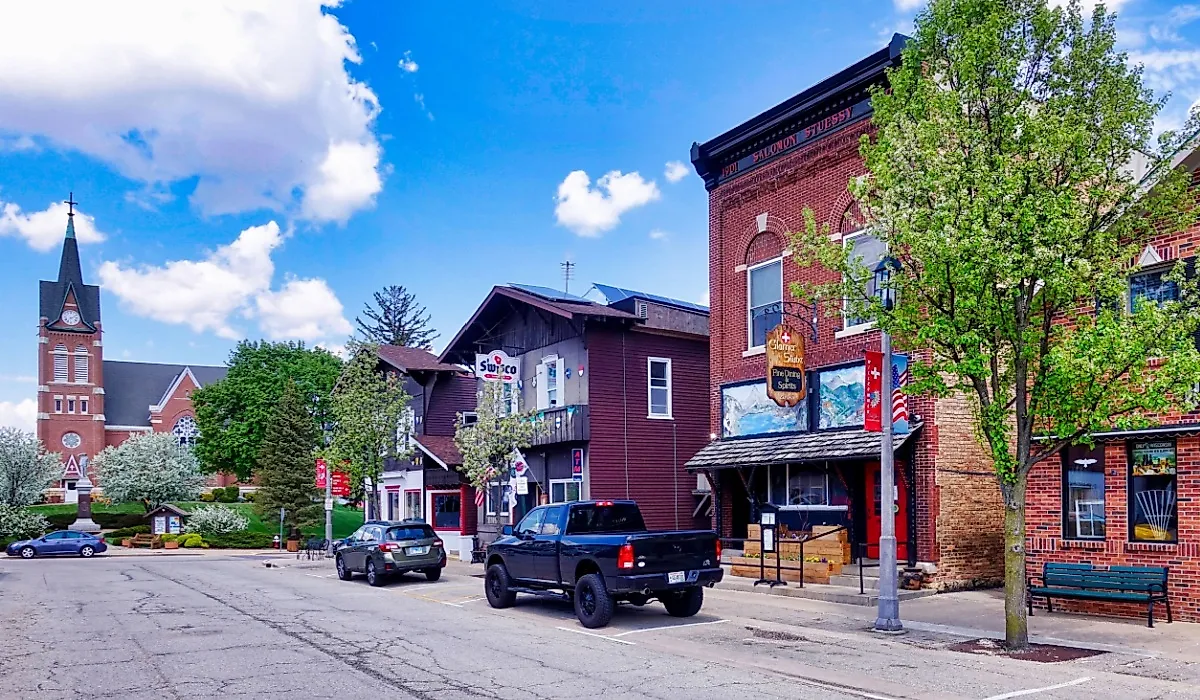
New Glarus was settled in 1845 by 108 immigrants from the Swiss canton of Glarus, and the town has spent the years since staying Swiss on purpose: chalet storefronts, a yodeling festival every August, Swiss and German surnames still on the mailboxes. It sits about 30 minutes southwest of Madison. Two museums hold the history: the Swiss Historical Village, 14 buildings including an 1890s cheese factory and a one-room schoolhouse, and the Chalet of the Golden Fleece, a Swiss-style house packed with the world-traveling collection of a local named Edwin Barlow.
The New Glarus Brewing Company sits on a hill just south of downtown and makes Spotted Cow, a farmhouse ale sold nowhere outside Wisconsin, which is enough to make the self-guided brewery tour a regular stop for people driving in from out of state. South of the village, New Glarus Woods State Park covers more than 400 acres of oak and hickory with campsites and trails, and the Sugar River State Trail, a 24-mile rail-trail, starts in town and runs south to Brodhead.
Sorting Them Out
For beer, Chippewa Falls and New Glarus are the anchors, one old-line, one a modern favorite. For time on the water, Hudson and De Pere both put their downtowns on a river. History runs deepest in Baraboo, with its circus, and New Glarus, with its Swiss village. For a plain afternoon in a good park, Plover, Waunakee, and Holmen each deliver without asking much. Spread across southern and western Wisconsin, none of these eight is far from a highway, and most work as a stop rather than a destination, which is the honest case for visiting them at all.