8 Timeless Towns In Virginia
One of the first parts of the United States to be settled by Europeans, Virginia’s history is woven into the very fabric of the country. Home to Colonial Williamsburg, the world’s largest living history museum, Williamsburg is a natural place to begin, with its restored Capitol and roots as an early colonial capital. Nearby, Jamestown reaches back even farther as the site of the first permanent English settlement in North America, where Historic Jamestowne and Jamestown Settlement bring the earliest days of colonial America vividly to life. Lexington adds a different layer of the state’s past in the Shenandoah Valley, where Washington and Lee University and the Stonewall Jackson House keep the 18th and 19th centuries close at hand. Virginia has played a pivotal role in American history, from the American Revolution to the final days of the Civil War, and these eight timeless towns tell that story especially well.
Williamsburg

The historic town of Williamsburg can trace its roots all the way back to 1632 when it was known as Middle Plantation. Later, in 1699, it became the capital of the Virginia Colony, underscoring its significance in what was to become the United States. Today, Williamsburg’s historic importance is preserved and presented through Colonial Williamsburg, the world’s largest living history museum. Covering 301 acres and featuring over 500 original and reconstructed buildings, it’s a wonderfully immersive experience that transports you back to the 18th century. In addition to authentic homes and businesses from this period, you can also visit the impressive Capitol building, completed in 1705, and the Governor’s Palace, dating from 1706.
The College of William & Mary, established in 1693, contributes to the town’s enduring legacy and ranks as one of the oldest higher education institutions in the United States. To truly experience how timeless this place is, spend a night or two at one of Williamsburg Inn’s Colonial Houses. These historic accommodations are near almost every major historic site in Colonial Williamsburg, including the King’s Arms Tavern, an authentic 18th-century tavern serving period-inspired meals.
Jamestown

Founded in 1607 on the James River, Jamestown holds the distinction of being the first permanent English settlement in North America. That fact alone would make it one of Virginia’s most significant historic destinations, but there is much more to this remarkably evocative place than a date in a textbook. It was here that England first established a lasting foothold in the New World, and where some of the earliest chapters of colonial America unfolded, including the leadership of Captain John Smith, the harsh “Starving Time” winter of 1609-1610, and the arrival of the first representative assembly in English America in 1619. Today, much of this story can be explored at Historic Jamestowne, where ongoing archaeological work continues to uncover the original 17th-century settlement.
A visit should also include Jamestown Settlement, a fantastic living history museum with detailed exhibits and recreations of the three ships that brought the first English settlers to Virginia: the Susan Constant, Godspeed, and Discovery. Recreated fort buildings and a Powhatan Indian village provide additional context and help bring the period vividly to life. Together, these attractions make Jamestown not just a place to learn about the origins of English America, but to experience them in a setting where the past still feels remarkably close.
Lexington

Lexington was established in Virginia’s beautiful Shenandoah Valley in 1778 during the tumultuous years of the American Revolution. Pay a visit today and you’ll find an enduring testament to this pivotal period of history, especially in Historic Downtown Lexington. A trip downtown reveals buildings such as the Lexington Presbyterian Church, constructed in 1845, and Stonewall Jackson House, built in 1800-1801 and home of the Confederate general. A great way to experience these and other downtown attractions is via a fun carriage ride. Offered by the Lexington Carriage Company, these one-hour trips back in time depart from the Lexington Visitors Center and last for about an hour.
You’ll also get a true sense of the era with a walk around the scenic Washington and Lee University. Founded in 1749, campus attractions like the Museums at W&L, which house impressive collections of art and historical artifacts, as well as the University Chapel built in 1868, are easily accessible from downtown Lexington. The nearby Virginia Military Institute, established in 1839, hosts the VMI Museum with exhibits and collections related to the town’s military heritage. Natural Bridge, a striking geological formation carved by Cedar Creek, provides a stunning natural attraction among the region’s historic sites.
Charlottesville

Since its establishment in 1762, Charlottesville has become synonymous with the early development of colonial America. The town’s most influential figure? That honor goes to Thomas Jefferson who left his mark with the stunning Monticello, his home, built between 1768 and 1809; and the University of Virginia (UVA), which he founded in 1819. Both are now UNESCO World Heritage Sites and are delightful to explore. The spectacular UVA grounds are centered around the famous Lawn and The Rotunda, as well as original (and still used) student lodgings, one of which once housed Edgar Allan Poe in 1826. Known as the Academical Village, this university campus model was emulated in other historic institutions across the country, such as the University of Nevada.
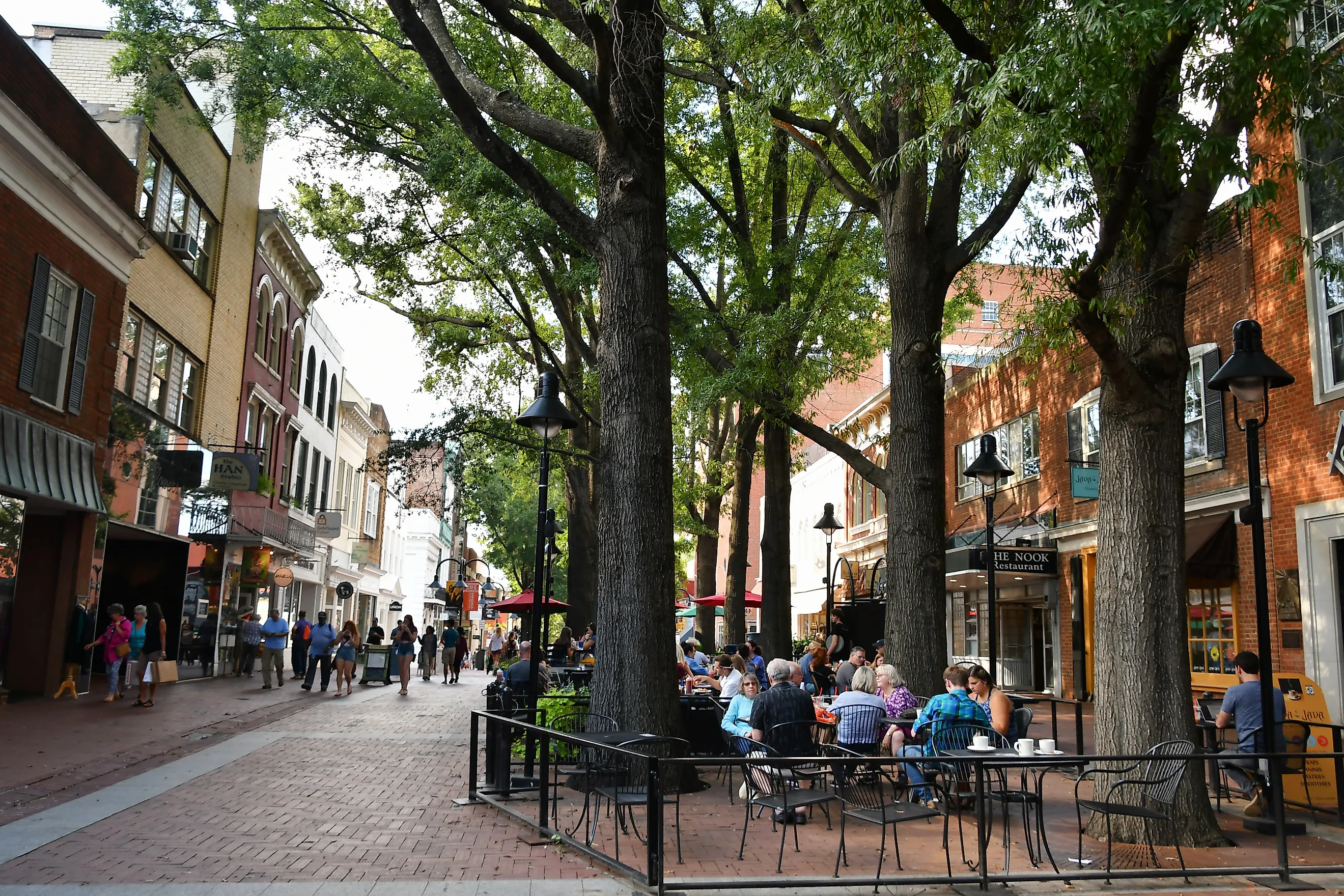
Another highlight of Virginia’s top college town is the Historic Downtown Mall, a walkable pedestrian area packed with excellent restaurants and entertainment options. It features the historic Paramount Theater from 1931 and The Jefferson Theater, built in 1912. For a memorable stay, consider booking one or two nights at the charming Oakhurst Inn, a lovely collection of former boarding houses and homes situated within a few minutes’ walk from UVA. For an authentic old-fashioned dining experience, Michie Tavern—established in 1784 near Jefferson’s Monticello—serves traditional dishes in a genuine period setting.
Winchester

Winchester, established in 1744, holds the distinction of being Virginia’s first town west of the Blue Ridge Mountains. Its strategic location in the Shenandoah Valley made it a vital crossroads during the French and Indian War, the Revolutionary War, as well as the Civil War. George Washington began his career here, supervising the construction of Fort Loudoun in 1756, remnants of which remain a point of interest today, as does his original office, a humble wooden affair that can be toured. The Civil War left a profound mark on Winchester, with the town changing hands over 70 times during the conflict. Sites such as the Stonewall Jackson Headquarters Museum, housed in a residence built in 1854, provide a fascinating glimpse into its wartime role.
Old Town Winchester, with its charming pedestrian mall, showcases the town’s historical significance through preserved architecture and cultural attractions like the Shenandoah Valley Civil War Museum housed in the town’s Old Court House. Be sure to also include the Museum of the Shenandoah Valley, a complex that combines regional history with gardens and art exhibitions, in your Winchester itinerary. You’ll also get a sense of timelessness with a stay at The George Washington Hotel, built in 1924 and offering luxurious yet historically inspired stays.
Yorktown

Founded in 1691, Yorktown was s to become one of the most crucial sites of the American Revolution. The Siege of Yorktown in 1781 effectively ended major combat operations, paving the way for American independence from Britain. Today, the Yorktown Battlefield, preserved as part of the Colonial National Historical Park, offers a chance to explore not just the site of this pivotal confrontation but also the nearby Yorktown Victory Monument, erected in 1881 to commemorate this decisive victory.
The American Revolution Museum at Yorktown is a wonderful place to explore, offering engaging interactive exhibits that really bring to life the broader context of the war and highlight the importance of the events that unfolded in this historic port town. Additionally, taking sailing excursions on a traditional schooner along the beautiful York River is a fantastic way to experience Yorktown’s rich history from a charming perspective.
Fredericksburg

Fredericksburg was established in 1728 along the Rappahannock River roughly mid-way between Richmond and Washington D.C. and served as an important colonial trading center. Its strategic location later made it a focal point of Civil War campaigns, most notably the Battle of Fredericksburg in December 1862. Today, the Fredericksburg and Spotsylvania National Military Park preserves remnants of these critical engagements, including Sunken Road and Marye’s Heights. Buildings such as the Kenmore Plantation, constructed around 1775, add to the town’s timelessness, as do guided battlefield tours and re-enactments.
The town’s charming historic district is home to a variety of fascinating buildings from different eras. You can explore the Rising Sun Tavern, which was originally built in 1760 as a private home and now serves as an intriguing museum. Don't miss the Fredericksburg Area Museum, where you’ll find interesting artifacts that tell the story of the town’s journey from a frontier settlement to a lively trading center.
Petersburg

Founded in 1748, Petersburg quickly became a vital trading post along the Appomattox River. Its economic and strategic importance continued into the Civil War, culminating in the Siege of Petersburg (June 1864-April 1865), an event which contributed to the eventual surrender at Appomattox Court House. Significant sites include Petersburg National Battlefield where you can learn about early trench warfare tactics. Blandford Church, built in 1735, still stands and boasts 15 Tiffany stained-glass windows, each dedicated to a Confederate state.
Strolling through Old Towne Petersburg is like stepping back in time, with charming 18th- and 19th-century buildings that now host delightful restaurants, galleries, and shops—each preserving their historic charm. Pocahontas Island, one of the oldest free African American communities in the U.S., adds a special touch of history and intrigue, highlighting the enduring spirit of this wonderful destination.
The Final Word
Virginia’s enduring appeal lies in its ability to connect travelers with pivotal moments in American history, with the best of them certainly demonstrating the kind of lasting significance that arises when communities honor their roots. And while these eight towns have each evolved over the centuries, a great deal of evidence about their early years can still be seen, whether in the form of cobblestone streets, period taverns, or grand architectural landmarks. Together, these eight timeless towns in Virginia stand as testaments to the Old Dominion’s rich heritage.