8 Stunning Small Towns In Western Australia
The most stunning small towns in Western Australia highlighted here are places where natural beauty takes center stage. In Coral Bay, the reef begins just offshore, turning the sea into an aquarium. In Kalbarri, deep red gorges cut through the earth, only minutes from the coast. From turquoise coves and towering karri forests to dramatic cliffs and calm lagoons, the landscapes surrounding these towns are what make them unforgettable.
Dunsborough

Dunsborough allows one to witness where Geographe Bay curves beneath Cape Naturaliste, creating some of the calmest, clearest swimming water in Western Australia. The coastline is the reason people come. Meelup Regional Park protects a string of beaches and granite-fringed coves between Dunsborough and Eagle Bay. Walking tracks link Meelup Beach to Castle Rock and Point Picquet, with short climbs to lookouts that double as whale-watching spots from June to December. The water stays sheltered because the bay faces north, and a limestone reef close to shore attracts blue gropers and cuttlefish in surprisingly shallow depths.
At the edge of the cape, Cape Naturaliste Lighthouse has operated since 1904. The white tower stands 20 meters tall, about 123 meters above sea level. Guided tours climb to the balcony for uninterrupted views across Geographe Bay, and during migration season, humpbacks are often visible offshore. A few minutes away, Sugarloaf Rock rises sharply from the ocean as a limestone stack just off the coast. It is a nesting site for seabirds, including red-tailed tropicbirds, and the viewing platform captures its scale against rolling surf.
Along the curve of the bay, Bunker Bay stretches wide and open. The sand is pale and fine, the water clear, and the seabed slopes gently before dropping to reef patches a few meters out, making it ideal for long swims and steady snorkels. Inland but still within the coastal setting, Eagle Bay Brewing Co. sits on a working farm with views over pasture and bushland toward the ocean. The brewery pours small-batch beers brewed on site, and the deck fills toward sunset as kangaroos graze beyond the fence line.
Denmark

Denmark wedges itself between the Karri forests and the Southern Ocean along Western Australia's south. At Greens Pool, granite boulders the size of small buildings sit just offshore, blocking the worst of the swell and leaving clear, protected water behind them. On rough days, you can hear waves breaking against the outer rocks while the inner pool stays calm enough for families to wade and snorkel.
A short walk over the headland leads to Elephant Rocks, where rounded granite formations rest in shallow turquoise water. The access path threads between boulders, and at low tide, small rock pools hold starfish and anemones. Both sit within William Bay National Park, where sheltered coves quickly give way to exposed cliffs.
Around 40 minutes west, the Valley of the Giants Tree Top Walk rises 40 meters above the forest floor. The 600-meter steel walkway moves gently through the canopy of red tingle trees, some more than 60 meters tall and centuries old. Back near town, the Denmark River opens toward Wilson Inlet before meeting Ocean Beach, a long stretch of white sand facing south. The surf and steady winds draw kite surfers, while swimmers usually head toward the inlet end, where conditions are more manageable.
Kalbarri

Kalbarri exists because the Murchison River carved gorges 400 million years in the making through a landscape that shifts from red rock formations to ocean cliffs within minutes of driving. The inland draw is Kalbarri National Park, which covers about 186,000 hectares. The Murchison River has carved through Tumblagooda Sandstone over hundreds of millions of years, forming gorges up to 100 meters deep in places. The Nature’s Window remains the park’s best-known formation, a naturally eroded rock arch framing a bend in the river.
The park extends to the coast, where geology creates different drama. Red Bluff presents layered coastal cliffs in burnt orange and terracotta hues that drop straight into the Indian Ocean, with a beach below accessible via steep paths for those willing to make the descent. These cliffs continue south to Pot Alley and Mushroom Rock, where wave action has carved the sandstone into overhangs and pedestals. Pot Alley takes its name from circular erosion holes in the rock platform, while Mushroom Rock balances improbably on a narrow stem. Both formations are best viewed at low tide when you can walk the rock platforms. Back at the river mouth, Chinaman’s Beach offers calmer water for swimming and paddleboarding.
Yallingup

Yallingup claims some of Western Australia's most powerful surf breaks alongside caves that tunnel deep into limestone beneath the town. At Yallingup Beach, the break sits close to shore and breaks over a shallow limestone reef. On a solid swell, it is fast and hollow, drawing experienced surfers who know the lineup well. Nearby breaks, including Rabbits and the left, often called Supertubes, work best when the wind swings offshore. It is not a beginner spot. A few minutes down the road, Smiths Beach opens into a wide bay with pale sand and low dunes. The southern end picks up more swell and suits confident surfers, while the northern corner is usually calmer when conditions settle.
Underground, Ngilgi Cave extends through limestone formed hundreds of thousands of years ago. Visitors can choose self-guided access with interpretive displays or guided adventure tours that venture into tighter sections. The chambers feature shawl formations, stalactites, and delicate helictites shaped by mineral-rich water over time. Above the caves, Canal Rocks presents a granite reef sliced by narrow channels where the Indian Ocean surges through gaps barely 2 meters wide. A boardwalk crosses these natural canals, delivering views into the churning water below while waves explode against the outer rocks. All of this sits within Leeuwin-Naturaliste National Park, which stretches roughly 120 kilometers between Cape Naturaliste and Cape Leeuwin, linking beaches, caves, and headlands along this part of Western Australia.
Lancelin

Lancelin built itself around wind and sand dunes that pile high enough to become Western Australia's unofficial sandboarding capital. Just outside town, the Lancelin Sand Dunes rise in bright white ridges that stretch across several square kilometers. Some of the slopes reach around 30 meters high. Four-wheel drives crawl up the steep faces, while sandboarders race back down on waxed boards. In the evening, people often climb the higher crests simply to watch the sun drop toward the Indian Ocean. That same wind powers the water sports along Lancelin Beach. During summer, the afternoon sea breeze, known locally as the Fremantle Doctor, often pushes through with steady 20-plus knot winds. The offshore reefs keep the bay relatively flat, which is why windsurfers and kitesurfers gather here most afternoons between November and March.
South of town, Wedge Island sits just off the coast, sometimes reachable by a narrow sand track depending on tides and conditions. The ocean side is rougher and popular with anglers, while the sheltered side looks back toward the mainland across shallow water where rays and fish move through seagrass. Closer to shore, South Ledge and North Ledge form low limestone reef platforms that help protect the main swimming area. The rock shelves also create pockets of calmer water where snorkelers spot small reef fish around the edges. Every January, these same waters host the Lancelin Ocean Classic, the country’s longest-running windsurfing race, when hundreds of competitors ride the wind up the coast.
Coral Bay

Coral Bay is one of the few places in Australia where you can step straight off the beach and find yourself swimming over a coral reef. At Coral Bay Beach, the reef begins surprisingly close to shore. You can wade out through knee-deep water before the sandy bottom gives way to coral gardens scattered with bommies (vertical columns of reef or rock that stand out from the surrounding reef). Green sea turtles often feed on the seagrass in the bay, and blacktip reef sharks move slowly through the deeper channels. A short walk south brings you to Paradise Beach, a quieter stretch where coral patches sit even closer to the sand. Snorkelers drift over small coral heads while parrotfish graze and schools of snapper gather in the current.
Further along the coast, Skeleton Bay sits beyond the main settlement and feels far more remote. The reef here drops into deeper water, and during certain seasons, manta rays pass through the area following plankton. Beyond swimming distance, Ningaloo Reef stretches along the coast for hundreds of kilometers. Boat tours leave from Coral Bay daily, taking visitors out to deeper sections where the reef wall falls away, and larger marine life appears. From March to July, many trips focus on encounters with whale sharks.
Back near shore, Five Fingers Reef offers another easy snorkel. Five coral ridges stretch toward the beach, creating narrow channels where fish move with the tides, so every snorkel tends to reveal something different.
Margaret River

Margaret River grew from a quiet farming settlement into the center of one of Australia’s best-known wine regions. Wine helped put the area on the map. Leeuwin Estate, established in 1974, was one of the wineries that proved the region could produce world-class wines. The estate’s Art Series Chardonnay regularly ranks among Australia’s best, but visitors also come for the cellar door tastings and the restaurant that looks out over rows of vines stretching toward the karri forest.
The ocean sits about 10 minutes away at Prevelly Beach, where the Margaret River flows into the Indian Ocean. Just south of the river mouth, Surfers Point produces powerful reef breaks that attract experienced surfers year-round and host the Margaret River Pro on the World Surf League tour. Underground, Lake Cave offers one of the region’s most striking cave chambers. Visitors descend deep below the surface to a still lake where limestone formations hang above the water, reflected clearly on the surface. South of town, Boranup Karri Forest rises in tall, straight trunks that often exceed 60 meters in height. Driving or walking through the forest gives a sense of how quickly the landscape here shifts from vineyard to dense woodland.
Busselton

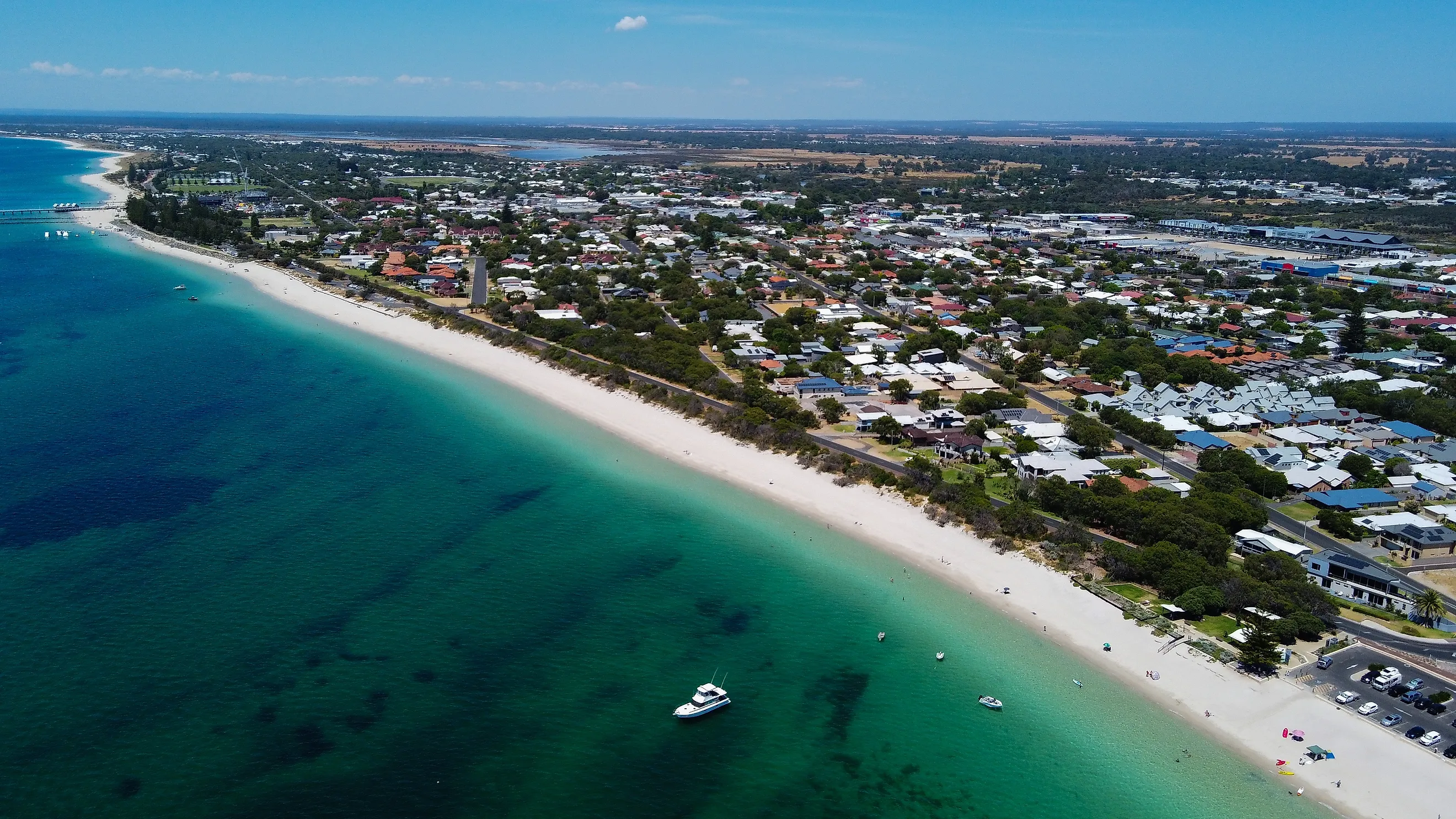
Busselton is best known for one thing: a jetty so long it disappears into the horizon before you reach the end of it. The Busselton Jetty stretches 1.8 kilometers into Geographe Bay. It was first built in 1865 so ships could load timber away from the shallow shoreline, but today it is more about the experience than shipping. Many people walk the full length, watching stingrays and fish moving through the clear water below the pylons.
Others hop on the small jetty train that runs out to the end. That’s where the Underwater Observatory sits. Visitors descend about 8 meters below the surface into a circular viewing chamber, surrounded by a reef that has formed around the jetty’s timber supports. More than 200 species of fish and marine life live here, including cuttlefish, octopus, and schools of yellowtail.
Back on shore, the Busselton Foreshore runs along the bay with wide lawns, playgrounds, and tall Norfolk pines. The beach shelves so gently that you can walk far into the water and still stand, which is why families tend to gather here through the warmer months. A short drive inland leads to Tuart Forest National Park, one of the few places on Earth where tuart trees grow naturally. Some of these eucalypts are several centuries old, and walking trails pass beneath their broad, pale trunks.
Across Western Australia, some of the most memorable places are the ones that stay small. In Coral Bay, the reef begins just beyond the sand, while in Kalbarri the landscape shifts quickly from coastal cliffs to deep sandstone gorges carved by the Murchison River. These Stunning Small Towns In Western Australia show how much variety exists in this region. Each one offers a setting shaped by the land and ocean around it, making the journey between them just as rewarding as the destination.