8 Quirkiest Pennsylvania Towns You Didn't Know Existed
Pennsylvania's quirks aren't random. The anthracite coal collapse left whole towns abandoned, mid-built, or burning. Nineteenth-century industrial experiments dropped concrete company towns into the woods and walked away when the math stopped working. German and Pennsylvania Dutch settlers brought place names that read strange to modern eyes but were ordinary in 1814. A few towns just decided to lean into a name or a coincidence and built a civic identity out of it. The eight below cover all of the above.
Lititz

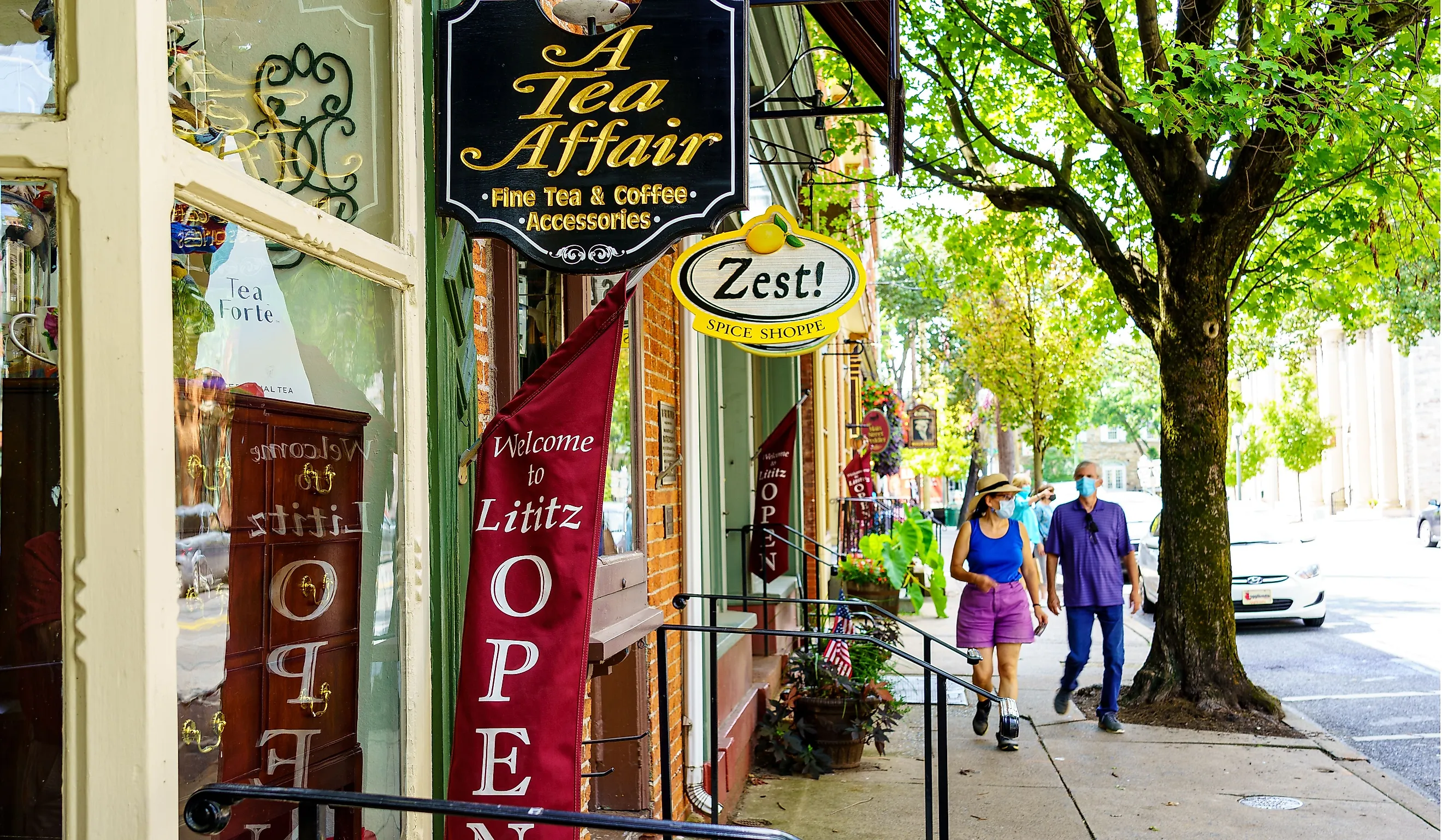
Lititz was first named America's Coolest Small Town by Budget Travel in 2013, but the quirk runs older than that. Julius Sturgis opened the country's first commercial pretzel bakery here in 1861, in a 1784 stone house at 219 E. Main Street. The original brick ovens are still in the building, and the 25-minute tour ends with a hands-on lesson in pretzel twisting. A few blocks east, Wilbur Chocolate is the home of the Wilbur Bud, a teardrop-shaped chocolate that predates the Hershey's Kiss by nearly three decades. Lititz Springs Park, the town's central green, sits over natural mineral springs and hosts a Fourth of July candle illumination that has been running since 1843. Aaron's Books anchors the indie bookstore scene downtown, and the Lititz Fire & Ice Festival in February turns Main Street into a sculpture gallery for a weekend.
Centralia

The Centralia mine fire started on May 27, 1962, when borough firefighters set the town landfill alight to clean it before Memorial Day. The fire reached an unsealed opening into the abandoned coal mines below and never stopped. Sixty-plus years later, it's still burning underground across roughly 400 acres, with one estimate giving it another 250 years of fuel. The borough's population, around 1,100 in 1962, was down to five at the 2020 census. The state condemned all properties in 1992, demolished most of the buildings, and the postal service discontinued the ZIP code in 2002. The Assumption of the Blessed Virgin Mary Church, on the hill above town, still holds Sunday services and is one of the few visible structures left.
The "Graffiti Highway," a paint-covered abandoned stretch of Route 61 that became Centralia's most-photographed feature, was buried under dirt in April 2020 by the private landowner. Visitors should still treat the area carefully, since smoking ground vents and sudden sinkholes remain hazards. The Pioneer Tunnel Coal Mine Tour in nearby Ashland gives the regional context, and the Big Mine Run Geyser in Ashland (Pennsylvania's only geyser) is the unintended byproduct of mine fire heat meeting heavy rainfall. For pop-culture pilgrims: Centralia inspired the look of the 2006 film adaptation of Silent Hill, not the original game.
Mars

Mars, a borough of about 1,700 in Butler County north of Pittsburgh, leans hard into the cosmic coincidence of its name. A flying-saucer sculpture sits in the middle of the town square, installed in 2006 and roughly 27 feet wide. The Mars New Year, held biennially, is the town's signature event: a multi-day festival with NASA partnership, planetary science exhibits, and costume-friendly programming aimed at families. The exact "year" celebrated tracks how many Earth years equal one Martian year (about 1.88 Earth years). The Mars Area History and Landmarks Society runs a small museum in the historic train depot, Stick City Brewing Company handles the local beer side, and Adams Township Community Park gives you somewhere to walk it off afterward.
Knox

Knox, a Clarion County borough of about 1,100 residents, calls itself the "Horsethief Capital of the World." The nickname has nothing to do with actual horse rustling. It traces back to a 19th-century vigilante group, the Knox Anti-Horse Thief Society, which formed to protect against actual thieves and somehow morphed over generations into civic pride. Horsethief Days every August leans into the bit, with parades, food stalls, and fireworks but exactly zero stolen horses. The Knox Glass Bottle Company once dominated local employment; today the town runs more on outdoor recreation. The Clarion River draws kayakers and anglers, and Cook Forest State Park (a short drive north) protects 8,500 acres including a 27-acre stand of old-growth hemlocks and white pines that escaped the 19th-century timber boom.
Intercourse

The name predates the connotation. When the village was renamed Intercourse in 1814, the word still meant social or commercial dealings (this was the meaning that gave us "course of life" and "discourse"). The town is unincorporated, sits in Lancaster County's Amish country, and yes, the welcome signs keep getting stolen as souvenirs. Kitchen Kettle Village, a cluster of more than 40 specialty shops built around a relish-and-jam company that started in 1954, anchors the visitor experience. Horse-drawn buggy rides leave from the village center for tours through working Amish farmland. The shoofly pie at Bird-in-Hand Bake Shop, in the neighboring town of Bird-in-Hand (yes, also a real name), is the regional standard. The People's Place Quilt Museum is worth an hour for the Amish craft tradition.
Concrete City

Concrete City, on the southeast edge of Nanticoke, is a ghost town that refused to die. The Delaware, Lackawanna and Western Railroad built the complex in 1911 as model housing for select foremen and technicians at the adjacent Truesdale Colliery: 20 poured-concrete duplexes around a central courtyard with tennis courts, a baseball field, and a wading pool. The construction method was so new that Thomas Edison was promoting concrete homes around the same time. By 1924, persistent dampness, the lack of indoor plumbing, and a township order requiring an expensive sewer system made the property uneconomic to maintain, and the Glen Alden Coal Company abandoned it. Demolition came next: 100 sticks of dynamite were detonated inside one duplex, and the building barely cracked. The company gave up. The structures are still standing, now overgrown and covered in graffiti. Frances Slocum State Park is nearby, and the Anthracite Heritage Museum in Scranton fills in the regional context, including the parts about the Susquehanna River's role in moving coal to market.
New Hope

New Hope, on the Delaware River across from Lambertville, New Jersey, has built a long second life as an arts colony, a queer-friendly weekend destination, and a town that takes its ghosts seriously. Several buildings in the historic district claim hauntings, and Ghost Tours of New Hope runs walking tours through them most weekends. The town's anchor cultural institution is the Bucks County Playhouse, founded in 1939 in a converted gristmill on the river, where Robert Redford, Grace Kelly, and Liza Minnelli all worked early in their careers. The New Hope Railroad runs heritage diesel and steam excursions through Bucks County farmland on tracks that date to 1891. Farley's Bookshop, in operation since 1967, is the kind of independent bookstore where staff still write recommendation cards for the front tables. The Delaware Canal towpath runs the length of town for an easy walk along the water.
Punxsutawney

Punxsutawney's signature event happens once a year on February 2, when Punxsutawney Phil emerges at Gobbler's Knob and (per the Inner Circle of the Punxsutawney Groundhog Club) either sees his shadow or doesn't. The tradition has run since 1887 and draws tens of thousands of visitors to the dawn ceremony. The 1993 Bill Murray film cemented the town's reputation, even though most of the movie was actually filmed in Woodstock, Illinois. Off-season, the Weather Discovery Center occupies the old post office on East Mahoning Street and runs interactive meteorology exhibits suitable for kids. The Phantastic Phils, fiberglass groundhog statues painted by local artists, are scattered through downtown like a public art trail. Barclay Square Park hosts community events on summer weekends. The Punxsutawney Historical and Genealogical Society covers the deeper local history at the Bennis House, a restored 19th-century home with rotating exhibits.
Eight Towns Worth The Detour
Each of these is reachable on a tank of gas from most of the state. Centralia smolders. Mars has a UFO. Concrete City stands because dynamite couldn't take it down. The interstates won't put any of this in front of you. The back roads will.