7 of the Quirkiest Towns in New England
New England's quirkiest towns each earn the label differently. Some have a single odd landmark: a fountain statue that vanished into an inn's attic for ten years, a 1922 drawbridge that still stops downtown traffic for sailboats, a 17th-century witch-trial site that grew into a year-round Halloween economy. Others built civic identity around a niche industry the rest of the country forgot, a sandwich nobody else makes, or a counterculture streak that never faded. The seven below trade the standard New England postcard for something stranger.
Wallingford, Vermont

Wallingford, Vermont, is a historic village on Route 7 in the Green Mountains of southern Vermont. The strangest local landmark is the "Boy and the Boot" statue at the corner of Route 7 and Route 140, one of a few dozen of its type around the world and the centerpiece of Wallingford's civic identity. Erected in 1898 in memory of local innkeeper Arnold Young, the painted metal figure shows a boy holding up his right boot, water dripping from the toe into a circular basin below. Around 1910 the statue disappeared. Ten years later it was found in the attic of the Wallingford Inn, and in 1927 it was reinstalled at the Inn's lawn, where it still stands every season except deep winter.
The mountains around the village hold their own oddities. Behind an old stone shop on Main Street, a skeleton was once unearthed alongside a rusted gun barrel. The remains were speculated to be a French and Indian War soldier, but the rest of the story never came to light. Vermont produces more maple syrup than any other state by a wide margin, with output topping three million gallons in each of the last several years. Locals can pick from any number of producers in and around Wallingford, including Coles Mapleside Sugar House.
Jonesport, Maine

Jonesport is a small fishing town on the Maine coast.
Jonesport, Maine, sits so far down the coast you have to want to go there, which is part of what makes it qualify here. The town is still a working lobster harbor where the boat-to-table supply chain runs in hours rather than days, and the surrounding waters include Moose Peak Lighthouse on Mistake Island, reachable only by charter boat. Watch for seals on the rocks at low tide and great blue herons hunting the flats.
The single strangest attraction is the Maine Coast Sardine History Museum, an independently run institution dedicated entirely to the lowly sardine. It traces the story of the dozens of canneries that once lined this stretch of coast, with original sardine cans, labels, packaging, crates, company letterheads, and photographs of the mostly-women workforce that kept the industry running before the last Maine cannery closed in 2010.
Beals Island, connected to Jonesport by a single bridge, has a long lobster-boat-building history (the Jonesport-Beals lobster boat is its own recognized hull style) and trails for hiking, birding, and biking on quiet roads.
Salem, Massachusetts

The town of Salem has turned its 1692 witch trials into a year-round civic identity. Witch-themed shops, haunted-history tours, and the month-long Haunted Happenings festival every October draw hundreds of thousands of visitors. The Salem Witch Museum is the most visited single venue, walking through the trial timeline and the broader European witch panics that ran from the 15th through 18th centuries. The trials themselves began when a group of girls in the village were said to be experiencing "strange visions and fits," a doctor diagnosed them with bewitchment, and what followed has often been compared to the modern "satanic panic."
The historic House of the Seven Gables, built in 1668 for sea captain John Turner, is the oldest surviving 17th-century wooden mansion in New England and was made famous by Nathaniel Hawthorne's 1851 novel of the same name. Today it operates as a museum showing furnishings, artifacts, and rare books from the period.
Along the Salem Harbor waterfront, Salem Maritime National Historic Site was established on March 17, 1938 as the first National Historic Site in the country. It covers nine acres, twelve historic buildings, and a working replica of the 1797 East Indiaman Friendship of Salem. The site interprets several centuries of Salem's maritime past, from the town's founding in 1626 through its peak as one of the wealthiest seaports in the early United States.
Woonsocket, Rhode Island

Woonsocket is a small city of about 43,000 with a string of unusual local traditions. Chan's Fine Oriental Dining, on Main Street, has paired Chinese food with live jazz and blues since the 1970s, hosting national acts in a back room behind the dining tables. The mill town once thrived along the Blackstone River, and Woonsocket Falls Dam remains the visible reminder of that economic past.
The city retains a strong French Canadian culture, originally settled by mill workers in the 1840s. The Museum of Work and Culture at 42 South Main Street covers the city's textile-industry history. The museum doesn't, however, cover Woonsocket's most peculiar food contribution: the Dynamite sandwich, a torpedo-roll alternative to the Sloppy Joe that locals consider their own. Ye Olde English Fish & Chips, opened in Woonsocket in 1922 by Yorkshire immigrants Harry and Ethel Sowden, still uses the original batter recipe and is now in its fourth generation of family ownership. On the city's border, the third-generation Pearl's Candy & Nuts is filled with old-school treats most shoppers remember from childhood.
The Stadium Theatre Performing Arts Centre & Conservatory, a rare survivor from the Vaudeville theatre era, was built in 1926 and has hosted touring music, dance, and theater since its 2001 restoration.
Mystic, Connecticut

Scenic view of a river in Mystic, Connecticut.
Mystic, Connecticut, earns its quirk through a working drawbridge that still stops traffic several times a day, a pizzeria Julia Roberts made famous in 1988, and a 19-acre open-air museum on the river that recreates a 19th-century seaport with actual working tradespeople. Mystic Seaport Museum, the largest maritime museum in the country, is the anchor of the town's identity. Inside its grounds you can watch a shipwright plane a hull by hand, board the Charles W. Morgan (the last wooden whaleship in the world, launched 1841 in New Bedford), and hear blacksmiths and coopers work their trades as they would have in 1875.
Off the Seaport grounds, Olde Mistick Village is a colonial-style shopping complex with 40-plus independent shops and restaurants. Mystic Pizza, the hole-in-the-wall immortalized by the 1988 Julia Roberts film, still runs a brisk trade on West Main Street. And the Mystic River Bascule Bridge, a counterweight-operated drawbridge built in 1922, opens several times a day for sailboat traffic, stopping downtown traffic cold and creating one of the better small-town photo ops on the Connecticut coast.
Portsmouth, New Hampshire

Portsmouth, New Hampshire, USA, town skyline along the Piscataqua River.
Portsmouth, New Hampshire, sits on the Piscataqua River and balances colonial preservation with a contemporary streak that occasionally veers into oddness. The annual Halloween parade, run since the 1990s, regularly brings out costumes that make Salem's look tame. Market Square, the downtown anchor, is dense with independent bookstores, art galleries, boutiques, and an eating-and-drinking scene that punches well above the city's 21,000 population.
Strawbery Banke Museum is the city's signature institution, preserving 32 historic homes and gardens spanning four centuries of Portsmouth life. The restored buildings cover everyday architecture and culture from the late 17th century through the mid-20th, room by room and yard by yard, on the original waterfront site where Portsmouth was founded.
Prescott Park, the city's waterfront green space, runs a summer-long festival of outdoor theater, live music, and dance under a tent on the Piscataqua. The Music Hall, a Victorian-era theater rebuilt as a 900-seat performing arts venue in the 1990s, anchors the indoor side.
Brattleboro, Vermont

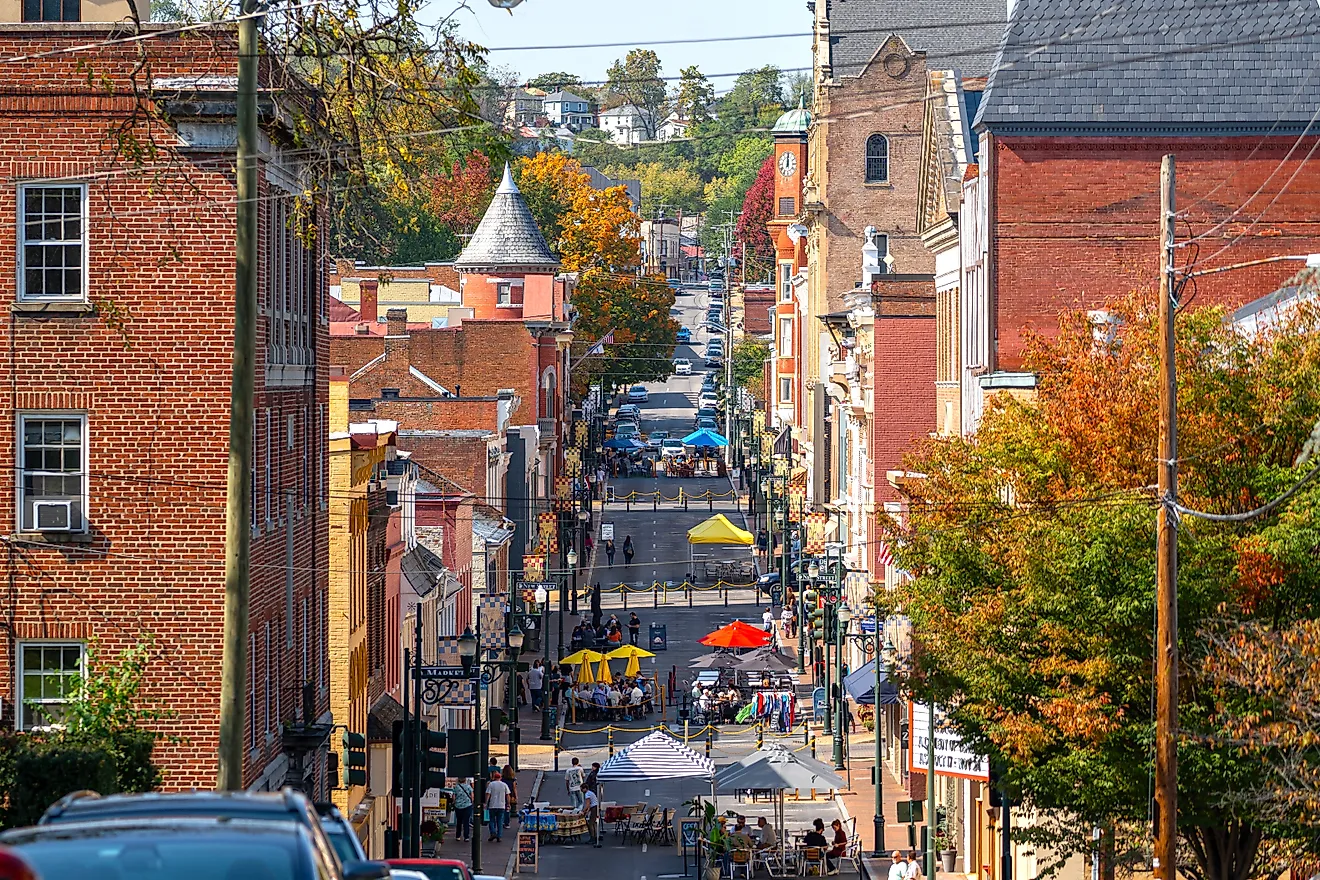
Brattleboro, on the west bank of the Connecticut River in southeastern Vermont, leans hard into its counterculture streak. Main Street runs through a walkable downtown of 19th-century brick buildings, independent bookstores, and the Brattleboro Food Co-op, a community institution since 1975. The Latchis Theatre, a 1938 art deco movie house built by four Greek-American brothers as a memorial to their immigrant father, anchors the corner of Main and Flat with Greek mythology murals on the walls and zodiac constellations painted across the auditorium ceiling.
The town ran its famous Strolling of the Heifers parade, a June procession of decorated dairy calves up Main Street, every year from 2002 until the pandemic ended it in 2020. The parent organization formally wound down in 2022, but the agriculture-and-arts ethos that produced the parade remains visible in the year-round programming. Gallery Walk on the first Friday of each month opens dozens of downtown spaces for new shows. The Brattleboro Museum & Art Center, housed in the old Union Station, rotates contemporary exhibits year-round. Retreat Farm, a ten-minute walk from downtown, runs pasture, woodland trails, and an outdoor food-truck scene during warm months.
A Journey Through New England's Eccentric Side
The quirkiest towns in New England each work a different angle on the region's eccentricity. A Vermont fountain statue that once vanished for a decade. A Maine museum devoted entirely to the sardine. Salem's witch-trial economy and Mystic's 1922 drawbridge that still stops downtown traffic on schedule. These seven trade the usual New England postcard for something genuinely stranger. The shared thread is small communities that built civic identity around something most towns wouldn't bother memorializing, and then kept the bit going long enough that it became the whole point.