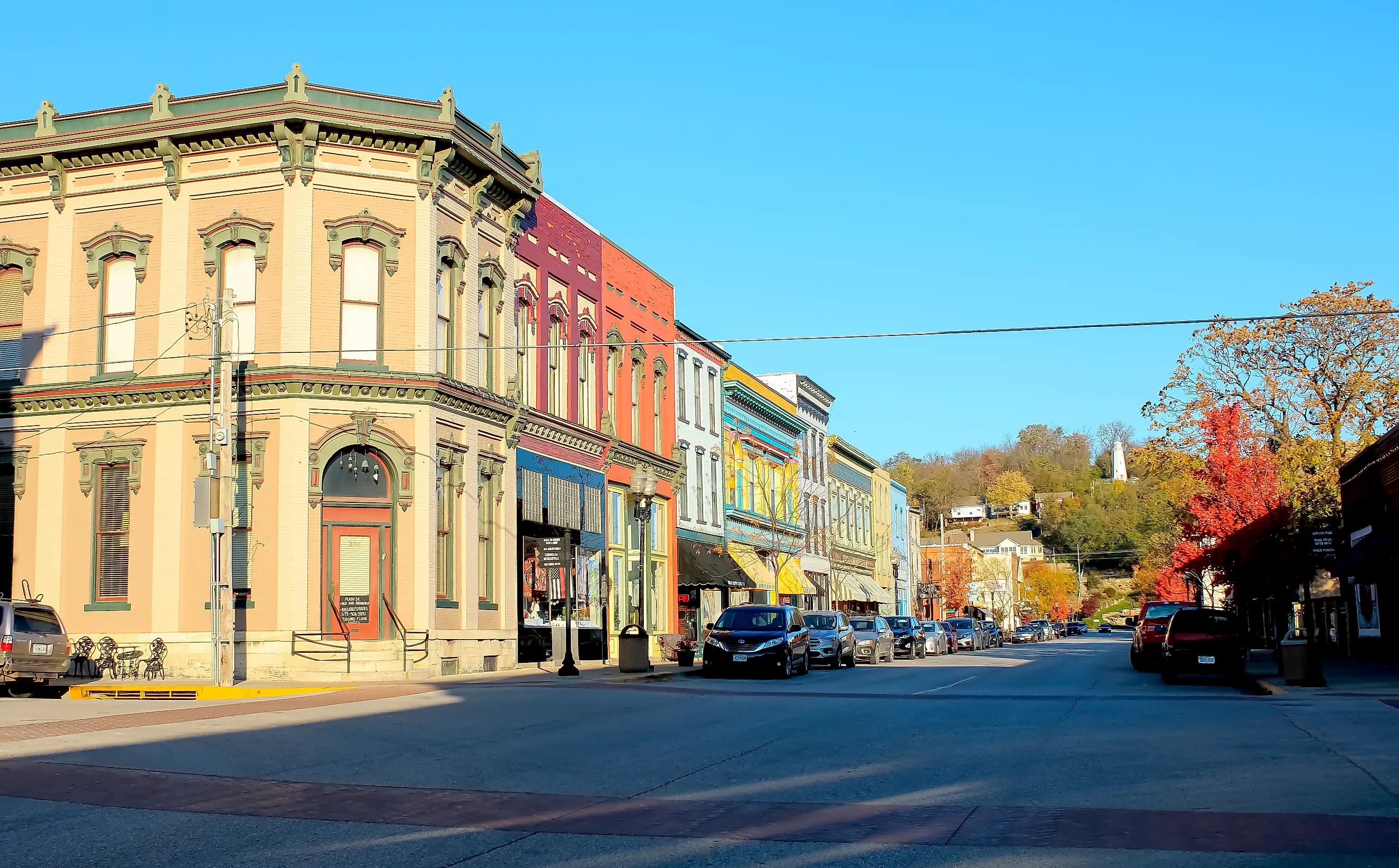
8 Picture-Perfect Main Streets In Missouri
The best Missouri main streets each carry a specific piece of the state's history in their brick and their layout. Some slope toward a river. Some sit under a courthouse tower. Others still show German settler, French colonial, or spa-era architecture in their downtown blocks. Every one of them is worth walking end to end.
Hermann

Founded in 1837 by German immigrants who wanted to preserve their language and culture in a new country, Hermann built Market Street to look like a Rhine village. Brick storefronts, iron balconies, and hills rising behind the business district still hold that plan today. The Deutschheim State Historic Site preserves the 1840s settler homes that started it all, and Hermannhof Winery keeps the wine-country identity within walking distance of downtown rather than pushing it to the edge of town. Stone Hill Winery, founded in 1847, was the second-largest winery in the world by 1900 before Prohibition shut it down, and it still operates today. The Katy Trail State Park cuts through the valley for walkers and cyclists who want the Missouri River corridor on foot.
Weston

Weston was a major departure point for the California Gold Rush before fires and river shifts ended its port days in the 1850s. What survived is a gentle slope of narrow sidewalks and old brick buildings that still look like a working commercial district. Pirtle Winery pours inside a former Lutheran church, giving a wine stop actual architectural weight. Holladay Distillery brings tours of one of the oldest distilleries in the state, founded in 1856 as McCormick Distilling. Just outside town, Weston Bend State Park runs wooded trails to a Missouri River overlook. The Main Street is small, but the texture holds a full afternoon.
Ste. Genevieve

Ste. Genevieve is the oldest permanent European settlement west of the Mississippi, founded by French colonists around 1735. That heritage still shows on Market Street through vertical-log construction, low frame buildings, and gallery spaces built into homes older than the United States. The Ste. Genevieve National Historical Park, established in 2020, gives the French colonial story a federal park presence with visitor exhibits and preserved buildings. The Bolduc House Museum runs another close-up look at the vertical-log building style. A short drive out of town, Pickle Springs Natural Area shifts the day into sandstone formations and creekside scenery. Few Missouri downtowns feel this specific to a single settlement story.
Hannibal

Samuel Clemens spent his boyhood in Hannibal, and the town has been cashing that check ever since. Main Street runs close enough to the Mississippi River that the water feels like part of downtown even when it is just out of view. The Mark Twain Boyhood Home & Museum turns the town's most famous story into preserved buildings and exhibits. The Hannibal Riverfront brings the river into the downtown experience, and Lovers Leap looks back over the whole town from a bluff to the south. The literary fame is the front door, but a river town sits underneath it, and the murals, storefronts, and old commercial blocks still read as the working port that made Twain's stories possible in the first place.
Parkville

Parkville has one of the most memorable approaches in Missouri, with historic storefronts climbing from the river lowlands toward the bluff and campus above town. English Landing Park runs the wide riverside strip with trails, open lawns, and views across the water. Park University, founded in 1875, rises above downtown with stone buildings that frame the street below. The Parkville Nature Sanctuary handles the quieter natural side with loop trails and creekside paths. The main street has layers, not just a row of shops.
Washington

Washington is home to the world's last surviving corn cob pipe manufacturer. The Missouri Meerschaum Company has been in business since 1869, when Henry Tibbe started making the pipes commercially, and the Corn Cob Pipe Museum on Front Street still traces that industry through preserved tools and product samples. The rest of Main Street runs brick buildings, local restaurants, galleries, and upper-story windows close enough to the Missouri River that the water shapes the mood. James W. Rennick Riverfront Park handles the walking-and-water side of the day. The Iron Spike Model Train Museum gives the railroad chapter a compact stop close to the main district. The Downtown Washington Historic District ties the German heritage, river commerce, and 19th-century architecture together in one walkable stretch.
Excelsior Springs

Excelsior Springs became a health resort because a farmer named Travis Mellion found mineral water on the East Fork Fishing River in 1880, and his sick daughter reportedly recovered after drinking it. The town has been built on that story ever since. The Hall of Waters, an Art Deco landmark opened in the 1930s as a mineral-water bottling and distribution site, still holds a water bar, spa spaces, and public offices. The Elms Hotel & Spa keeps the resort-town identity operating with over 125 years of continuous service. The Superior Well Pagoda is smaller but easy to miss if the day moves too quickly, and its street-level detail is part of the point.
Boonville

The Battle of Boonville, fought on June 17, 1861, was the first Civil War land engagement west of the Mississippi. Boonville's Main Street still has the sturdy commercial buildings of the old riverport that hosted that fight. Hotel Frederick, a restored 1905 hotel, gives the block a strong historic anchor near the river. The River, Rails & Trails Museum ties the town's transportation stories into a single visitor stop. The Katy Trail State Park runs directly into Boonville, and the Katy Bridge still holds the rail and river history in one structure. This is a heavier-boned Main Street than most and worth walking for that reason.
Eight Main Streets, Eight Stories
These eight main streets in Missouri each hold a different chapter of the state's history in their brick and their layout. Ste. Genevieve runs French colonial. Hermann and Washington lean on German settler heritage. Weston and Boonville hold the river-trade era. Hannibal carries Mark Twain. Parkville stacks its downtown between a river park and a hilltop campus. Excelsior Springs built its blocks around mineral water. Every one of them can be walked in an afternoon and rewards visitors who take the time.