8 Offbeat Gulf Coast Towns To Visit
The Gulf Coast is where Florida invented air conditioning a half-century before it became necessary, Mississippi keeps a town named after a pirate, Alabama tries to copyright a sunset, and Louisiana eats 30,000 pounds of crawfish over a single weekend in May. The eight towns below each commit to one specific offbeat thing the rest of the Gulf has not quite copied. Pack the camera and the appetite.
Grand Isle, Louisiana

Grand Isle is a seven-mile barrier-island town with about 700 year-round residents and a stubborn relationship with hurricanes. Hurricane Ida in August 2021 damaged or destroyed nearly every structure on the island; the rebuilds went up on taller stilts. The Bridge Side Marina is the local hangout for the offshore fishing fleet, and the town is the staging ground for the Grand Isle Tarpon Rodeo, the oldest fishing tournament in the United States (since 1928).
Grand Isle State Park covers a one-and-a-half-mile stretch of beach with camping, fishing piers, and a butterfly-and-bird-banding station that runs through spring and fall migration. The Migratory Bird Festival in early spring catches the warbler waves crossing the Gulf, with more than 200 species recorded in a single weekend. Camardelle's Seafood Market on Highway 1 buys directly off the boats and sells boudin, gulf shrimp, and everything in between at dock-side prices.
Cedar Key, Florida

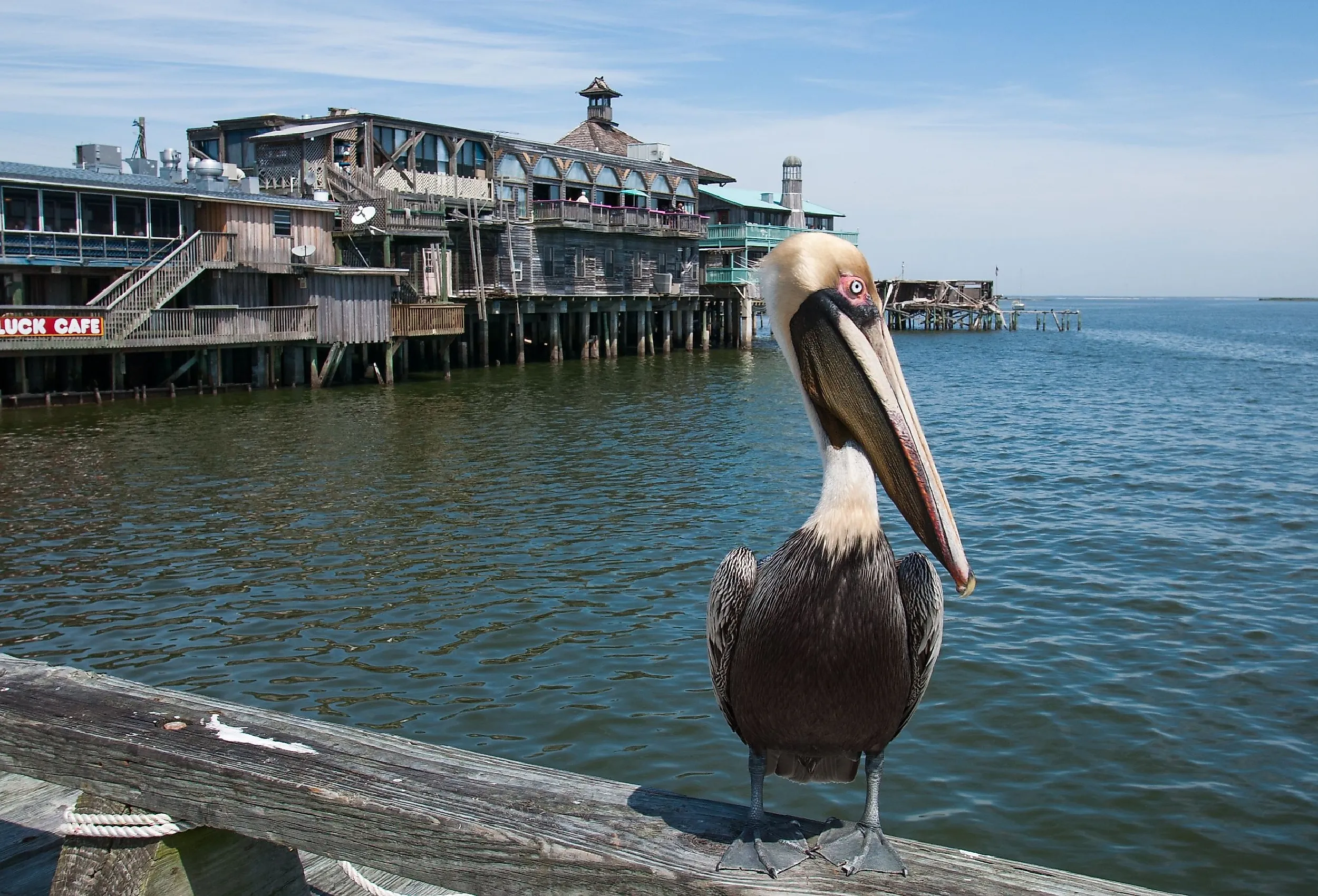
Cedar Key, Florida's Levy County island town with a population of about 700, has spent the last 175 years quietly avoiding the rest of Florida. The town was the western terminus of the David Levy Yulee railroad in 1861 and a brief boom port for cotton and pencil-cedar timber before yellow fever and a hurricane shut it down in 1896. The result is a small fishing village that the 20th century mostly skipped. The Cedar Key Historical Society Museum runs an honest local-history collection from the 1870s through the cedar boom.

Cedar Key is the largest clam producer on the East Coast (the surrounding waters grow more than 100 million farmed clams a year). The annual Cedar Key Seafood Festival in mid-October centers on the Suwannee-River-mouth clam, with stalls running clam chowder, clam fritters, and steamed clams in the dozens. The Tipsy Cow Bar & Grill and the 2nd Street Café both serve gulf-fresh seafood with waterfront views. The Cedar Key Museum State Park covers more local history with a focus on the 19th-century pencil-cedar industry.
Gulf Shores, Alabama

Gulf Shores is Alabama's southernmost town (population about 16,000) and runs the cleanest stretch of beach the state has, with the Gulf Shores public beach pulling in roughly six million day visitors a year. The Bon Secour National Wildlife Refuge on the western end of the Fort Morgan Peninsula protects 7,000 acres of dunes, salt marsh, and pine flatwoods, with the loggerhead and Kemp's ridley sea turtle nesting program running every May through October.
The Hangout Music Festival, held on the Gulf Shores public beach since 2010, draws over 35,000 fans a day with headline acts on six stages, sand sculptures, and a beach-bar setup. The Sand in My Boots Festival in mid-May, founded by country star Morgan Wallen in 2024, has become one of the largest country music beachfront festivals on the Gulf. For more relaxed entertainment, the Alabama Gulf Coast Zoo is the state's only full zoo with both indoor and outdoor exhibits.
Venice, Florida

Venice is the Sarasota County town that markets itself as the "Shark Tooth Capital of the World." The claim is not metaphorical. Venice Beach's offshore boneyard, a stretch of fossil-bearing sediment that the prehistoric Gulf laid down between 35 million and 5 million years ago, is currently being eroded into the surf zone at a steady rate. Visitors sift wet sand with a wire-mesh "Florida snow shovel" and reliably come home with handfuls of black-and-white fossilized shark teeth, including the occasional Carcharocles megalodon tooth the size of a human palm.

The annual Sharks Tooth Festival each April fills downtown's Venezia Park with vendors selling fossils, jewelry made from teeth, and the kind of cheerfully strange specialty merchandise that this particular obsession generates. The Venezia Park Historic District holds Italian-inspired 1920s architecture from the city's John Nolen-planned development era. Sharky's on the Pier and Dockside Waterfront Grill serve fresh-from-the-Gulf seafood and good sunset views.
Pass Christian, Mississippi

Pass Christian (population about 6,200) was a French maritime outpost in 1699 named for Nicolas Christian L'Adnier, a Canadian-French pilot who used the pass between Cat Island and the mainland for navigation. Locally pronounced "Pass Krees-chee-ANN" (the French way) and known as "The Pass," the town survived Hurricane Camille in 1969 and was leveled by Hurricane Katrina in 2005, when the entire downtown moved or was destroyed; the rebuild has produced one of the better-restored small Gulf Coast downtowns.
The Scenic Drive Historic District along the beachfront holds the surviving antebellum and Victorian-era homes that escaped Katrina. The Pass Christian Yacht Club, founded in 1849, is the second-oldest yacht club in the United States (after the New York Yacht Club). War Memorial Park, just off the beach, runs picnic and barbecue space and the annual Christmas in the Pass holiday lighting that draws steady crowds in December.
Breaux Bridge, Louisiana

Breaux Bridge (population about 7,500) sits in St. Martin Parish and was officially designated the "Crawfish Capital of the World" by the Louisiana Legislature in 1959. The annual Crawfish Festival on the first weekend of May serves more than 30,000 pounds of crawfish to roughly 50,000 visitors across the three-day weekend, with crawfish-eating contests, crawfish étouffée, crawfish boudin, crawfish jambalaya, and just crawfish-by-the-pound all on the menu. The festival runs continuous Cajun and zydeco music on multiple stages.

Outside of festival weekend, Café des Amis on Bridge Street and Buck and Johnny's both host a Zydeco Breakfast on Saturday mornings (couples dancing in front of breakfast plates, before noon, every week) that has become a recognized Cajun cultural institution. Lake Martin, a few miles east of town, runs swamp tours through cypress-tupelo wetland where alligators, herons, roseate spoonbills, and great egrets nest in spring and summer.
Dauphin Island, Alabama

Dauphin Island is a 14-mile barrier island off Mobile Bay that the locals have branded the "Sunset Capital of Alabama," a title made easier by the fact that Alabama's Gulf coast is short and most of it has trees in the way. The island has a year-round population of about 1,700. Fort Gaines, the masonry fort begun in 1821 and completed in the mid-1800s, saw the August 5, 1864 Battle of Mobile Bay, when Union Rear Admiral David Farragut famously bellowed (or possibly didn't actually bellow) "Damn the torpedoes, full speed ahead!" as he forced his fleet through a Confederate minefield to take the bay.
The Dauphin Island Sea Lab on the eastern end of the island runs the Estuarium aquarium, which displays the four major habitats of coastal Alabama (Mobile-Tensaw delta, Mobile Bay, barrier island, and northern Gulf) in tanks designed for school groups and Alabamians alike. The Audubon Bird Sanctuary near Fort Gaines is one of the best stopover habitats for warblers and other neotropical migrants crossing the Gulf during spring and fall.
Apalachicola, Florida

Apalachicola sits at the mouth of the Apalachicola River and was once the third-busiest cotton-shipping port on the Gulf, behind New Orleans and Mobile. The town's claim to American history was earned by local physician John Gorrie, who in 1851 patented a mechanical ice machine to cool the fever wards of his yellow-fever patients (his thesis was the cool air, not yet the germ theory, but the cooling worked anyway). He died in 1855, broke and largely uncredited. The John Gorrie Museum State Park on Sixth Street displays a working replica of his ice machine; air conditioning, refrigeration, and modern food preservation all trace their lineage to his patent.

The town was the country's top oyster producer through most of the 20th century, supplying roughly 90 percent of Florida's oyster harvest at peak production. The Apalachicola Bay oyster industry collapsed in 2012 from upstream water diversion and overharvest, and the state of Florida closed wild harvest from 2020 to 2025 to allow rebuilding. Trinity Episcopal Church (1839) and the Raney House Museum (c. 1838) survive from the cotton-port era. The Florida Seafood Festival in early November still draws steady crowds for oysters that now mostly come from out-of-state waters.
Eight Towns The Gulf Did Not Smooth Out
The eight Gulf Coast towns above each kept a piece of the Gulf the rest of the coast forgot. Grand Isle keeps rebuilding after every hurricane. Cedar Key kept the 19th century by accident. Venice runs a beach economy on prehistoric shark teeth. Pass Christian keeps the French pronunciation. Breaux Bridge holds the Crawfish Capital designation by act of legislature. Dauphin Island markets sunsets through three trees. Apalachicola invented the ice machine and let the credit go elsewhere. Pick the town, pack the appropriate tools.