8 Northern California Towns Where Time Stands Still
The upper half of California shines light on Spanish settlement, the Gold Rush era, the timber boom, and the beatnik scene. From the North Coast up to the Sierra Nevada, and down through El Camino Real, Northern California features strings of small towns where time seems to stand still. Begin this eight-stop itinerary near the very top in Crescent City, then listlessly meander through the realm of Franciscan Missions, Old West boardwalks, Gingerbread mansions, wooden water towers, and hippie beach towns.
Crescent City

While it is the architecture that gives most of the following towns their old-fashioned feel, it is the sea and the trees that cement Crescent City in time. Exit the Redwood Highway for Front Street, park by Beachfront Park, and then follow the foghorn out to Battery Point Beach. Here, you will spot the Cape Cod-style Battery Point Lighthouse, aka Crescent City Lighthouse, listed on the National Register of Historic Places, a California Historical Landmark, and one of the northernmost maritime beacons in California. Lit in 1856, Battery Point Lighthouse (and living quarters) is isolated in time, but also geographically, as it can only be accessed via a low-tide isthmus (so plan accordingly).

Crescent City also acts as a gateway to Redwood National and State Parks. Not only do these coastal redwoods constitute some of the world's tallest trees, but many of them were standing before the arrival of Columbus, and some were even sprouting at the time of Christ. To hike and camp amongst these time-capsule canopies, drive five miles northeast into Jedediah Smith Redwoods State Park, or cruise equidistant south to Del Norte Coast Redwoods State Park.
Eureka

Founded in 1850 as a supply post for the Gold Rush-related mining industry, Eureka is the oldest city in Humboldt County, and one of the oldest in all of Northern California. Thanks to this legacy, and its extensive Old Town lined with artsy 19th-century commercial buildings, Eureka was designated a California Cultural District in 2017. At the end of its Main Street (i.e., 2nd Street), you will find two eccentric, highly-photographed Victorian structures built by the lumber magnate, William Carson. In chronological order, there is the 1855 Carson Mansion (now the Ingomar Club), followed by the 1889 Pinc Lady Mansion.

Eureka is also home to the circa-1853 Fort Humboldt State Historic Park. On this strategic (and scenic) bluff overlooking Humboldt Bay, Ulysses S. Grant was stationed for six months following the Mexican-American War. Unfortunately, the fort fell into disrepair after it was abandoned in 1870, though the original hospital still stands, and other important structures, such as the Surgeon's Quarters, have been faithfully reconstructed.
Ferndale

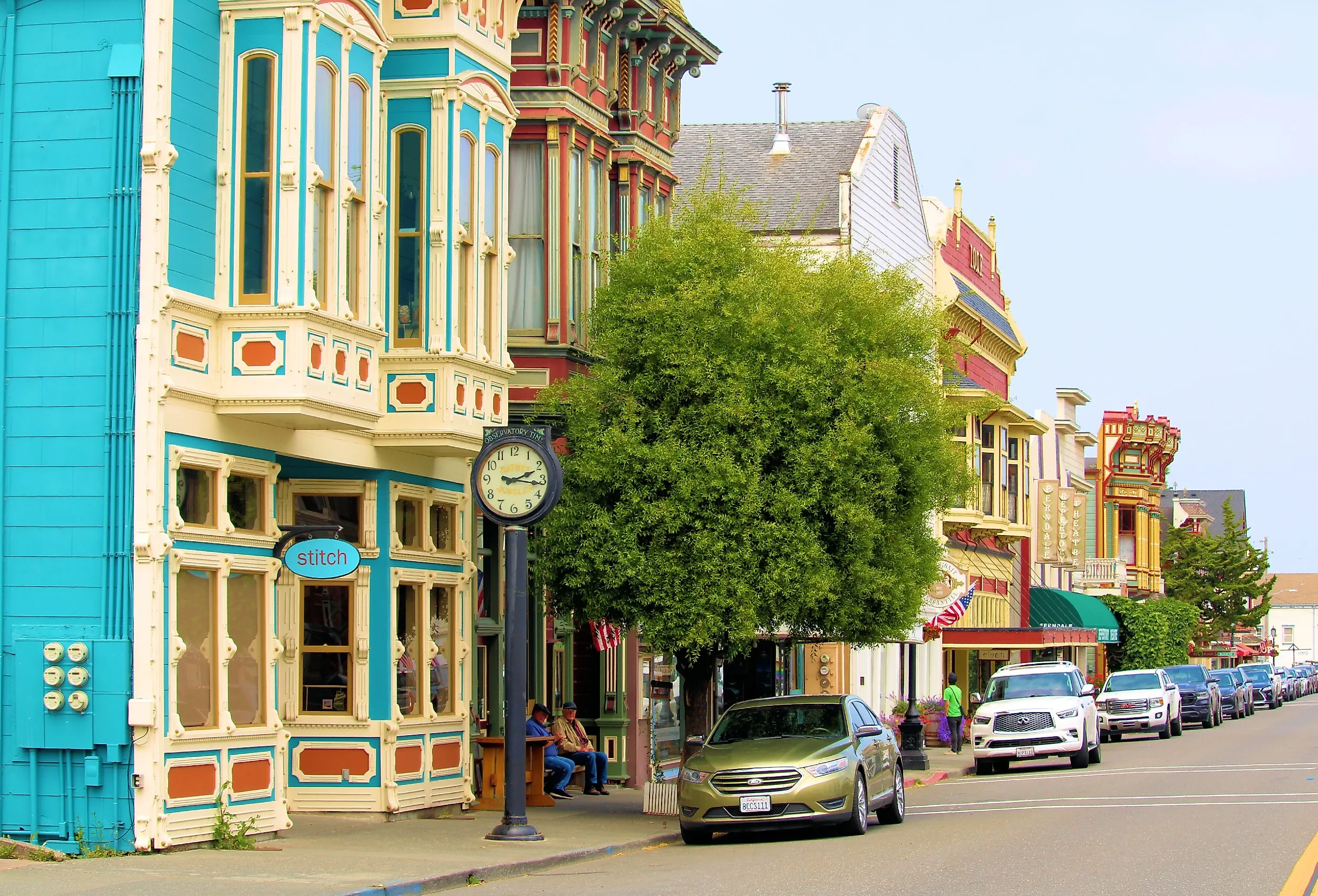
Another Humboldt County time capsule sits just 20 miles south of Eureka. Ferndale continues the trend of Victorian storefronts and ornate mansions, but in this case, its mid-19th-century opulence stemmed from the dairy industry, rather than mining-related measures. Here, amidst the peaceful North Coast pastures, wealthy farmers erected large dwellings, affectionately called "Butterfat Palaces," with distinctive "gingerbread" trim. The best example of this playful design is the Gingerbread Mansion Inn over on Berding Street, but Ferndale's Main Street, as a whole, really seals the nostalgia-inducing aesthetic. In addition to the gingerbread stylings, note the charming mercantiles, creameries, coffee shops, and even a commercial blacksmith housed within this string of attractive facades.

In recognition of Ferndale's extensive and immaculate architecture, the entire town has been designated as a California Historical Landmark. The National Register of Historic Places has also listed the aforementioned Main Street Historic District, as well as the Fern Cottage Historic District. Finally, on your way into and out of town, take a moment to appreciate the Eel River-spanning Fernbridge, the longest poured concrete bridge in the world that is still in operation.
Mendocino

About midway down California's North Coast, there is a timeless enclave that fuses the shimmering beauty of the Pacific Ocean with a pastel, woody town. Rather than mineral extraction or dairy farms, Mendocino grew around its lumber mill for the better part of a century. Following the decline of the timber industry, the village pivoted to the arts, drawing creative types through the founding of the Mendocino Art Center, in conjunction with an ever-growing density of studios/galleries. The area's inspiring scenery didn't hurt either. To this day, painters and photographers set up shop along the trail-lined cliffs of Mendocino Headlands State Park.

Adding to Mendocino's frozen-in-time look are its wooden water towers peppered throughout its modest peninsular grid, as well as two small museums: the 1854 Ford House Visitor Center & Museum on Main Street and the 1861 Kelley House Museum just a block away on Albion Street. Check off noteworthy historical structures, soak in the wispy peripheral trails, and spot the secret beaches as you stroll around Mendocino.
Stinson Beach

This last coastal community is interchangeable with many of Marin County's bohemian, moderately developed towns. Point Reyes Station, Bolinas, Muir Beach, Sausalito (still to an extent), and of course, Stinson Beach, all have qualities that make them at home in the 1950s, and that will probably persist through the 2050s. This latter example has a blink-and-you'll-miss-it commercial set up along the Shoreline Highway, between Bolinas Bay and Mount Tamalpais, supported by a sandy beach stretching as far as the eye can see.

The little market, the singular book shop, surf shop, and boutique shop, a couple of cafes, and limited lodges set amidst the sunny, yet misty scenery, that may make you feel like you'll see Jack Kerouac, Jack Kornfield, or Alan Watts doing a headstand in the sand. So even though Stinson Beach was settled not long after the previously visited destinations, it's more so the vibe, rather than historic infrastructure, that gives this pick its timeless distinction.
Nevada City

Away from the Pacific, forge into the Sierra Nevada mountain range, unchanging through the eons, but also instrumental during the Gold Rush. Nevada City sits in a foothills subregion aptly named Gold Country. Founded in 1849 as a simple mining camp, its successes saw an explosion of Victorian homes, sizable hotels, and classy theatres (to counterbalance the not-so-classy saloons), all enshrined in Nevada City's Downtown Historic District.

Book a room at the National Exchange Hotel or Speakeasy Suites (i.e. some of the oldest hotels west of the Rockies), catch a show at the weathered Nevada Theatre (i.e. California's oldest continually-operating performance venue), or its fellow red-brick companion, the Off Broad Street Theatre, and let those overhanging walkways whisk you back into the Wild West as you window-shop along Broad and Commercial Street.
Truckee

Truckee brings us even higher into the Sierras, into Lake Tahoe territory. Now surrounded by ski resorts and all sorts of summer attractions, Truckee retains a similar Old West aesthetic as its aforementioned Nevada County neighbor. Its Historic Downtown boardwalk introduces tourists to the shops and saloons of this enduring timber and transit town, while the adjacent Museum of Truckee History and Truckee Railroad Museum (housed within an old rail car next to the extant Amtrak Station) delves deeper into those formative years. And given that this was a rowdy frontier town in its heyday, a quick tour of the preserved, yet scrappy, Old Jail Museum is also a must.

Downtown Truckee on its own is sufficient to transport us into the past, but we'd be remiss to ignore the region's Donner Party legacy. A few minutes west of town, Donner Lake looks much the same as it did when over half of the 87-strong party of the Emigrant Trail perished on its shore (and on the ridges above) during the winter of 1847. Donner Memorial State Park honors their bravery and also helps curious passersby to understand one of the more infamous tragedies in the annals of American history.
San Juan Bautista

San Juan Bautista is the southernmost spot on this list (just across California's regional equator), but it is also a fitting place to end, as it offers a connection to three distinct historical eras. For starters, SJB's main street (i.e. Third Street), gives one last look at those anachronistic boardwalks, this time with some Latin American influence (in both appearance and commercial offerings). This is a much quieter strip compared to Truckee or Nevada City, but temporally arresting all the same.

Next up, San Juan Bautista State Historic Park occupies much of Second Street, inviting visitors into the pre-California Spanish colonial era. Mission San Juan Bautista (circa-1797) stands at its core, and is one of 21 such catholic monuments along El Camino Real (i.e., The Royal Road). Feeling the dirt road crunch underfoot white staring off into the arid hills, you really do feel like you've gone back in time.

And lastly, San Juan Bautista is a base town for Pinnacles National Park. Though the newest of California's national parks (i.e., established in 1908 as a national monument and upgraded in 2013 to its current status), the eponymous geological formations are the remnants of a volcanic field that erupted 23 million years ago. Those magnificent spires, combined with the underlying caves and boulder fields, make modern explorers feel part of something ancient.
Up North and Back in Time
Northern California brings West Coast travelers well beyond the state's fast-paced population centers and into small towns where time seems to stand still. These eight entries all have special ways of transporting their patrons into the past. Sometimes it is the natural landmarks that accomplish this by shifting perspectives beyond mere centuries and into multi-millennial increments. In other cases, it is serene Spanish influences, elegant English designs, and/or the weathered wood of the Old West that casts the necessary spell. So if you have ever felt like an old soul, or simply yearn to glimpse bygone eras, head north.