8 Coziest Small Towns in Upstate New York
Upstate New York stretches well beyond the Hudson Valley, running north past the Tappan Zee Bridge all the way up to the Canadian border, with a westward arm covering the Catskills, Finger Lakes, and Lake Erie shoreline. Each of the major sub-regions has its own working economy and town character. The Hudson Valley holds artist colonies and Catskill access. The Finger Lakes hold the most concentrated wine industry on the East Coast. Central New York holds the National Baseball Hall of Fame. Saratoga Springs sits at the eastern edge of the Adirondack Park with the country's oldest active thoroughbred track. The eight towns ahead each handle a different piece of that geography.
Catskill

Catskill sits on the western bank of the Hudson River, 35 miles south of Albany, and serves as the eastern gateway to the Catskill Mountains. The town runs about 11,300 residents and holds a 19th-century commercial core along Main Street that has been steadily revived since the mid-2010s. The Bridge Street Theatre, in a converted industrial building, programs regional theatre and music year-round. The Thomas Cole National Historic Site, just outside town, preserves the home and studio of the founder of the Hudson River School of landscape painting, who lived there from 1836 until his death in 1848.
Outside town, the Catskill Park covers 700,000 acres of state-protected and private land with more than 300 miles of hiking trails. Options run the gamut: easy creekside walks for families and demanding summit climbs on the 35 peaks above 3,500 feet that make up the Catskill High Peaks. The Hudson Athens Lighthouse, an 1874 cast-iron lighthouse on a shoal in the river, runs guided tours and a small museum during the summer season.
Saugerties

Twenty minutes south of Catskill along the Hudson, Saugerties was a paper mill and bluestone quarrying town through the 19th century. Its historic business district was one of the earliest in the country listed on the National Register of Historic Places, and the surviving 19th-century buildings now hold the Emerge Gallery & Art Space, the restored Exchange Hotel, and Smith Hardware (continuously operating since 1909). The town is best known nationally as the legal home of the 1969 Woodstock festival site, which was held about 60 miles southwest in Bethel but was originally planned for Woodstock proper, immediately west of Saugerties.
The Saugerties Lighthouse, built in 1869 at the mouth of Esopus Creek and now operating as a two-room bed-and-breakfast and museum, is reachable by a half-mile tidal walking trail. The Catskill Animal Sanctuary rescues farm animals and runs guided tours on a 110-acre property. The Esopus Bend Nature Preserve covers 160 acres of floodplain forest along Esopus Creek and supports hiking, photography, paddling, and bald eagle sightings.
Cooperstown

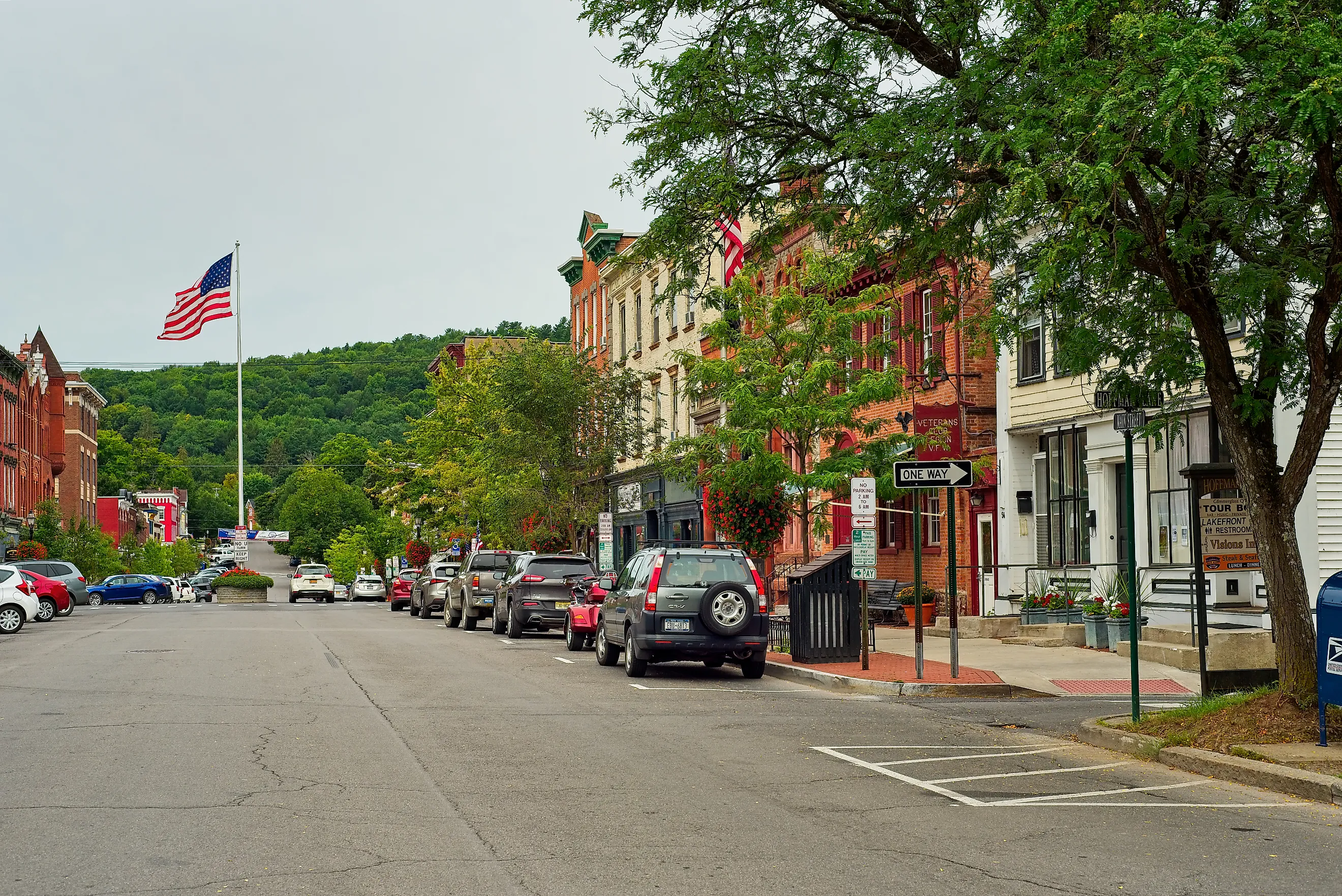
Cooperstown sits at the southern tip of Otsego Lake in central New York. The town runs about 1,800 year-round residents and is dominated by the National Baseball Hall of Fame and Museum, founded in 1936 around the (now-discredited) legend that Abner Doubleday invented baseball in Cooperstown in 1839. The Hall inducts new members each summer and the induction weekend draws serious baseball fans by the tens of thousands. The museum holds more than 40,000 artifacts including Babe Ruth's 1923 jersey and Cal Ripken's 2,131st consecutive-game lineup card.
Beyond the Hall, the Fenimore Art Museum holds the Eugene and Clare Thaw Collection of American Indian Art, considered one of the finest holdings of Native American material in the country. The Farmers' Museum recreates an 1845 upstate rural village with working trades. The Glimmerglass Festival, an internationally regarded opera company, runs an annual July-August season at the Alice Busch Opera Theater just north of town. Otsego Lake supplies the source water for the Susquehanna River.
Ithaca

Ithaca sits at the southern tip of Cayuga Lake, the longest of the Finger Lakes at 38 miles. The city runs about 32,000 permanent residents, with a much larger seasonal population through Cornell University (about 26,000 students) and Ithaca College (about 5,000). The Ithaca Commons is a four-block pedestrian-only stretch holding restaurants, cafés, and the Cinemapolis art-house cinema. Cornell's 750-acre central campus, anchored by McGraw Tower and the I.M. Pei-designed Herbert F. Johnson Museum of Art, occupies East Hill above the town.
The greater Ithaca area holds more than 150 documented waterfalls, the highest concentration of waterfalls in the eastern United States. Ithaca Falls drops 150 feet through the city's northern edge, and Taughannock Falls (15 minutes north) drops 215 feet in a single plunge, the tallest single-drop waterfall east of the Mississippi. Buttermilk Falls State Park and Robert H. Treman State Park, both within minutes of downtown, offer additional hiking and swimming routes through gorge landscapes.
Penn Yan

Penn Yan occupies the northern tip of Keuka Lake in Yates County. The town's name is a portmanteau of "Pennsylvania" and "Yankee," reflecting the two settler populations that established the village in the early 1800s. The Birkett Mills, founded in 1797, is one of the largest buckwheat millers in the country and still mills the well-known Wolff's Kasha brand. Nearby, the Yates County Courthouse, the Knapp Hotel, and Struble's Arcade anchor the historic district.
Penn Yan also serves as a strong base for Finger Lakes wine touring. The Keuka Lake Wine Trail includes Dr. Konstantin Frank Winery, founded in 1962 by the Ukrainian-born viticulturist credited with bringing serious European vinifera varieties (riesling in particular) to the region. The Keuka Outlet Trail follows an old canal and railway bed for about 7 miles east toward Dresden on Seneca Lake.
Saratoga Springs

Saratoga Springs anchors its identity on three local industries, captured in the town's official slogan: health, history, and horses. The town's mineral springs draw visitors to Saratoga Spa State Park, where the 1935 Roosevelt Baths & Spa still offers traditional mineral water treatments. The park also holds the Saratoga Performing Arts Center (SPAC), the summer home of the New York City Ballet (July) and the Philadelphia Orchestra (August).
The horses carry most of the recognition. Saratoga Race Course, opened on its current site in 1864, is the oldest active thoroughbred racetrack in the United States, with the main meet running July through Labor Day. The adjacent National Museum of Racing and Hall of Fame covers the sport's history with thousands of artifacts and an annual induction ceremony in August. The downtown Broadway corridor holds Victorian-era hotels, restaurants, and the Saratoga Springs Public Library inside the former Spa Bottling Plant.
Watkins Glen

At the southern tip of Seneca Lake, Watkins Glen handles two distinct draws. Watkins Glen International is one of the most respected road-racing circuits in North America. The track hosted the United States Grand Prix as part of the Formula 1 calendar continuously from 1961 to 1980. Watkins Glen International now hosts a NASCAR Cup Series race and an IndyCar event each summer, plus the Vintage Grand Prix Festival each September that returns historic race cars to the village street circuit used through the 1950s.
Watkins Glen State Park anchors the other half of the town's identity. The park's main feature is a 1.5-mile gorge trail with 19 waterfalls and roughly 800 stone steps. Glen Creek cut the gorge over 12,000 years through the surrounding shale and sandstone. The trail typically opens from mid-May through early November depending on water and ice conditions. Downtown Watkins Glen runs about 1,800 residents and holds a working harbour on Seneca Lake, with the Glen Mountain Market Bakery & Deli as the standby breakfast and lunch stop. Several Seneca Lake wineries operate within a short drive of town.
Geneva

Geneva occupies the northern tip of Seneca Lake, the same lake whose southern end holds Watkins Glen. The town's nickname, "Lake Trout Capital of the World," reflects the deep cold-water trout fishery in Seneca Lake (the deepest of the Finger Lakes at 632 feet) and the annual Lake Trout Derby each Memorial Day weekend, which has run since 1964 and remains one of the largest freshwater fishing tournaments in the Northeast.
Downtown Geneva is built around Hobart and William Smith Colleges. South Main Street holds federal-era and Victorian buildings including the Smith Opera House, an 1894 theatre that still operates as a community arts venue. Rose Hill Mansion, just east of town, runs tours of an 1839 Greek Revival country estate. Seneca Lake State Park, on the town's southern edge, covers about 141 acres of lakefront.
The Upstate Read
The eight towns above each map onto a different piece of upstate New York's working geography. Catskill and Saugerties anchor the Hudson Valley. Ithaca and Penn Yan represent the Finger Lakes. Cooperstown handles central New York's farmland and lake country. Saratoga Springs sits at the eastern edge of the Adirondack Park. Watkins Glen and Geneva bookend Seneca Lake. None of the eight functions as a theme-park stop. Each holds a working downtown, a regional economic identity, and a landscape that rewards more than a half-day visit.