8 Best Downtowns In Scotland
Scotland is full of great downtowns thanks to stone architecture, maze-like closes and wynds, and coastal centers where historic streets often open directly onto harbors. In St Andrews, Market Street, North Street, and South Street lead directly to the cathedral ruins and the castle above the sea. In Melrose, cafés and small hotels cluster around Market Square just steps from the red stone walls of Melrose Abbey and the Roman-focused Trimontium Museum. In Portree, brightly painted buildings curve around the harbor while steep streets climb to cafés, galleries, and lookout points above the bay. Across all eight towns, the downtown is not a separate district but the beating heart of the town.
St Andrews

St Andrews has one of the clearest town layouts in Scotland, organized along Market Street, South Street, and North Street, which run parallel across the center. Market Street carries most of the shops and cafés, often busy with students and visitors, while South Street gradually opens toward the ruins of St Andrews Cathedral. The cathedral grounds are reached directly through narrow streets, with St Rule’s Tower rising above the surrounding buildings. On the opposite side, North Street leads toward university buildings and older, elegant stone facades. St Andrews Castle sits at the edge of the center above the sea, so within a short walk, the town shifts from active commercial space to open coastal views and historic ruins without interruption.
Oban

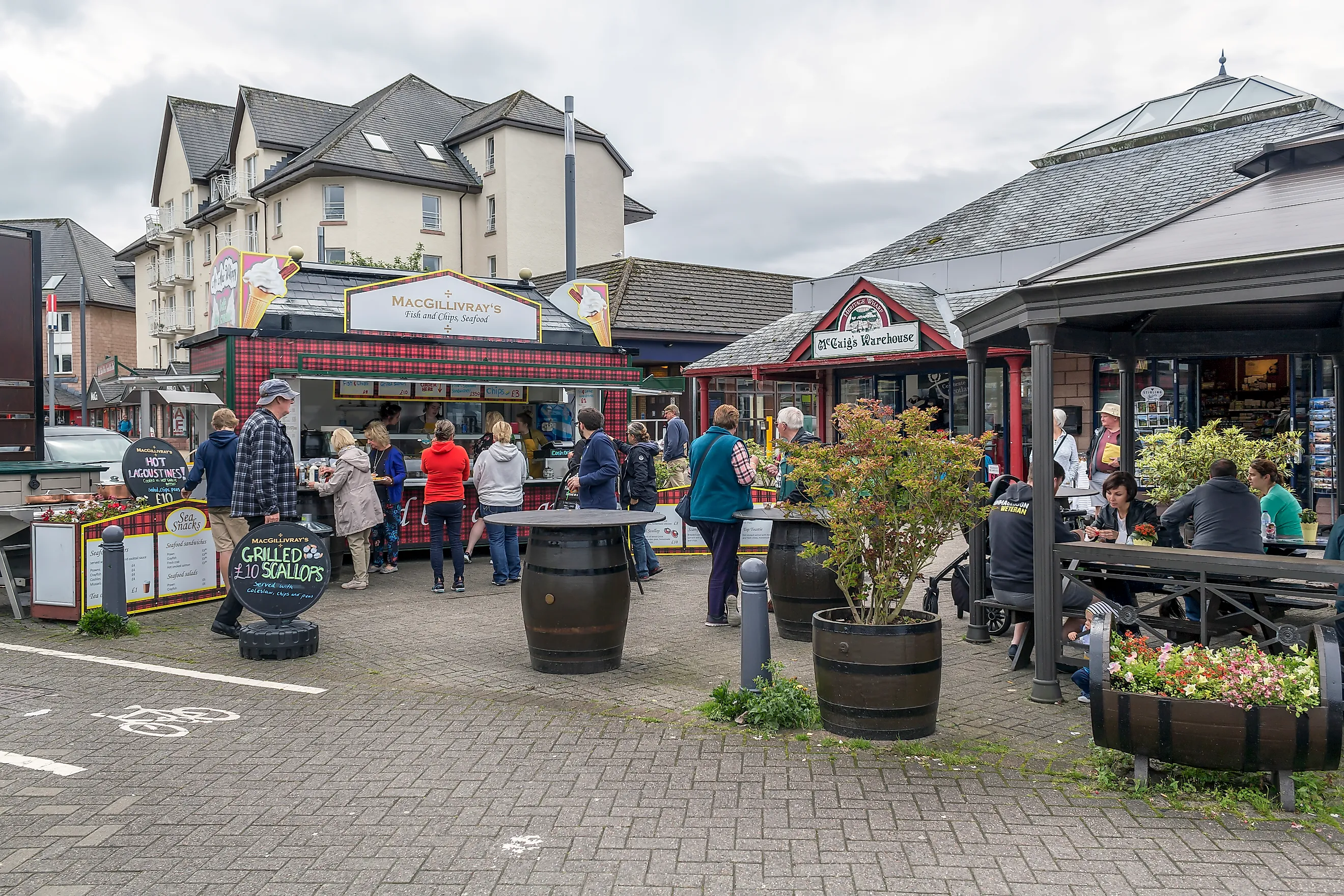
Oban’s center forms around its harbor, where the curve of the bay shapes how the town is laid out. George Street runs just back from the water and holds the main concentration of shops, restaurants, and hotels, while short, steeper streets lead upward toward McCaig’s Tower, which overlooks the whole town. From the waterfront, the tower is visible above the rooftops, creating a constant visual reference point. Nearby, Oban Distillery is built directly into the street; its stone façade blends into the surrounding edifices, creating a unified picture. The harbor itself remains active, with ferries arriving and departing throughout the day, and because the train station sits near the waterfront, activity through the town stays focused on this same central strip.
Pitlochry

Pitlochry’s downtown follows Atholl Road, a broad main street where local businesses sit close together without gaps or large developments. The street does not feel staged, but unique, with foot traffic moving steadily between storefronts. Just off the road, Blair Athol Distillery sits within walking distance, its entrance marked by traditional stone buildings and signage rather than a separate complex. Toward the river, the Pitlochry Festival Theatre is set slightly below street level, with paths leading down through trees toward the River Tummel. From there, the dam and salmon ladder can be reached on foot, where the sound of moving water becomes part of the experience, linking the town center to its surrounding landscape.
Melrose

Melrose is arranged around Market Square, where the space opens slightly before narrowing again into surrounding streets. Shops, cafés, and small hotels line the square, but the main presence comes from Melrose Abbey, a partly ruined monastery of the Cistercian order. The abbey’s red stone walls and carved details rise above the nearby buildings, visible from multiple points in the center, reminding us of the fragility of human endeavours. The Trimontium Museum, located close to the square, adds another layer of history by connecting the town to its Roman past. What stands out is how little distance separates these elements. You move from a café table to abbey ruins in minutes, and the transition feels as though we naturally move through portals in time, keeping the center active while still anchored in its history.
Peebles

Peebles is built around a wide High Street that still functions as the town’s main gathering place rather than a secondary commercial strip. Independent shops, cafés, and everyday services line both sides, with buildings set close enough together to keep the space contained. The Chambers Institution stands prominently along the street, its stone façade marking one of the town’s key civic buildings, even as parts of it undergo ongoing work. Nearby, references to John Buchan remain tied to the same central stretch, reinforcing the town’s literary connections without moving away from the High Street. The River Tweed runs just beyond, but the town’s identity stays focused on the street itself, where daily life continues at a steady, local pace.
Kirkcudbright

Kirkcudbright’s downtown centers on its High Street, where color, scale, and historic buildings give the town a distinct identity. The Tolbooth, with its clock tower and arched base, stands prominently near the middle of the street, marking the civic core. A short walk away, MacLellan’s Castle introduces a heavier stone structure, its walls partially open and set within a small green space that remains connected to the street grid. The castle was the residence of the prominent MacLellan family, from whom it derived its name. One who steps into the castle learns about the rags-to-riches story of the MacLellan family, whose reversal of fortune led to the castle’s demise. Broughton House, an 18th-century town house and museum, sits within the same area, its garden enclosed but visible from nearby lanes. The harbor lies just beyond, close enough that the presence of water shapes the feel of the town, while galleries and small shops reflect its long association with artists.
Inveraray

Inveraray’s center is unusually structured, with Main Street running in a straight line toward Loch Fyne rather than bending or narrowing. The whitewashed buildings on either side create a uniform appearance, reflecting the town’s planned layout. At the upper end of Church Square, Inveraray Jail provides a glimpse into 19th-century prison life, its solid stone structure contrasting with the lighter façades around it. Moving down the street, the view gradually opens toward the waterfront, where the pier and harbor sit at the edge of the town. The distance between these points is short, and because the layout is so direct, the center feels easy to read, with movement naturally drawn from one end toward the water.
Portree

Portree’s center forms around its harbor, where a curved row of brightly painted buildings follows the water’s edge. The colors stand out, with streets rising upward from the harbor and narrowing as they climb. The waterfront includes piers and open edges where boats are moored, and people move along the harbor without needing to step away from it. Shops, cafés, and small galleries sit along the streets above, including places like Sea Breezes, known for serving fresh local seafood, connected by short, sloping routes that bring you back down toward the water. The change in elevation, combined with the curve of the bay, gives the center a layered feel, where views shift as you move through it.
In Scotland’s smaller towns, the town centres are places where daily activity, history, and setting come together, with views and surroundings shaping how the town is experienced. A High Street, harbor edge, or market square often carries shops, cafés, and civic buildings within a few connected blocks, while major landmarks sit directly within that same space rather than on the outskirts.