7 Offbeat Towns to Visit in North Carolina
A few North Carolina towns stake their whole identity on one strange fact rather than a pretty view. A federal highway outside Bryson City dead-ends at a tunnel that locals call the Road to Nowhere. In Beaufort, divers raised cannons from Blackbeard's flagship, wrecked off the inlet in 1718. The steepest standard-gauge mainline railway grade ever built in the country crests at Saluda. White squirrels live in Brevard, protected by a town ordinance.
Beaufort

Beaufort, founded in 1709, is the third-oldest town in North Carolina. In June 1718, the pirate Blackbeard grounded his flagship, the Queen Anne's Revenge, near Beaufort Inlet. Divers found the wreck in 1996. The cannons and ship's bell they raised are now at the North Carolina Maritime Museum on Front Street. Admission is free. The Old Burying Ground on Ann Street shelters graves from the 1700s under live oaks, several markers worn past reading.
Across Taylor's Creek, the Rachel Carson Reserve protects a chain of marsh islands. Feral Banker ponies graze there, said to descend from horses a local doctor turned loose generations ago. Visitors watch them from the waterfront or cross by water taxi. Shackleford Banks, the barrier island in Cape Lookout National Seashore, has its own wild herd. Local lore ties those horses to a Spanish shipwreck in the 1500s. Boats for both leave from Front Street.
Brevard

Brevard built its identity around a rodent. White squirrels live here, a pale variant of the eastern gray squirrel, not true albinos. The story goes that a pair escaped an overturned carnival truck in the 1950s and bred in the wild. In 1986, the town council made Brevard a squirrel sanctuary. Harming one breaks the local ordinance. The campus of Brevard College is the easiest place to find them. Every Memorial Day weekend, the White Squirrel Festival takes over downtown. On February 2, a resident squirrel forecasts the season in place of a groundhog.
Brevard also goes by Land of Waterfalls, with more than 250 in the county. One of them, Sliding Rock, is a smooth granite ledge in Pisgah National Forest that doubles as a natural water slide. Swimmers ride it 60 feet down into a cold plunge pool.
Bryson City

Bryson City grew up a rail town. The trains still leave from the middle of it. The Great Smoky Mountains Railroad sends excursion trains out of the downtown depot, through tunnels and river gorges. A restored 1942 steam locomotive pulls some of them. Round trips along the Nantahala Gorge or the Tuckasegee River take most of a day. Downtown is a few blocks of bookshops and breweries around the 1908 courthouse, now home to the Swain County Heritage Museum.
Lakeview Drive leads to the spot locals call the Road to Nowhere. Fontana Dam flooded the old highway in the 1940s and displaced more than a thousand residents. The government promised a replacement route through the new national park. Only six miles got built before environmental concerns halted the rest. In 2010, the government paid Swain County $52 million to drop the project. The pavement ends at a quarter-mile tunnel. Hikers walk through it to reach the trails beyond.
Edenton

Edenton was a colonial capital of North Carolina in the early 1700s, one of the oldest towns in the state. The 1767 Chowan County Courthouse still hears cases. It is the oldest government building in North Carolina. In 1774, fifty-one local women here signed a resolution to boycott British tea and cloth. The act became known as the Edenton Tea Party, an early instance of women's political action in the colonies. The 1758 Cupola House stands a few blocks off, behind restored gardens.
On the waterfront, the 1886 Roanoke River Lighthouse is the last screw-pile lighthouse left in North Carolina. Its square wooden keeper's quarters rest on pilings screwed into the sound bottom, a design built for shallow water. Harriet Jacobs was born into slavery in Edenton in 1813. Her 1861 memoir, "Incidents in the Life of a Slave Girl," became an American classic. A self-guided trail links the sites tied to her life and escape.
Mount Airy

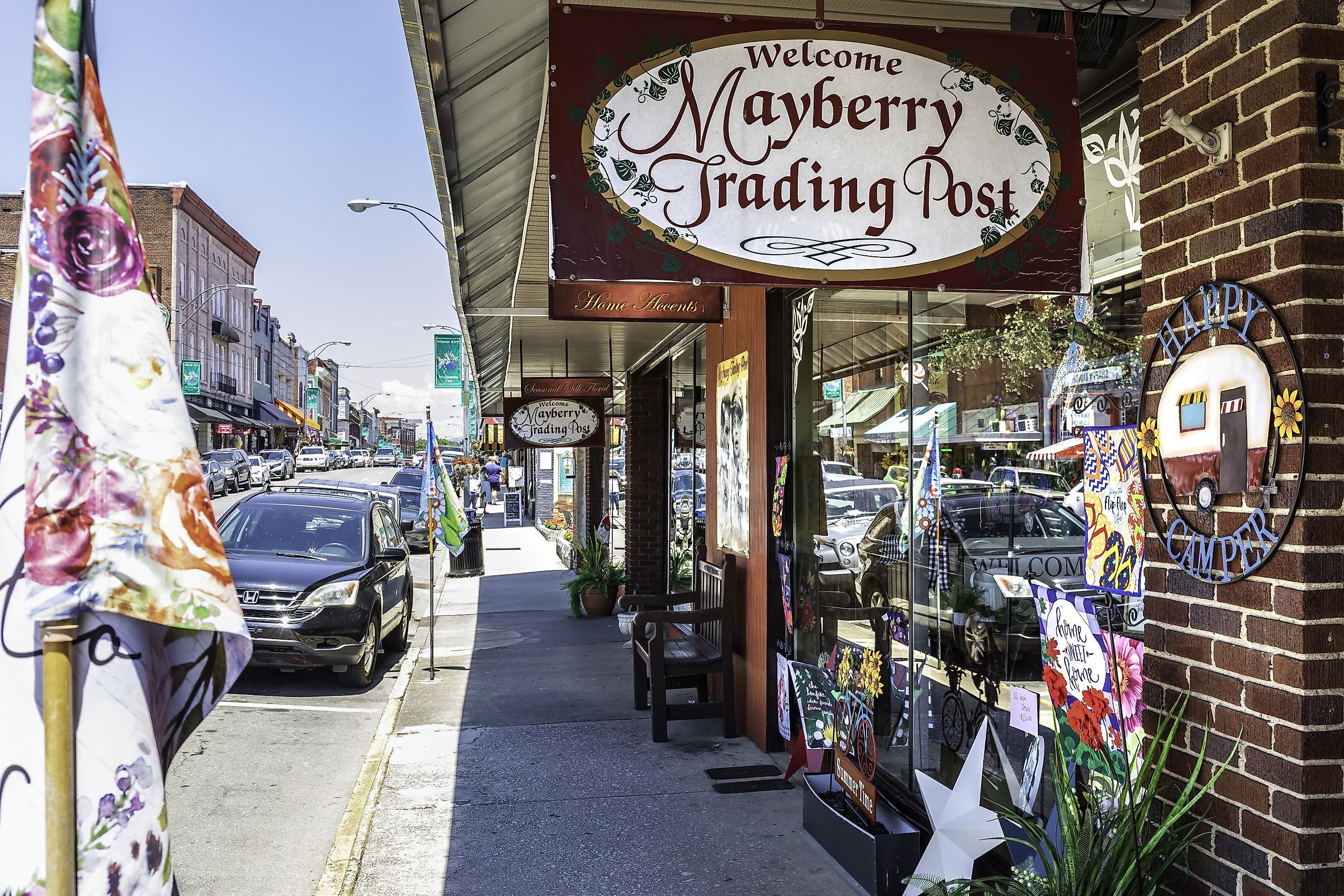
Mount Airy gave the world Mayberry. Andy Griffith grew up here, and his 1960s sitcom borrowed heavily from the town. Mount Airy has leaned into it ever since. The Andy Griffith Museum is full of his scripts and costumes. Replica squad cars carry visitors on Mayberry tours. The 1938 Earle Theatre still screens films and airs the WPAQ Merry-Go-Round, a live old-time radio show that has run for decades.
A few miles south, Pilot Mountain rises as a lone quartzite knob above the Piedmont. Its rounded pinnacle is visible for miles. The Saura people called it Jomeokee, the great guide, and used it to navigate the region. Pilot Mountain State Park has trails to its base.
Saluda

Saluda exists because of a railroad grade so steep that engineers nearly gave up. The Saluda Grade, finished in 1878, was the steepest standard-gauge mainline railway grade ever built in the country. It climbs more than 600 feet in under three miles. Runaway trains wrecked on it so often that the railroad built spur tracks to catch them. The line closed in 2001. In 2025, the corridor was sold off for a rail trail. The Saluda Historic Depot downtown documents that history with photographs and salvaged equipment.
Every July, Saluda hosts Coon Dog Day, a street festival for the region's hunting hounds. A parade and live music take over downtown. The Green River Gorge drops through the Blue Ridge foothills just west of town. Whitewater paddlers run its rapids.
Seagrove

Seagrove is a small Piedmont town with an outsized craft. Around 100 working potters operate within a short drive, one of the densest concentrations in the country. Their studios line the rural roads near NC Highway 705, known locally as the Pottery Highway. Potters have dug the local red clay here since the late 1700s, first for jugs and crocks. In 2005, the state named the area the birthplace of North Carolina traditional pottery. Most studios open year-round, and the potters often work the wheel as visitors look on.
The North Carolina Pottery Center on East Avenue traces two centuries of the craft. Its staff can point visitors toward the studios worth their time. Jugtown Pottery, revived in 1921, is still run by sixth-generation potters. The town gathers twice a year, for the April kiln openings and the pottery festival before Thanksgiving.
The Offbeat Side of North Carolina
Each of these towns leans on one specific, strange thing. Mount Airy rebuilt its identity around a fictional version of itself. Seagrove turned a bed of red clay into one of the country's densest clusters of potters. Edenton guards a 1767 courthouse and the memory of a women's protest that beat the Revolution to it. None of it is scenery. It is confidence, the refusal to sand the odd parts smooth.