7 Best Towns In Germany For Retirees
The Federal Republic of Germany stands as Europe's most well-endowed nation by many standards. Not only does Germany’s economic strength and manufacturing expertise attract migration, but its location bordering nine countries reinforces its central role in Europe. Yet finding the right place to retire proves challenging given Deutschland’s abundance of options, particularly for retirees no longer bound to stay confined within large metropolises like Berlin, Frankfurt, or Munich due to employment.
As they explore the Country of Poets and Thinkers, retirees step into a number of alluring communities scattered across all directions, from countryside villages maintaining a medieval aura to hillside towns where Alpine meadows meet cobblestone squares. Without embracing urban bustling, the quality of life persists in these small towns through accessible healthcare, walkable historic districts, and neighborhoods that are polite and secure. For international retirees considering European relocation or German citizens downsizing after decades in urban centers, these towns balance cultural richness with practical affordability that rivals the best of Europe.
Altdorf bei Nürnberg, Bavaria

Altdorf bei Nürnberg gives retirees Bavarian small-town life without sacrificing proximity to urban amenities, as the historical city of Nuremberg rests a 20-minute drive away. Sophienquelle von Grünsberg cascades through baroque fountain architecture commissioned during the 1720s as a sentimental landscape garden, with water spilling over multiple basins into the main fountain before flowing underground into the Schwarzach River. Kloster Gnadenberg preserves ruins from a Birgittenorden monastery, with the convent building now displaying exhibitions on medieval architecture and regional archaeology alongside a revitalized garden. Löwengrube bei Altdorf cuts into the sandstone hillside, where an old quarry transformed into rock cellars.
Märchenmühle Reiterhof operates as an equestrian facility and pension outside town boundaries, where seniors curious about horseback riding or simply wanting a countryside atmosphere find accommodation and instruction. According to the nation's leading real estate portal ImmoScout24, the cost of purchasing one-room apartments starts as low as €150,000. Meanwhile, detached houses and bungalows along routes like Palatinate Street typically run around three times that rate, keeping Altdorf relatively modest compared to Nuremberg district pricing while maintaining easy access through reliable public transit and roadways.
Crimmitschau, Saxony

Crimmitschau brings Saxon textile heritage to life in the Zwickau district, where retirees explore working museums rather than read plaques. Blankenhain Castle, northeast of town, houses Deutsches Landwirtschaftsmuseum, combining castle exhibitions with open-air displays. From the architectural sensations to valuable items inside them, the story of German agricultural evolution becomes almost tangible as one walks through crop practices and pastoral traditions that flourished in the nation before it became a subsistence economy.
Another educational hub, Tuchfabrik Gebr. Pfau operates as the Saxon Textile Museum inside a preserved cloth factory, where original machines from the early industrial era still run during guided tours, spotlighting wool processing from raw fiber through spinning and weaving into finished fabric.
In line with history, nature is another catalyst in and around Crimmitschau, refusing to let its elderly miss urban comforts. The Hydrogeologisches Denkmal Teufelshöhle exposes geological layers through sandstone near Frankenhausen, where erosion revealed ancient formations, and groundwater springs created a small pond that curious seniors examine time and again, thanks to no entry fees. Koberbachtalsperre Vorsperre spreads south of town to soothe the locals via a reservoir and surrounding walking paths.
Seniors circle water at their own speed while benches face the Saxon countryside, perfect for afternoon reading or simply watching light change across hills. Crimmitschau maintains a remarkably modest housing market for Germany's industrial strength, with small properties starting under €50,000, while well-maintained houses rarely exceed €300,000. This defies the premium pricing that shadows most Saxon towns with comparable heritage and access.
Heusenstamm, Hesse

Heusenstamm compactly equips retirees with castles, communication history, and modern recreation that surprise you like a tourist, except time never becomes a barrier once you settle in to spend your twilight years here. Schloss Schönborn Heusenstamm, the magnificent castle, fills downtown with baroque elegance, hosting medieval festivals and concerts within its historic walls while serving as the town's administrative heart. The Museum of Communication in Heusenstamm stores telecommunications history through telegraph equipment, vintage telephones, and postal vehicles displayed inside a former telecommunications depot.
Right outside Heusenstamm’s town limits, though not far, Funpark Rodgau delivers a playful contrast to the verdant countryside vibes and modern quality of life. Adventurers of all ages challenge each other at bowling, escape rooms, adventure golf, and laser tag, keeping active seniors engaged, entertained, and nowhere close to homesickness. Over at ImmoScout24, cozy and spacious cottages mostly fall in the range of €400,000 to €650,000, making Heusenstamm accessible for retirees balancing Hesse location advantages with financial planning.
Jüchen, North Rhine-Westphalia

Just outside the core of the Ruhr Valley, Jüchen welcomes retirees into agricultural tranquility where green spaces far outnumber nightlife venues, a deliberate rhythm that attracts older demographics while younger residents commute elsewhere for entertainment. Cologne is less than 40 minutes away by train, while Aachen can be reached in about 1.5 hours by bus or train. There, the Three Country Point brings Germany, the Netherlands, and Belgium together at Dreiländereck.
Within Jüchen itself, the Garzweiler Skywalk observation deck at Jackerath juts out over the massive open-pit lignite mine, where retirees watch some of the world's largest excavators operate below. An early 19th-century work of architectural beauty, Schloss Dyck unfolds like a fairytale castle across four islands, surrounded by English landscape gardens and exotic plants.
Beller See Park's fusion pond sits directly west of town boundaries, perfect for summer afternoons when seniors prefer waterside relaxation over strenuous activity. Nearby Mönchengladbach Zoo offers day trips without requiring a full-day commitment. Hambach strip mine operates as another observation point where gigantic machinery demonstrates industrial engineering on a scale most retirees have never witnessed.
Housing spans all ranges here in Jüchen, from charming, terraced houses and bungalows starting around €130,000 to antique rural estates, with most properties hovering around €600,000. This keeps Jüchen accessible despite proximity to metro cities like Cologne and Düsseldorf.
Hirschau, Bavaria

Hirschau accommodates outdoor enthusiasts through Monte Kaolino, where a massive sand dune precipitating from kaolin mining waste has been transformed into an amusement park. Combining sand skiing, summer toboggan coaster, swimming pools, and camping under one admission, Bad & Campingplatz am Monte Kaolino lets retirees stay onsite with direct pool access included. In the meantime, the Monte Coaster rail-guided toboggan descends through wooded areas after climbing the sand mountain by lift. The observation tower, Aussichtsturm Rödlas, also going by Massenrichter Tower, rises near Rödlas village, producing panoramic Upper Palatinate views from its triangular platforms.
South of Hirschau, aquatic spots and wetlands follow Stelzenbach and Eschembach streams through numerous small lakes, where walking paths let retirees explore without strenuous demands. Downtown diners, inns, and beer gardens like Hirschau Castle Hotel prepare traditional Bavarian dining in warm settings.
The Bayerisches Rotes Kreuz Wasserwacht Hirschau provides water rescue and first-aid services, contributing to local safety for residents and visitors. Hirschau lies along Bundesstraße 14, the main road connecting Nuremberg toward the Czech border, with property prices in the town and surrounding Amberg-Sulzbach district generally ranging from around €275,000 to €300,000 for typical homes.
Idar-Oberstein, Rhineland-Palatinate

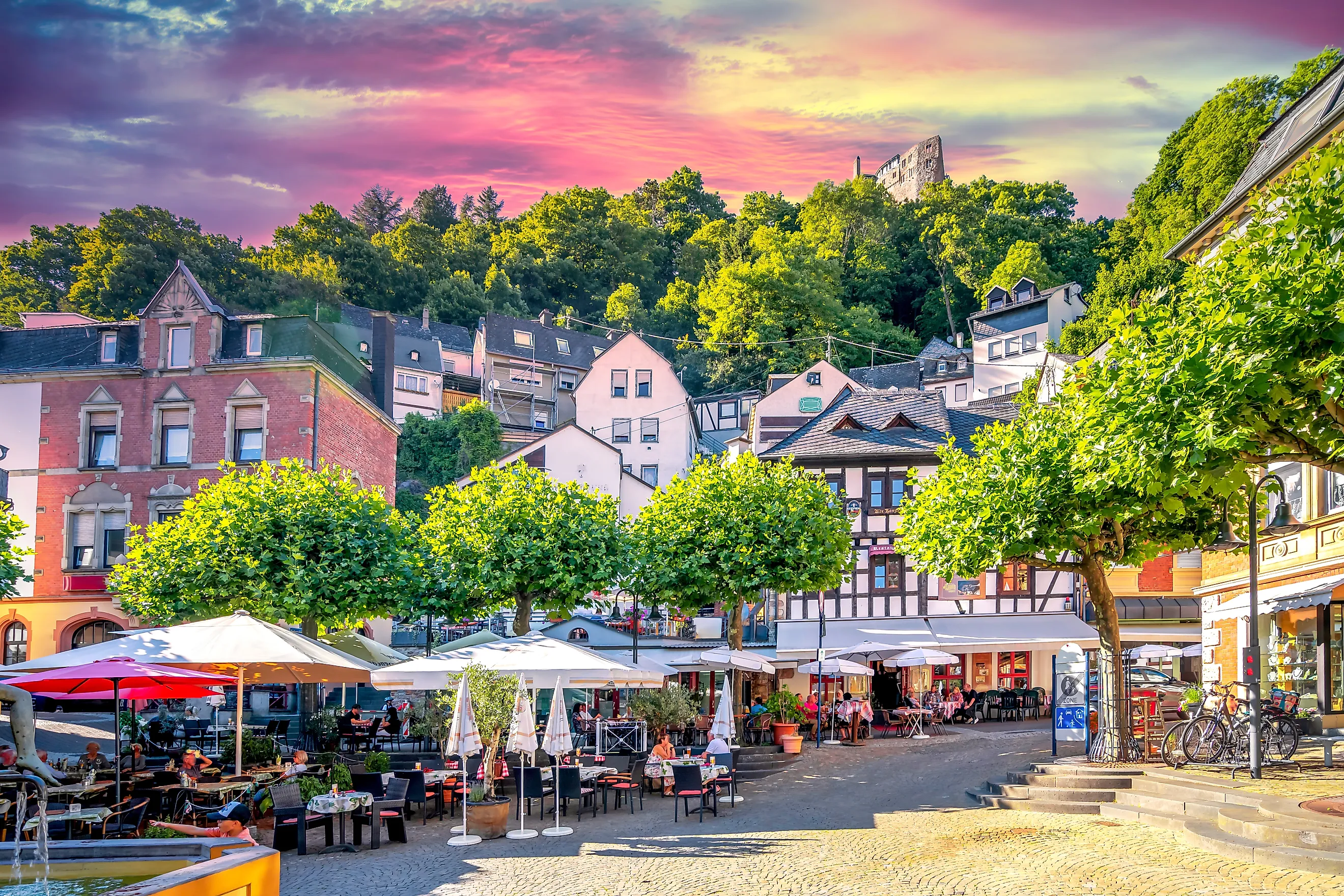
The twin cities of Idar-Oberstein manifest the best of Deutschland at once through panoramic nighttime views. This phenomenon particularly takes place at Schloss Oberstein, the castle on hills above the Oberstein district, where Gothic architecture seizes the spotlight across the Nahe valley. Burg Stein, the so-called Altes Schloss or Bosselstein, rises higher still with observation platforms that let residents gaze across forests without climbing further. The garrison town's reputation comes from Klotzbergkaserne, where military presence has largely influenced community identity. Downtown, Idar Marketplace and Schule Am Markt preserve historic commercial energy through weekend stalls and educational events.
At Edelsteinminen Steinkaulenberg, a dig field exists where one can search for agates, amethysts, smoky quartz, and other stones, and keep whatever one finds. Deutsches Edelsteinmuseum displays thousands of gemstones across several floors with fluorescence rooms and carving demonstrations. Idar-Oberstein straddles both sides of the Nahe River at the Hunsrück edge, letting retirees explore riverfront paths and experience the signature peace and recreation the region offers. Klinikum Idar-Oberstein GmbH furnishes medical care for area residents. Within the Birkenfeld district, housing priorities remain generous with no shortage of options under €100,000, while investing up to three times that amount accommodates affluent buyers comfortably.
Calau, Brandenburg

At Calau’s center, the historical district exudes countryside tranquility in Oberspreewald-Lausitz while honoring the most humorous jabs uttered in its streets. Here, Calauer Witzerundweg connects bronze Schusterjungen sculptures with wordplay heritage and Burgruine Dunkelsburg through an antiquated path that makes even the oldest seniors smile. Mobile Welt des Ostens spotlights Eastern Bloc vehicles from decades past, while Slavic Castle Raddusch, right outside Calau and in Vetschau/Spreewald, reconstructs early medieval fortification methods through authentic building techniques that archaeologists uncovered before lignite mining began.
Luckaitztaler Ziegelturm, a brick viewing tower, stands high enough for panoramic views across Lower Lusatian Ridge Nature Park (Naturpark Niederlausitzer Landrücken). Am Springteich Park lets retirees spend afternoons pond-side without an agenda. 2022's census data confirms that the average resident age approaches 50 among Calau’s population of more than 7,600, demonstrating that the town suits retirees seeking slower rhythms. Property rates remain modest according to ImmoScout24, with premium new construction around €250,000, while older properties start significantly lower, keeping Brandenburg retirement affordable without sacrificing quality of life.
Quiet Corners of Germany That Make Retirement Shine
From frigid islets near Denmark, where Baltic winds define coastal chimes, to Bavarian Alps cascading toward Austria, Germany’s best retirement towns are eclectic, culturally and geographically. Hirschau in Bavaria and Idar-Oberstein in Rhineland-Palatinate exemplify how Germany’s regions cultivate distinct local flavors through traditions, architecture, and cuisine. While in Brandenburg, Calau opens up its vast green meadows, Heusenstamm fuses Hessian heritage with modern convenience minutes from Frankfurt.
Each of these corners balances healthcare infrastructure with cultural engagement, letting retirees stay active through castle tours, gemstone mining, observational decks, and beer gardens that turn strangers into regulars within weeks. Germany refuses to manufacture retirement communities through gated developments, instead letting organic neighborhoods welcome newcomers into exquisite towns that require neither Mediterranean beaches nor Alpine resorts.