6 Charming Old Railroad Towns In North Carolina
So much of America’s growth as an industrial powerhouse is due to the rise of the railroad as a major means of moving stuff. Its impact on North Carolina was no less profound. From the Piedmont foothills to the Blue Ridge Mountains, iron rails connected once remote communities to the rest of the country throughout the 19th and 20th centuries. In the process, towns sprang up at junctions, depots, and repair yards, their economies fueled by a steady flow of freight and passengers.
Some of these places became major hubs where dozens of trains would pass through daily; others fulfilled equally vital roles, but as small outposts near difficult-to-get-to mountain passes. And while the age of passenger rail travel has largely faded, many of the towns that grew up around these lines remain and have turned their railroad heritage into tourist attractions. If you’re curious to find out more about the early days of America’s railroad heritage, these six former whistle stops in North Carolina are good places to start.
Spencer

Its location midway between Atlanta and Washington, D.C., made Spencer an ideal place for the Southern Railway to build a locomotive repair facility. This it did in 1896, naming it after the company’s first president. At the same time, they carefully laid out a community around the new workshops, selling lots at reduced rates to employees and businesses.
By the 1920s, Spencer Shops employed nearly 3,000 workers and was the largest steam locomotive repair operation in the Southeast. Now preserved as the North Carolina Transportation Museum, the railway still fuels the town’s economy, though now as a tourist attraction. Highlights include the Bob Julian Roundhouse & Turntable, a 37-stall structure built in 1924. The largest remaining facility of its kind in North America, it houses an impressive collection of historic steam and diesel locomotives.

Train rides around the property are fun, as is exploring the massive Back Sho,p where steam engines were once overhauled. Almost two football fields in length, the shop’s chock-full of old cars, fire trucks, and even historic aircraft. The museum's Barber Junction Depot, built in 1898 and relocated here, now serves as the visitor center.
While you can spend a day exploring the museum, the town itself is also worth wandering. North Carolina’s largest historic district, its attractive tree-lined streets provide other nostalgic fun, including the N.C. Museum of Dolls, Toys & Miniatures. A must for young and old alike, displays of toy trains are included.
Bryson City

Train lovers and nature enthusiasts alike won’t want to leave Bryson City off their North Carolina bucket lists. It’s home of the Great Smoky Mountains Railroad, a tourist railroad formed in 1988 after securing an expired lease just days before the dismantling of the tracks. Since then, this heritage railway has been operating excursions between Dillsboro and Nantahala along the 53 miles of track it rescued.
The railway’s most popular route is its Nantahala Gorge Excursion, a four-and-a-half-hour round trip covering 44 miles of stunning scenery. Along the way, it crosses the historic Fontana Trestle over Fontana Lake, following the Nantahala River through its dramatic gorge (go for the open-air gondola cars if the weather allows).
The Tuckasegee River Excursion is another good option. Shorter at 32 miles, this round trip to Dillsboro passes through the Cowee Tunnel, a structure made famous in the hit 1993 movie, The Fugitive. The railroad's steam loco, built in 1942, is the star of fun wine and whiskey-themed excursions, as well as Polar Express rides at Christmas.
The Smoky Mountain Trains Museum is free to visit with your ride. It houses a collection of more than 7,000 Lionel model trains, along with a large operating layout. Bryson City's compact downtown is where you’ll find the Mountain Layers Brewing Company, pouring great local craft beers just a short walk from the depot, and The Bistro at the Everett Hotel, the town’s top fine dining spot.
Saluda

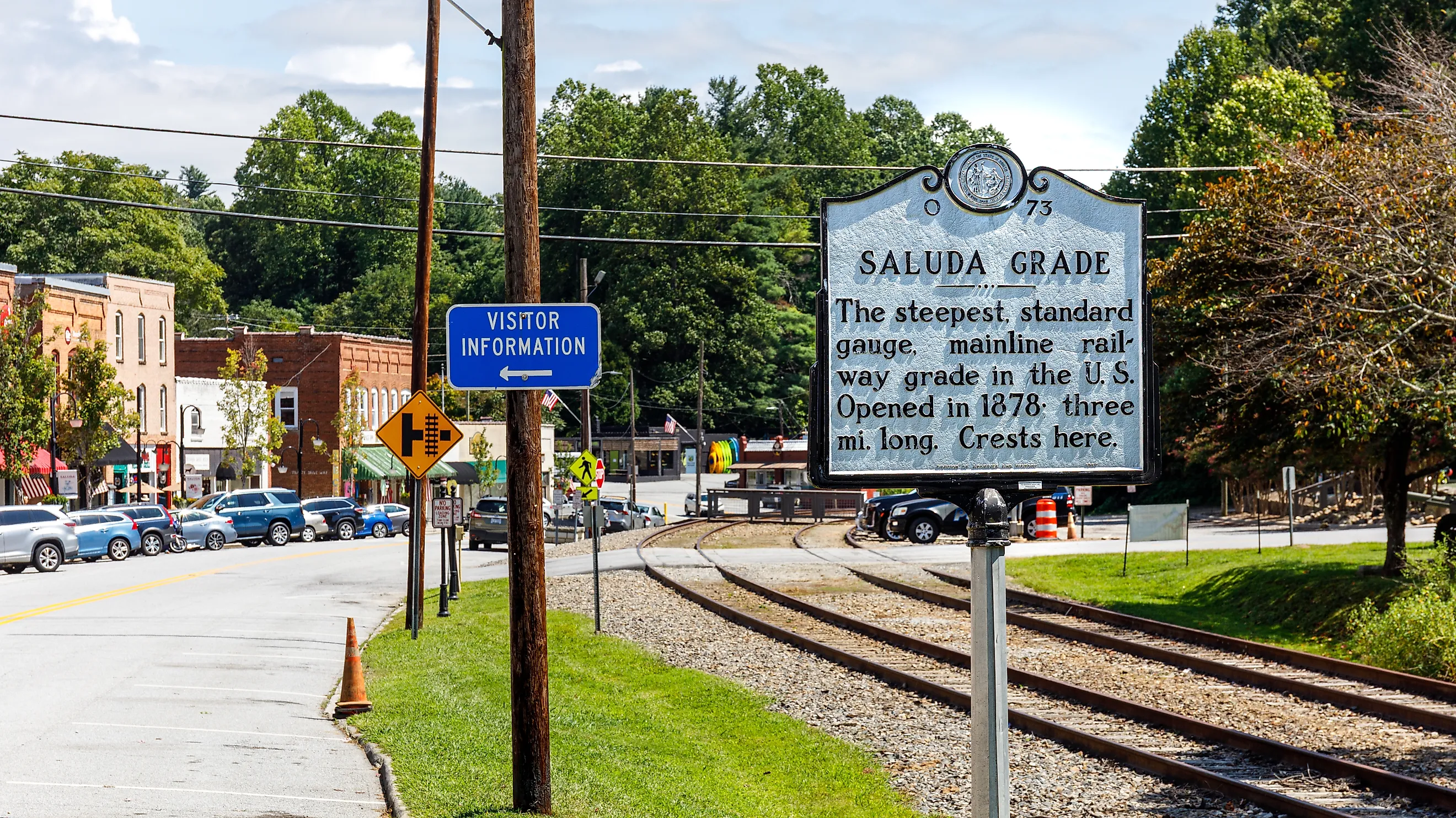
The tiny mountain town of Saluda is famous among train enthusiasts for its location at the crest of the Saluda Grade. The steepest standard-gauge mainline railroad grade ever built in the United States, it drops 606 feet in under three miles, with grades of 4.7 to 5.1 percent in some sections.
The line was constructed in the 1870s to connect Spartanburg, South Carolina, with Asheville, and was selected as engineers could find no other manageable route up the Blue Ridge Escarpment. The first train reached Saluda in 1878, and the town was incorporated three years later. For more than a century, the grade was so notorious that many runaway trains crashed, three of them in the summer of 1903 alone.
Though the trains stopped running in 2001, the tracks still run parallel to Saluda Main Street, and the railroad's presence is impossible to miss. The old depot, built in 1903, is now the Saluda Depot Museum with railroad memorabilia and dioramas of the trains that once traveled the route.
Though consisting of just three blocks, Saluda's downtown is fun to explore. Thompson's Store, a fixture here since 1892, is the oldest grocery store in North Carolina, while the adjacent Ward's Grill has been operated by the same family since the turn of the 20th century. M.A. Pace General Store, more than a century old, also functions as an informal museum of small-town commerce.
Old Fort

Old Fort has been a gateway to the Blue Ridge Mountains since before the Revolutionary War, when it functioned as the westernmost pioneer outpost in North Carolina. Its railroad story began in the 1850s with the building of a line from Salisbury to the French Broad River and points west. Despite reaching Old Fort in 1869, the steep grades stopped progress dead in its tracks.
It took another decade, lots of convict labor, and the first-ever use of nitroglycerin in the southeastern United States to blast the seven tunnels and 13 miles of ascending, looping track between Old Fort and Black Mountain. Despite the loss of more than 120 laborers from explosions, cave-ins, and mudslides, when the line finally reached the summit at Ridgecrest in 1879, it was considered one of the great engineering achievements of its era.

The most visible legacy of that effort is Andrews Geyser, a man-made geyser located a few miles outside Old Fort that was constructed around 1885 as an early tourist attraction. The Old Fort Train Depot Museum is also worth seeing and features exhibits, including a model of the Old Fort Loops, the section of track where the mainline turns back on itself several times as it tackles the grade. There’s also a restored Southern Railway caboose parked at the depot. Other Old Fort attractions include the Native American Arrowhead Monument and the Mountain Gateway Museum with its displays on local life and history.
Mount Airy

While you might know Mount Airy from The Andy Griffith Show, it was the construction of the Cape Fear and Yadkin Valley Railroad in the late 1880s that saw the town prosper. Known locally as Flat Rock, the area became the world’s largest open-faced granite quarry by the 1890s, earning Mount Airy its “Granite City” nickname. Notable town landmarks from this period include the Mount Airy Museum of Regional History, housed in an old store downtown with four stories jam-packed with exhibits about about the granite quarry, pioneer life, and regional history.
As for Andy Griffith, the town’s railroad history greatly influenced his television show, as well as its current attractions. The Andy Griffith Museum on Main Street houses a large collection of artefacts from the actor's career, while the adjacent Andy Griffith Playhouse is where you’ll find a bronze statue showing the iconic opening sequence of Sheriff Taylor and Opie walking to the fishing hole.
Hamlet

Whether you choose to be (or not to be!) in Hamlet for its railway references or its music history, you won’t come away disappointed. Located in the flat Sandhills of south-central North Carolina, Hamlet was incorporated in 1897 at the intersection of two rail lines, and by the 1930s had earned the nickname “Hub of the Seaboard.” Another three lines followed, radiating outward toward Richmond, Wilmington, Atlanta, Savannah, and Columbia.
At its peak, upward of 30 passenger trains would pass through each day, leading to countless hotels, shops, and restaurants popping up to serve a constant stream of travelers. The end of World War II saw the construction of a massive rail yard nearby that was described at the time as the most modern rail facility in the world, with a capacity of 5,000 cars.

The centerpiece of the town’s railroad heritage is the Hamlet Depot. Built in 1900 and the only Victorian Queen Anne-style train station in the state, this elegant building now functions as an Amtrak stop and the home of the Hamlet Depot & Museums. Highlights of this free attraction include a large model train layout that recreates 1950s-era Hamlet, while across the street, the Tornado Locomotive Building houses a fully restored 1839 steam engine.
And the music? Well, Hamlet was the birthplace of jazz saxophonist John Coltrane. References to the legendary musician include the Coltrane Blueroom, a small museum of memorabilia, opened in the building where Coltrane was born. A large mural of the musician now adorns a wall on the Opera House in downtown Hamlet.
Where the Tracks Lead
North Carolina's old railroad towns are justifiably proud of their railway past. Pay a visit to these six old railroad towns and you’ll learn how iron rails and the iron horses that rode them not only shaped communities, but entire regions… and, ultimately, the entire country. Be sure to add them to your list of must-visit destinations in beautiful North Carolina.